
Is It a Sin to Waste Sperm? What the Bible Actually Says
Wasting sperm is not named as a sin anywhere in the Bible, but Scripture treats deliberate, lust-driven seed-wasting as sinful when it is tied to lust, disobedience, or rejection of God's design for sex according to the historic Christian reading of Genesis 38:9-10, Matthew 5:28, and 1 Corinthians 6:18-20. The act itself is not a stand-alone sin like adultery or theft, but the motive almost always is. If you are asking "is it a sin to waste sperm" because you are stuck in pornography or compulsive masturbation, this guide gives you the verses, the theology, and the practical path forward.
Many believers feel real shame about this question, which keeps them isolated and silent. Is Watching Porn Against the Bible is the companion question most readers also ask. Quitting porn dramatically reduces the temptation to waste seed in lust, because it removes the most common trigger — and quittrapp's solution, quit porn, may be exactly what you need to align your body with your faith.
Table of Contents
What Does the Bible Say About Masturbation?

1. No Explicit Mentions of Masturbation in the Bible
Masturbation is never directly named in Scripture, unlike adultery, theft, or idolatry. The Hebrew and Greek texts have no specific word for it — the single biggest reason Christians remain confused today.
Is it forbidden? Acceptable? A gray area? The absence of a word does not mean the absence of a principle. Scripture is rich with teaching on sexual purity, lust, self-control, and the purpose of the body — and those principles speak directly to masturbation and to wasting sperm (also called "spilling seed" in older translations).
2. The Story of Onan: What's Actually Going On
"Then Onan knew that the offspring would not be his; so whenever he went in to his brother's wife, he would waste the semen on the ground, so as not to give offspring to his brother. And what he did was wicked in the sight of the LORD, and he put him to death also." — Genesis 38:9-10. This passage is the most-cited proof text for the claim that wasting sperm is a sin, but biblical scholars widely agree on a more careful reading.
Onan's sin was not masturbation. It was willful disobedience to the Levirate marriage law (Deuteronomy 25:5-10), which required him to father a child on behalf of his deceased brother. He took the pleasure of the act and rejected its God-given purpose. His punishment was for selfishness, rebellion, and the deliberate rejection of life — not for "wasting sperm" in isolation.
Why this matters
We must not build doctrine from a misapplied story. Still, the passage reveals a clear principle: using sexuality for selfish pleasure while rejecting its design — life, covenant, union — is serious in God's eyes. That principle carries forward into the masturbation and wasted-sperm discussion.
3. Masturbation, Lust, and the Teachings of Jesus
"But I tell you that anyone who looks at a woman lustfully has already committed adultery with her in his heart." — Matthew 5:28. This is the clearest teaching in Scripture about sexual purity. Even with no physical act, Jesus calls the lustful thought heart-level adultery.
Why it matters for masturbation
Masturbation almost always involves sexual fantasy or pornography. The act may be private, but the thoughts indulge lust — which Jesus equates with adultery in the heart. The physical act is not directly forbidden, but the mental environment in which it almost always occurs is deeply sinful.
4. Relevant Biblical Principles That Apply to Masturbation
Even without a direct command, the following biblical teachings provide unambiguous guidance.
a. Self-Control Is a Fruit of the Spirit. "The fruit of the Spirit is… self-control." Galatians 5:22-23. Masturbation becomes a clear problem when it is compulsive, addictive, or done without discipline. Spiritual maturity requires self-governance.
b. We Are Called to Flee from Sexual Immorality. "Flee from sexual immorality. All other sins a person commits are outside the body…" 1 Corinthians 6:18. Paul uses the term porneia — any misuse of sexual desire outside of marriage — which logically extends to habitual, lust-driven masturbation.
c. Honor God with Your Body. "You are not your own… therefore honor God with your body." 1 Corinthians 6:19-20. This includes how we handle sexual urges, our thought life, and how we steward physical desire. Masturbation is not neutral; it either honors or dishonors the body God gave us.
5. Questions Every Christian Should Ask About Masturbation
Because the Bible does not list masturbation as sin in itself, we must evaluate context, motive, and result. Here are the diagnostic questions every believer should prayerfully consider:
Is this act feeding lustful thoughts or pornographic cravings?
Do I feel distant from God afterward, or drawn closer?
Is this controlling me, or am I in control?
Am I using this as a substitute for comfort, intimacy, or escape?
If Jesus were physically present in the room, would I still do this?
Is It a Sin When You Masturbate?

Confusion Among Christians About Masturbation
Many Christians feel conflicted. Some hear it's "normal" and "not a big deal." Others hear it's a grave sin that condemns the soul. The confusion exists because Scripture never explicitly says, "Masturbation is a sin." With no black-and-white command, it becomes a question of spiritual discernment.
When Masturbation Becomes Sin
Although the act is not directly condemned, it becomes sinful the moment it is tied to any of the following four conditions.
It Involves Lust or Pornography
"Anyone who looks at a woman lustfully has already committed adultery with her in his heart." — Matthew 5:28. Masturbation is almost always paired with sexual fantasy or visual stimulation, which makes the act an expression of lust. Even when no one else sees, it is heart-level adultery before God.
It Is Done Without Self-Control
"The fruit of the Spirit is… self-control." — Galatians 5:22-23. When masturbation becomes compulsive, it violates the fruit of self-mastery. The danger is not just what you are doing — it is whether you can stop. Addiction is slavery, and Scripture says we were saved for freedom (Galatians 5:1).
It Becomes a Substitute for God
"You shall have no other gods before me." — Exodus 20:3. When masturbation is used to cope with boredom, stress, or loneliness, it becomes a false comforter. Christians are called to turn to God — not to the body — for emotional relief. At that point, the act replaces prayer and becomes idolatrous.
It Leads to Guilt, Shame, and Spiritual Distance
"Your iniquities have made a separation between you and your God…" Isaiah 59:2. Many who masturbate report feeling spiritually numb afterward. If the act damages your walk with God, clouds your conscience, or makes you feel unworthy to pray, it is causing real spiritual harm.
Can Masturbation Ever Be Non-Sinful? (Controversial but Honest)
Some Christian thinkers argue there are rare cases where masturbation may not be sinful, such as:
It is not driven by lust or fantasy.
It is not addictive or compulsive.
It is not replacing real intimacy.
It is done in a moment of managing sexual pressure, not indulgence.
This position is highly debated. Most believers find that even "non-lustful" masturbation eventually triggers sexual thoughts, and most choose to avoid it altogether — not from legalism, but from spiritual prudence. "Everything is permissible but not everything is beneficial… I will not be mastered by anything." 1 Corinthians 6:12.
Freedom in Christ vs. Abuse of Grace
Some Christians misuse grace as a license to justify habits that slowly enslave them. "Shall we go on sinning so that grace may increase? By no means!" Romans 6:1-2. Freedom is not permission to indulge the flesh — it is the power to say no to what controls you and yes to what draws you closer to God.
Practical Questions for Self-Examination
Every believer must be honest before God about motive. These diagnostic questions help expose the truth:
Am I using this act to escape stress, fear, or sadness?
Do I feel spiritually dry or distant afterward?
Would I do this if Jesus were physically sitting in the room?
Has this become something I hide or lie about?
Is this action producing the fruit of the Spirit, or feeding the flesh?
If the honest answer convicts you, that conviction is the Spirit drawing you into freedom.
Is Wasting Sperm a Sin in Christianity?

Wasting sperm — also called spilling seed or wasting semen — is treated as sinful in Christianity whenever it is deliberate, lust-driven, or rejects God's design for sex. The act in isolation is never named as sin in Scripture, but the historic Christian reading from Augustine through Aquinas to modern Catholic and Protestant teaching is that intentional ejaculation outside of marital intercourse violates the God-given purpose of seed: life and covenant union. Below are the verses, the theology, and the most-searched related questions answered directly.
God designed Sperm to Create Life
Scripture treats sex — and by extension semen — as given for the sacred purpose of life and covenant union. "Be fruitful and multiply…" (Genesis 1:28) and "The two shall become one flesh" (Genesis 2:24) summarize God's plan. Sperm is not a meaningless fluid; it is life-bearing and sacred. Every emission outside its God-intended purpose — within marriage, toward unity and life — is a misuse of a sacred function. Wasting sperm for self-pleasure turns the gift inward for selfish gratification rather than outward for marital love and life.
The Sin of Onan — A Clear Warning About Wasted Seed
"So whenever he went into his brother's wife, he would waste the semen on the ground… And what he did was wicked in the sight of the Lord, and He put him to death also" (Genesis 38:9-10). Onan wanted pleasure without responsibility — he used sex while rejecting its purpose, wasting sperm to avoid fatherhood. God called this "wicked" and judged him with death. The immediate context was levirate marriage, but the underlying principle stands: deliberate seed-wasting is sinful when it rejects God's design for life-giving sexuality.
Bible Verses About Wasting Sperm
There is no single verse that says "do not waste sperm," but four passages form the consistent biblical witness on the topic. Each appears repeatedly in historic Christian commentary on the question.
Genesis 38:9-10 — Onan deliberately spills his seed and is judged for wickedness.
Leviticus 15:16-18 — Any emission of semen requires ritual cleansing, signaling that the act carries spiritual weight.
Deuteronomy 23:10-11 — A man who has a nocturnal emission must leave the camp until evening — emission has spiritual significance, but is treated separately from sin.
1 Corinthians 6:18-20 — Flee sexual immorality; your body is a temple of the Holy Spirit; you were bought at a price.
Taken together, these verses do not name wasting sperm as a stand-alone sin. They do establish that semen is sacred, that deliberate misuse for lust is condemned, and that involuntary emission is not equated with willful sin.
Leviticus 15: Semen Was Considered Sacred — Not Casual
"When a man has an emission of semen… he must bathe his whole body with water, and he will be unclean until evening" (Leviticus 15:16). Under the Mosaic Law, emission was not called a sin, but it required purification — a clear signal that ejaculation carried spiritual weight. Christians today are not under ceremonial law, but the principle stands: semen is spiritually significant, not something to be wasted on lust.
Wasting Sperm is Selfish and Lust-Driven
"Do not think about how to gratify the desires of the flesh" (Romans 13:14). "Love… is not self-seeking" (1 Corinthians 13:5). Masturbation — the primary way men waste seed — is almost always self-centered and disconnected from intimacy, love, and covenant. When a man repeatedly wastes his seed for pleasure, he becomes enslaved to his body rather than led by the Spirit (Galatians 5:16-17).
Early Church Fathers Strongly Condemned Seed-Wasting
Historical Christian voices — from Augustine to Aquinas — taught that wasting seed was a grave sin and a rejection of God's purpose for sex. Humanae Vitae (1968), the Catholic Church's clearest modern statement, continues this exact line of reasoning: every sexual act must remain open to the transmission of life. Modern leniency on this issue is a compromise with the flesh, not a reflection of biblical holiness.
God Holds Us Accountable for How We Steward Life
"Your body is a temple of the Holy Spirit… You are not your own" (1 Corinthians 6:19). Semen carries the potential for life — that is not trivial. God gave the male body a sacred ability; wasting it dishonors the Giver and defiles the temple. Wasting sperm is not just a waste of biology — it is a spiritual misalignment with God's design.
How to Release Sperm Without Sinning as a Christian
There are three ways a Christian man can release sperm without sin, according to the historic Christian reading of Scripture: marital intercourse, involuntary nocturnal emission, and medical necessity. Each aligns with God's design.
1. Marital intercourse. Sex within a covenant marriage is the only sexual context Scripture explicitly blesses (Hebrews 13:4; 1 Corinthians 7:3-5). Within marriage, the release of seed is good, holy, and life-affirming.
2. Nocturnal emission (involuntary). Deuteronomy 23:10-11 treats a nocturnal emission as a matter of ritual cleansing — not moral failure. Because it is involuntary and not driven by lust, the historic Christian consensus is that nocturnal emissions are not sinful.
3. Medical necessity. When a doctor requires a sperm sample for fertility testing, most Protestant ethicists allow the act when no lust or pornography is involved, though Catholic moral theology applies stricter conditions.
What does not qualify: any release driven by pornography, lust, fantasy, or compulsion.
Is Donating Sperm a Sin?
Sperm donation is contested ground in Christian ethics. The Catholic Church, in Donum Vitae and Humanae Vitae, teaches that sperm donation is morally illicit because it separates the procreative act from the marital union and typically requires masturbation to obtain the sample. Many Protestant ethicists are more permissive when donation aids a married couple struggling with infertility, but most still raise concern about the means of collection. The biblical principles to weigh are stewardship of life, marital exclusivity, and the method of obtaining the sample.
Is Wasting Semen a Sin?
"Wasting semen" and "wasting sperm" are the same question — semen is the fluid that carries sperm. The biblical answer is identical: not directly named as sin, but condemned wherever it is paired with lust, disobedience, or rejection of God's design (Genesis 38:9-10; Matthew 5:28; 1 Corinthians 6:18-20). The synonym matters because older translations use "semen" or "seed," while modern readers search "sperm."
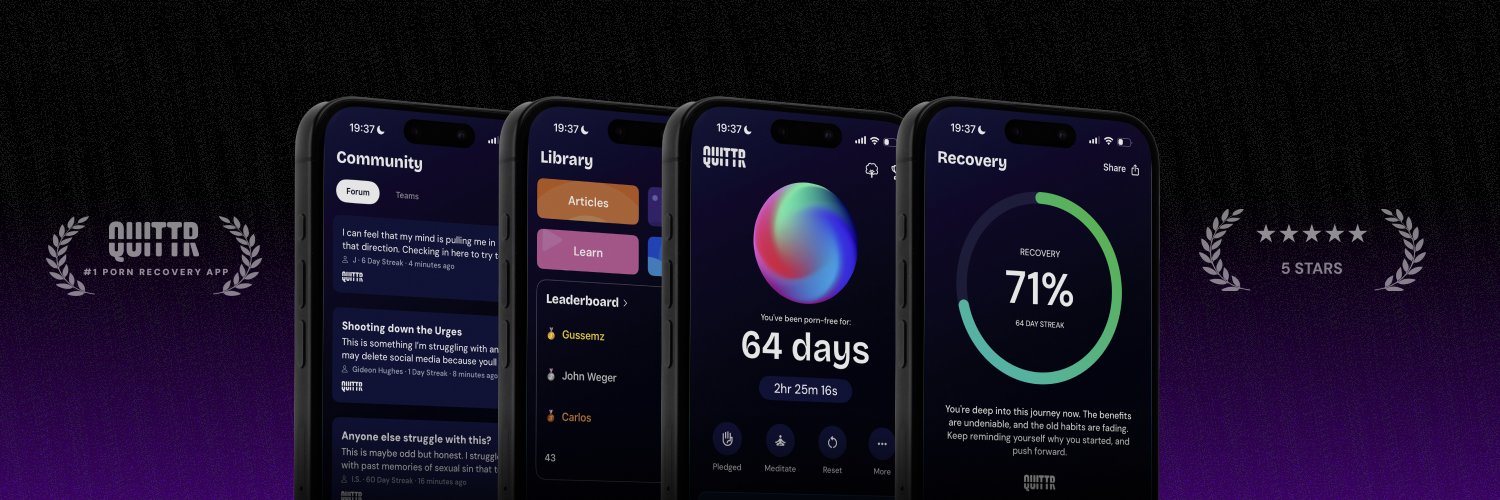
If you feel stuck in a cycle of porn use and want to break free, QUITTR is a science-based and actionable way to quit porn forever. Our app combines practical tools with supportive features, including an AI-powered support system, community leaderboards, meditation exercises, and progress tracking. We have built in essential features such as a content blocker, streak tracker, AI Therapist, recovery journal, leaderboard, meditation games, lessons, educational content, relaxing sounds, side-effect awareness, life tree features, and more.
Whether you are seeking support, education, or practical tools to quit porn forever, QUITTR offers a private, understanding space to work toward your personal goals. Try the #1 science-based way to stop porn by joining our 28-day challenge to compete with other people for the longest streak.
What the Bible Says About Sexual Morality

1. God designed Sex — But with Boundaries
Sex is not a dirty word in Scripture.
It is
Created by God (Genesis 2:24)
Called good (Genesis 1:31)
Symbolic of covenant (Ephesians 5:31-32)
But like fire, it was meant to burn within boundaries:
Within marriage only (Hebrews 13:4)
Between one man and one woman (Genesis 2:22-25)
For unity, love, and procreation (Malachi 2:15)
The biblical view of sexuality is holy, joyful, and purposeful — but only when lived according to God's design. Any use of sexuality outside this framework, including lust, fornication, adultery, masturbation, and pornography, is sin because it twists a sacred gift into self-centered gratification.
2. Sexual Immorality is Serious in the Bible
Sexual immorality (Greek: porneia) is one of the most repeated warnings in Scripture. It refers to any sexual act outside of marriage, and God takes it seriously:
"Flee from sexual immorality… he who sins sexually sins against his own body." — 1 Corinthians 6:18. "It is God's will that you should be sanctified: that you should avoid sexual immorality." — 1 Thessalonians 4:3. "But the sexually immoral… their place will be in the lake of fire." — Revelation 21:8.
Why is it so Serious? Because
It distorts God's image in us
It wounds the body, spiritually and emotionally
It chains people to addiction and shame
It destroys relationships, families, and futures
The Bible does not warn us to restrict pleasure; it warns us to protect purity, intimacy, and identity.
3. The Theology of the Body — You Are Not Your Own
The Theology of the Body, as explained by St. John Paul II in his 129 Wednesday audiences (1979-1984) and echoed in Paul's letters, teaches that:
The human body is a theological symbol
Sexuality is a visible sign of spiritual truths like love, self-gift, and covenant
What we do with our bodies reflects our beliefs about God and self
"Do you not know that your bodies are members of Christ himself?... You are not your own; you were bought at a price. Therefore honor God with your body." — 1 Corinthians 6:15, 19-20.
The Body
Is meant to glorify God, not gratify lust
Is not a playground for desire, but a temple of the Spirit
Is designed for union — not isolation and fantasy
Wasting seed, watching porn, and masturbating reduce the sacred theology of the body to a cheap imitation of love.
4. Jesus Elevated the Standard: Purity Starts in the Heart
In the Old Testament, purity was primarily concerned with actions. Jesus raises the bar to the thought life.
"You have heard… 'Do not commit adultery.' But I tell you that anyone who looks at a woman lustfully has already committed adultery in his heart." — Matthew 5:27-28.
Jesus Teaches That
Lust is not neutral — it is the root of sexual sin
Your thought life matters as much as your behavior
Holiness is not just about what you avoid, but what you pursue
Purity, then, is not just about stopping porn or masturbation. It is about:
Renewing your mind (Romans 12:2)
Training your eyes (Job 31:1)
Reclaiming your desires for God's glory
5. Christian Ways to Overcome Masturbation Addiction
If wasting sperm has become a compulsive cycle, the path out is not white-knuckle willpower — it is a combined spiritual, relational, and practical strategy. The most effective Christian ways to overcome masturbation addiction consistently include the following five disciplines:
Confession to a trusted brother or sister. James 5:16 — "Confess your sins to each other and pray for each other so that you may be healed." Shame thrives in secrecy.
Accountability and content blockers. Remove the trigger before the temptation arrives. Proverbs 4:14-15 — "Avoid it, do not travel on it; turn from it and go on your way."
Scripture memorization for moments of temptation. Psalm 119:11 — "I have hidden your word in my heart that I might not sin against you."
Fasting, prayer, and physical disciplines. The body learns to obey the Spirit when it is consistently denied (1 Corinthians 9:27).
A clear replacement habit. Romans 12:21 — overcome evil with good. Replace the time, not just the urge.
6. How Quittr Helps You Live the Bible's Call to Purity
The journey to sexual holiness is not easy, but it is possible. Quittr AI is more than a tracker — it is a practical tool designed to help believers take concrete steps toward biblical purity.
What Quittr Offers
Streak & Relapse Tracker: Measure progress and see patterns
Daily Devotionals & Scripture Reminders: Keep your heart anchored in truth
Temptation Journal: Process emotions and triggers in a biblical framework
Victory Log: Build momentum by celebrating every day of faithfulness
Community Stories: Stay encouraged by reading real-life testimonies of breakthroughs
Godly Goals: Set spiritual intentions like fasting, prayer, or media limits
Root Work Prompts: Reflect on why you turn to PMO and how God can heal those wounds
Quittr AI does not just help you quit porn — it enables you to become the man or woman God created you to be.
Join Our 28-day Challenge & Quit Porn Forever with the #1 Science-based Way To Quit Porn
QUITTR is a science-based and actionable way to quit porn forever. Our app combines practical tools with supportive features, including an AI-powered support system, community leaderboards, meditation exercises, and progress tracking. We've included essential features such as a content blocker, streak tracker, AI Therapist, recovery journal, leaderboard, meditation games, lessons, educational content, relaxing sounds, side-effect awareness, life tree features, and more.
Whether you're seeking support, education, or practical tools to quit porn forever, QUITTR offers a private, understanding space to work toward your personal goals. Try the #1 science-based way to stop porn by joining our 28-day challenge to compete with other people for the longest streak.