
The Negative Effects Of Excessive Masturbation
QUITTR is the #1 porn quitting app in the world. Join 1,000,000+ others on a mission to be the best person they can be.

Last Edited
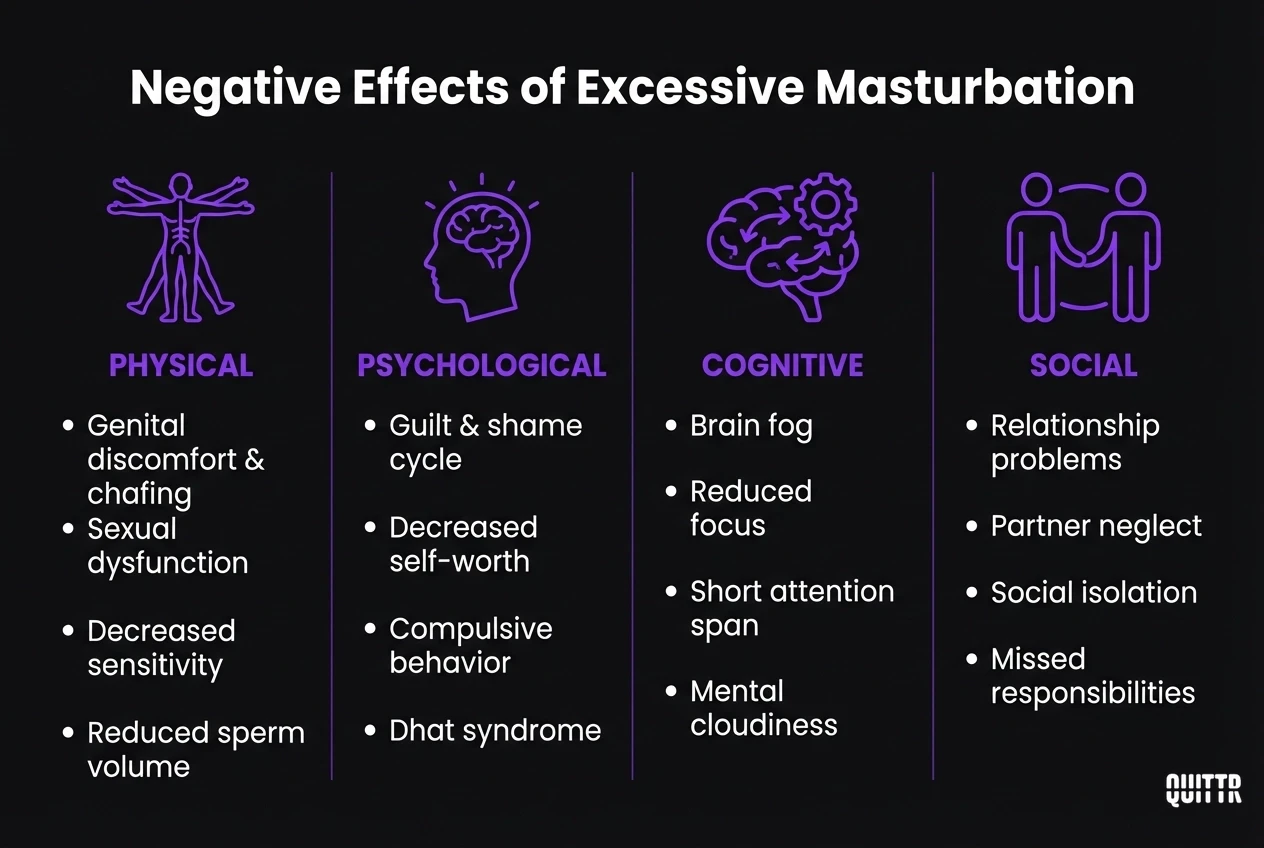
Over-masturbation can result in a negative impact on anyone who practices it. Excessive masturbation impacts physical and sexual health, psychological and emotional balance, cognitive abilities, and relationships. Below, we outline the negative effects of masturbating too much and potential outcomes:
Physical effects: Can lead to genital discomfort like chafing and soreness, and certain masturbation techniques may contribute to sexual dysfunction, including erectile issues and desensitization.
Psychological effects: May trigger a guilt cycle and decreased self-worth, often driven by moral incongruence between the behavior and personal values.
Cognitive effects: Can cause brain fog and reduced focus, where the mind constantly drifts toward sexual thoughts.
Social effects: Creates interference with responsibilities and relationship problems, as individuals may choose isolation or partner neglect over real-world intimacy.
While masturbation is a natural biological behavior, it can become excessive as it shifts from a healthy action to a compulsive habit. When this happens, the brain's reward system undergoes gradual changes through repeated dopamine release during compulsive behavior.
Excessive masturbation can replace genuine sexual human connection with a trance-like state of isolation, leaving individuals in a cycle of temporary highs followed by emotional and physical crashes.
What Is Excessive Masturbation?
Excessive masturbation is when the frequency of masturbation moves from becoming a choice to being a compulsion that you can't control.
Three signs of excessive masturbation are when it interferes with your daily life, has an impact on your physical health, or has an impact on your mental well-being. When masturbation impacts your daily life, you end up skipping school, work, or social hangouts. The physical impact appears as irritation or pain, usually in the genitals. The mental impact is from the sense of compulsion, where you lose control over the habit.
When masturbation becomes a compulsion, it changes from being a healthy source of stress relief to becoming a source of stress on the body and mind.
What Are The Negative Effects Of Excessive Masturbation?
The list below describes the negative consequences of excessive masturbation:
Impact on physical and sexual health: Certain masturbation techniques can lead to soreness, reduced sensitivity, and difficulty during partnered sex.
Psychological and emotional balance issues: Excessive masturbation can lead to feelings of intense guilt, burnout, and stress.
Impact on cognitive abilities: You may find it hard to pay attention or feel like your brain is moving more slowly than usual.
Relationship problems: You may avoid people in favor of staying home alone, or stop wanting to be close to your partner.
Urinary and Prostate Issues
Excessive masturbation may contribute to irritation in the pelvic area, though evidence for this is limited. Prostatitis is a painful inflammation of the prostate gland. One hypothesis published in Medical Hypotheses (Shoskes & Landis, 2009) proposed that very frequent ejaculation could contribute to pelvic symptoms, but clinical studies have not confirmed a causal link between masturbation and prostatitis.
Sexual Dysfunction
Sexual dysfunction associated with masturbation is primarily linked to idiosyncratic masturbation techniques rather than frequency alone. A 2022 study by Grubbs and Kraus (n=3,586 men) published in the International Journal of Impotence Research found that masturbation frequency was only weakly related to erectile functioning.
Erectile dysfunction (ED) associated with masturbation typically involves atypical techniques such as excessively tight grip or prone positioning, which condition the body to stimulation not replicable during partnered sex. Delayed ejaculation is another recognized consequence. Clinical research by Perelman (2016) identified idiosyncratic masturbatory style as the primary factor causing delayed ejaculation, based on over 300 clinical cases.
Decreased Sexual Sensitivity
Decreased sexual sensitivity is a reduced responsiveness to sexual stimulation caused by certain masturbation habits. Physical desensitization can occur when repeated friction reduces sensitivity in the genitals over time. Mental desensitization, where the brain requires more intense stimulation, is primarily associated with pornography use rather than masturbation alone.
Genital Discomfort
Genital discomfort is direct physical pain or irritation in your private areas caused by overmasturbation. The most common types of genital discomfort are Edema, a form of swelling, and chafing, which causes raw, red, or stinging skin from constant rubbing.
Impact on Sperm/Fertility
Frequent ejaculation temporarily reduces the volume and sperm count of each ejaculate. A 2016 study by Welliver et al. published in Translational Andrology and Urology found that daily ejaculation over 2 weeks reduced semen volume by approximately 40% and lowered sperm concentration from 118 million/mL to 68 million/mL. Sperm quality markers such as motility, morphology, and DNA integrity were maintained. These reductions are fully reversible once normal ejaculation frequency resumes.
Chronic Fatigue
Post-orgasmic fatigue is a normal temporary response to ejaculation caused by the release of prolactin and oxytocin. You might experience physical tiredness or mental sluggishness shortly after masturbation. These effects typically resolve within hours. There is no clinical evidence that masturbation causes persistent chronic fatigue.
Guilt and Shame
Excessive masturbation may cause negative emotions where you feel bad, dirty, or disappointed in yourself. These feelings of guilt and shame often include immediate regret, that feeling of wishing you hadn't done it, and social shame, where you fear that people around you might find out about your habits.
Decreased Self-Worth
Decreased self-worth after excessive masturbation is a loss of self-respect or the feeling that you aren't good enough as a person. This can lead to feelings of inadequacy, where you feel like a failure, or negative self-talk, where you constantly criticize yourself in your own head.
Dhat Syndrome
Dhat syndrome is a cultural concept of distress, most prevalent in South Asia but documented in other regions, characterized by anxiety, depression, and somatic symptoms (fatigue, weakness, sexual dysfunction) related to the belief of losing semen ("dhat") through urine, nocturnal emissions, or masturbation. It usually involves a mix of physical symptoms, such as fatigue, and a deep emotional fear of leaking vital nutrients or life force.
Reduced Focus and Cognition
Reduced focus and cognition, also known as brain fog, can be caused by excessive masturbation. It can show up as mental cloudiness, where you can't think clearly, or a short attention span, where you find yourself easily distracted.
Compulsive Behavior
Compulsive behavior is when you masturbate because you feel you have to, not because you want to. It can appear as a routine compulsion, where you do it at the same time every day regardless of how you feel, or as a stress reaction, where you automatically turn to the habit to hide from boredom, sadness, or pressure.
Interference with Responsibilities
Interference and responsibilities caused by excessive masturbation are when the habit gets in the way of your real life. It typically manifests as procrastination, where you put off important tasks, or absence, where you miss work, school, or important appointments.
Relationship Problems
Relationship problems caused by excessive masturbation is about the distance or tension that grows between you and your loved ones. It can lead to partner neglect, where you choose masturbating over being intimate with a significant other, and social isolation, where you stop socializing and prefer to stay home alone to masturbate.
What Are The Effects Of Masturbation On Different Organs?
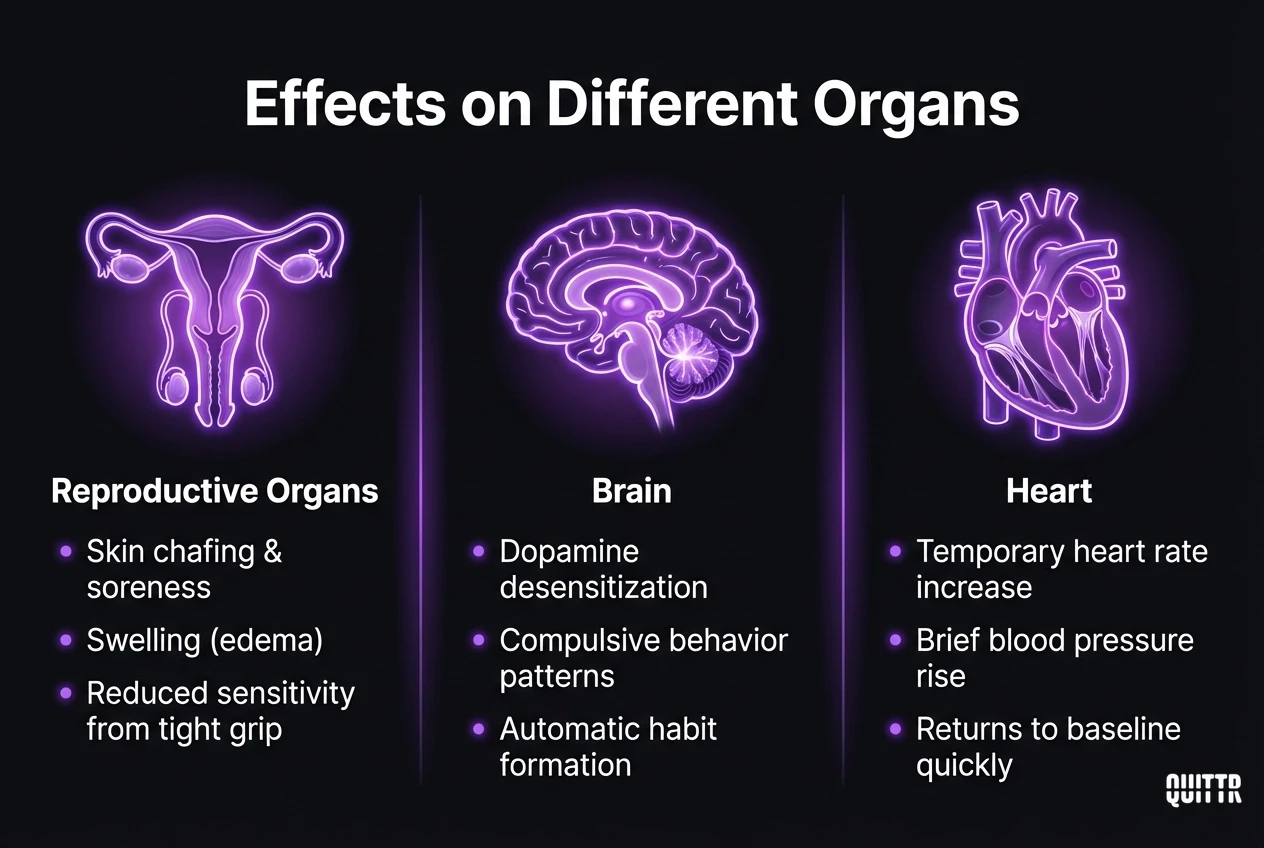
Excessive masturbation can impact several organs in the body. The reproductive organs are most directly exposed to physical irritation. The brain may change how it processes pleasure and focus, particularly when pornography is involved.
Below, we list the organs affected by excessive masturbation and the specific effects that masturbation can have on them:
Reproductive organs: Overmasturbation can lead to skin chafing, soreness, and in rare cases, swelling (edema) of the genitals. Certain techniques, such as excessively tight grip, may reduce sensitivity to normal touch over time.
Brain: Dopamine desensitization has been observed in substance addiction and, with mixed evidence, in compulsive pornography use. Whether excessive masturbation alone produces similar changes has not been directly studied. Compulsive behavior patterns may develop where the habit feels automatic rather than voluntary.
Heart: Masturbation temporarily raises heart rate and blood pressure to levels equivalent to mild-to-moderate exercise, comparable to brisk walking. These return to baseline quickly and do not pose a cardiovascular risk.
Does Masturbation Cause Inflammation?
No, masturbation does not cause systemic inflammation. Excessive or rough masturbation can cause localized skin irritation and chafing from mechanical friction. This is a temporary friction injury, not an inflammatory disease process.
Masturbation causes brief, normal hormonal fluctuations (temporary changes in testosterone, prolactin, and cortisol) that return to baseline within minutes. These are not hormonal imbalances and do not trigger systemic inflammatory responses. The limited research on masturbation and immune function actually shows temporary immune enhancement, including increased natural killer cell activity, after orgasm.
Does Masturbation Decrease Testosterone?
No, masturbation does not cause a long-term decrease in total testosterone levels. Testosterone may rise modestly during sexual arousal and returns to baseline shortly after orgasm.
A study by Exton et al. (2001) published in the World Journal of Urology tested 10 men before and after a 3-week abstinence period. The study found that the acute act of orgasm did not alter testosterone levels in either condition, though baseline testosterone concentrations were slightly higher following the abstinence period.
What Are The Common Myths About Masturbation?
The most common myths about masturbation are that it can cause physical problems such as blindness, disabilities, or a disruption in sperm count. However, most of these myths are false and typically originate from historical taboos, cultural fears, or a lack of understanding about human biology.
Below, we provide a list of the most common myths about masturbation:
It causes blindness or vision problems.
It causes hairy palms or physical deformities.
It lowers your sperm count permanently.
It causes your genitals to shrink (or grow).
It leads to mental illness or insanity.
It causes acne or pimples.
What Is Gooning?
Gooning is a slang term for an extreme form of edging in which someone masturbates for prolonged periods while deliberately avoiding orgasm, in order to enter a trance-like, euphoric mental state. The main difference is that conventional masturbation focuses on climaxing, while Gooning's focus is on maintaining the pre-orgasmic state of arousal.
Gooning is the result of porn addiction getting worse. It often happens as porn addicts chase the increasing highs that they need from seeking more extreme content. This trance of seeking more extreme content results in a loss of control, even in the face of daily responsibilities and life.
Due to the trance that occurs in Gooning, more significant risks are raised compared to regular masturbation sessions. These elevated risks include total numbness, physical damage, extended lengths of brain fog, and a loss of time that can stretch into days and nights.
How Excessive Masturbation and Porn Addiction Are Connected?
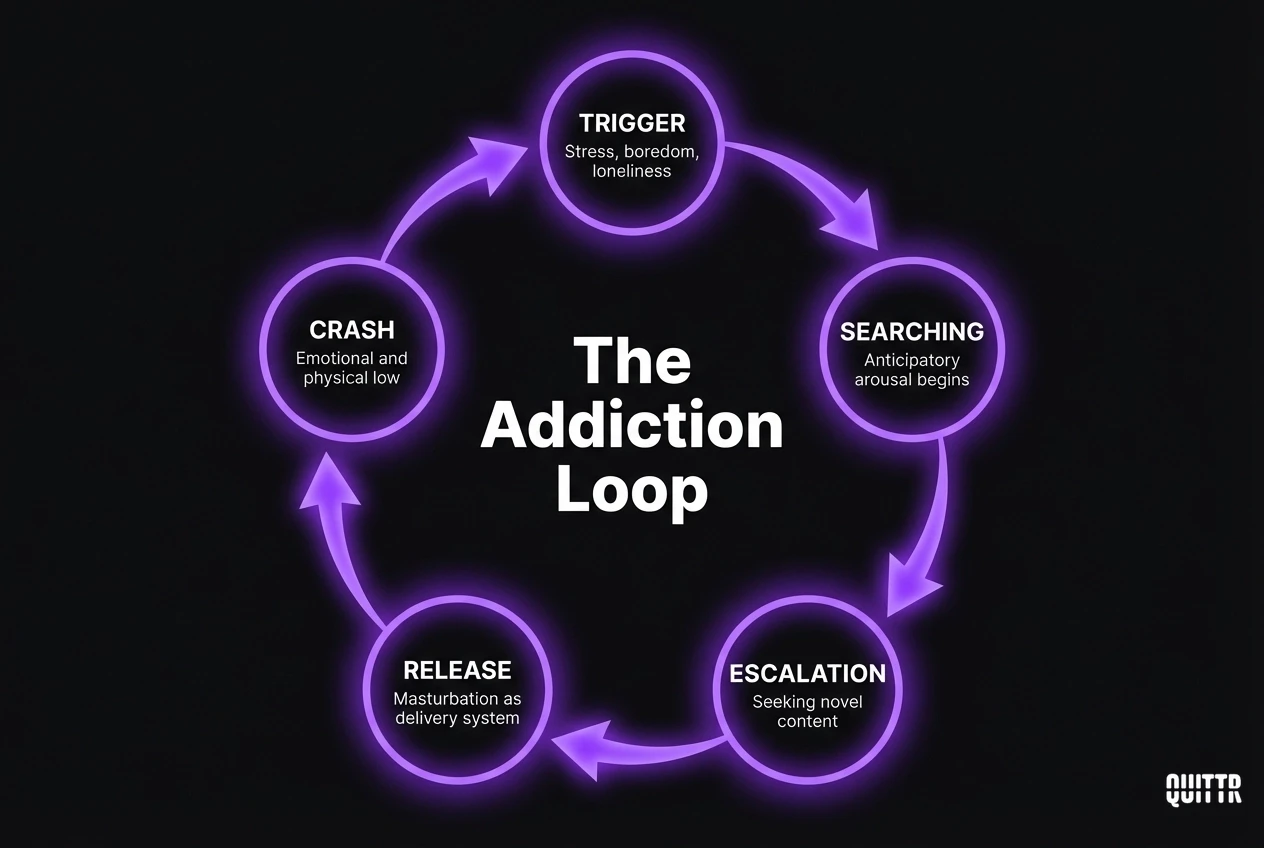
Excessive masturbation and porn addiction are two halves of a constant loop. They join to create a cycle where the brain demands higher levels of stimulation from porn to achieve the physical release from masturbation.
The connected cycle of addiction begins with a trigger, such as stress, boredom, or loneliness. This leads to a phase where searching for porn causes a state of anticipatory arousal, driven by incentive salience, where the brain's "wanting" system responds to cues that predict sexual reward. The tendency to seek novel content may reflect a mechanism analogous to the Coolidge Effect, a biological phenomenon in which sexual interest renews with each new potential mate. Finally, excessive masturbation serves as a delivery system that fixes the craving for porn.