

What Are The Effects of Pornography Addiction?
QUITTR is the #1 porn quitting app in the world. Join 1,000,000+ others on a mission to be the best person they can be.
Last Edited
Pornography addiction affects the brain, mental health, relationships, and sexual health through neurological, psychological, and behavioral changes. Pornography addiction is a compulsive behavioral condition in which an individual continues to consume pornography despite negative outcomes across multiple spheres of life.
Problematic pornography use disrupts the brain's dopamine reward system. The mesolimbic dopamine pathway receives repeated overstimulation from novel sexual content, which leads to tolerance, desensitization, and impaired impulse control. Tolerance means the individual requires increasing stimulation to achieve the same reward response. These neurological changes drive downstream effects across mental health, relationships, and sexual function.
The World Health Organization recognized compulsive sexual behaviour disorder (CSBD) in the ICD-11 in 2019, validating the clinical significance of these effects. The effects of pornography addiction compound over time as tolerance deepens and consequences accumulate across all domains. These effects are reversible with sustained abstinence and professional treatment.
The effects of pornography addiction include brain changes in dopamine signaling and gray matter volume, mental health impacts like depression and anxiety, relationship damage from trust erosion and unrealistic expectations, sexual dysfunction including pornography-induced erectile dysfunction, and compounding long-term consequences. The effects of porn addiction are listed below.
Brain effects — compulsive pornography use is associated with lower gray matter volume, altered prefrontal cortex connectivity, and reduced reward system sensitivity to normal stimulation.
Mental health effects — pornography addiction increases the risk of depression, anxiety, chronic shame, and social isolation.
Relationship effects — pornography addiction erodes trust, reduces intimacy, creates unrealistic sexual expectations, and causes partner distress.
Sexual effects — pornography addiction causes pornography-induced erectile dysfunction (PIED), reduced libido for real partners, and escalation to more extreme content.
Long-term effects — effects compound over time as tolerance deepens, escalation progresses, and consequences accumulate across all domains.
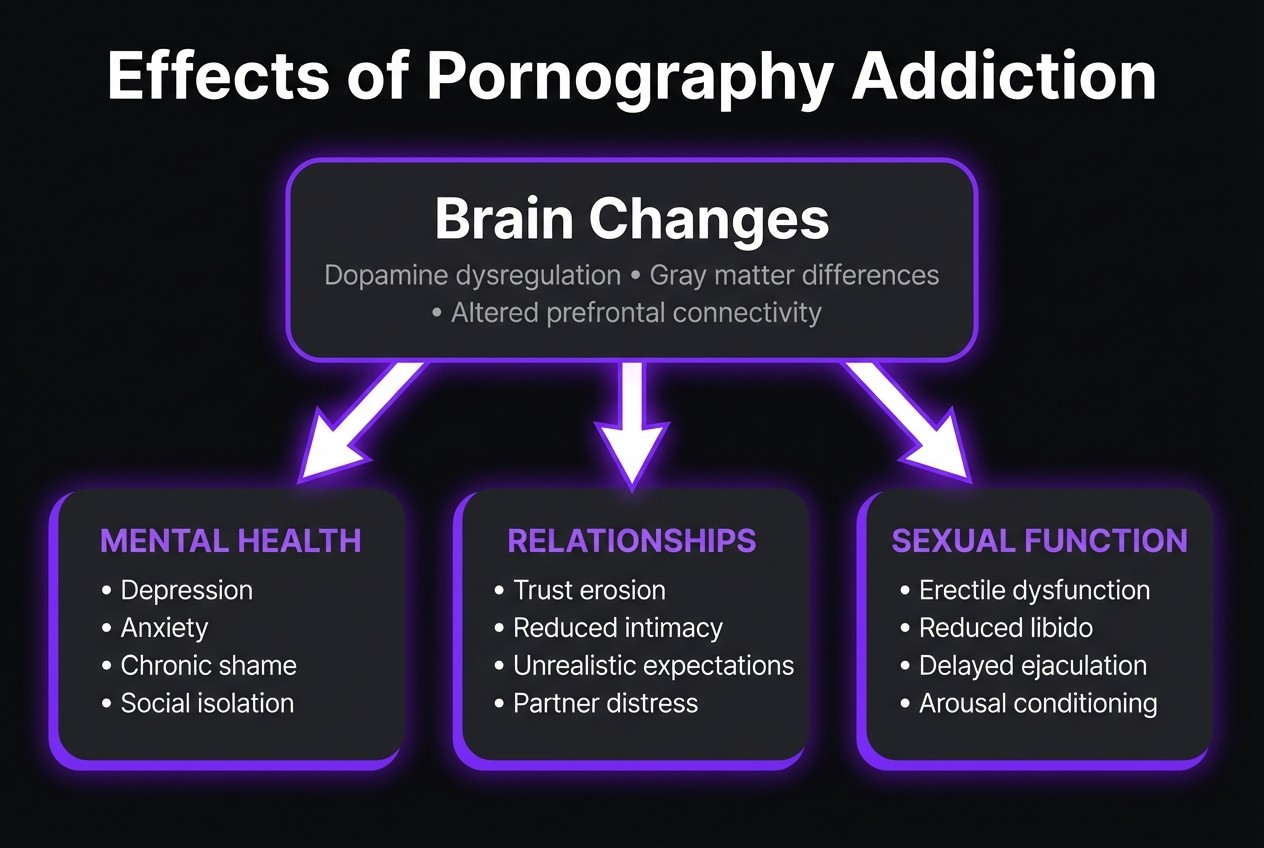
Table Of Contents
How Does Pornography Addiction Affect the Brain?
Pornography addiction is associated with disruption of the dopamine reward system, differences in gray matter volume, and altered functional connectivity between the striatum and the prefrontal cortex. These three categories of brain differences are reward system disruption, structural changes, and impaired impulse control. All three are observed in neuroimaging research, though whether they are caused by compulsive use or reflect pre-existing vulnerabilities remains under investigation.
Compulsive pornography use overstimulates the mesolimbic dopamine pathway. The nucleus accumbens receives repeated dopamine surges from novel sexual content. The brain adapts by reducing its sensitivity to dopamine stimulation, producing tolerance. The individual needs more stimulation to achieve the same reward response. Todd Love et al. (2015, Behavioral Sciences) reviewed the neuroscience of internet pornography addiction and confirmed that compulsive pornography use produces tolerance and sensitization consistent with substance addiction models.
Reduced baseline dopamine signaling produces anhedonia. Anhedonia is a reduced capacity to feel pleasure from everyday activities and diminished motivation. This desensitization drives further pornography consumption as one of the few remaining sources of sufficient dopamine activation.
Dr. Valerie Voon at the University of Cambridge (2014) found that compulsive pornography users showed heightened cue-reactivity in the ventral striatum when exposed to pornography cues. This neural pattern mirrors the response observed in substance addicts exposed to drug cues.
Altered connectivity between the striatum and the prefrontal cortex is associated with reduced ability to regulate compulsive behavior. The prefrontal cortex is responsible for decision-making, impulse control, and evaluating long-term consequences. These neuroimaging findings reveal measurable structural and functional differences in the brains of compulsive pornography users.
Does Pornography Change Brain Structure?
Yes, pornography addiction changes brain structure.
Dr. Simone Kühn and Dr. Jürgen Gallinat at the Max Planck Institute for Human Development (2014, JAMA Psychiatry) found that individuals with higher pornography consumption had reduced gray matter volume in the caudate nucleus. The same study found reduced functional connectivity between the caudate nucleus and the dorsolateral prefrontal cortex.
The caudate nucleus is involved in reward processing and goal-directed behavior. Reduced gray matter volume is associated with higher pornography consumption, though whether this represents a consequence of use or a pre-existing vulnerability has not been determined. Reduced connectivity to the prefrontal cortex means the brain's impulse control system has a weakened connection to the reward system.
These structural differences parallel those documented in substance addiction, including reduced gray matter in reward regions and impaired prefrontal regulation.
How Does Pornography Addiction Affect Mental Health?
Pornography addiction affects mental health by increasing the risk of depression, anxiety, chronic shame, social isolation, and emotional numbing. The neurological changes described above have direct psychological consequences. Dopamine desensitization, reduced gray matter, and impaired impulse control each contribute to measurable psychological deterioration.
Compulsive pornography use creates a self-reinforcing cycle. Low mood drives pornography use for dopamine relief. Pornography use deepens desensitization. Deeper desensitization worsens low mood.
Shame and secrecy compound the psychological burden. Pornography addiction often involves hidden behavior, producing chronic shame that reinforces social withdrawal and isolation.
Reduced baseline dopamine signaling diminishes the ability to experience pleasure, connection, and motivation in daily life. This emotional numbing is a direct consequence of the reward system changes produced by compulsive pornography use. Depression and anxiety are the two most documented mental health consequences of pornography addiction.
Can Pornography Addiction Cause Depression?
Yes, pornography addiction can cause depression.
Dopamine desensitization reduces the brain's capacity for experiencing everyday pleasure, producing persistent low mood. Chronic shame and social isolation from hidden compulsive behavior compound depressive symptoms. A 2019 systematic review by de Alarcón et al. in the Journal of Clinical Medicine identified depressive symptoms as a recurring comorbidity in individuals with compulsive pornography use.
Can Pornography Addiction Cause Anxiety?
Yes, pornography addiction can cause anxiety.
Pornography creates unrealistic sexual expectations that produce performance anxiety in real sexual encounters. Withdrawal-related anxiety occurs when access to pornography is restricted, as the dopamine system seeks its conditioned stimulus. Shame and secrecy increase avoidance of social interaction, producing social anxiety.
How Does Pornography Addiction Affect Relationships?
Pornography addiction affects relationships by eroding trust, reducing emotional and physical intimacy, creating unrealistic sexual expectations, and causing significant partner distress. These effects damage relationships through multiple interconnected pathways.
Pornography addiction typically involves hidden behavior and active deception. Discovery by a partner produces feelings of betrayal and broken trust. Partners of pornography addicts report emotional responses comparable to betrayal trauma. A 2017 longitudinal study by Samuel Perry in the Archives of Sexual Behavior found that beginning pornography use between survey waves was associated with significant decreases in marital quality for married adults.
Compulsive pornography use redirects sexual energy and emotional connection away from the partner. Dopamine desensitization reduces the brain's reward response to real-world intimacy. Partnered sexual experiences become less satisfying than pornography. The individual may withdraw from physical and emotional intimacy as the addiction progresses.
Pornography establishes distorted templates for sexual behavior, body image, and relationship dynamics. These unrealistic expectations create dissatisfaction with real partners and real sexual experiences. Partners may feel pressured to conform to standards shaped by pornographic content.
The shame cycle of use, guilt, secrecy, and isolation withdraws the individual emotionally from the relationship. Emotional disconnection deepens as the individual prioritizes pornography use over relationship engagement.
Partners of pornography addicts experience decreased self-esteem, feelings of sexual inadequacy, and heightened anxiety about the relationship's stability. Partners report feeling shut out, confused, and inadequate.
How Does Pornography Addiction Affect Sexual Function?
Pornography addiction affects sexual function by causing erectile dysfunction, reducing libido for real partners, delaying ejaculation, and conditioning arousal patterns to screen-based stimulation. These sexual effects are a direct consequence of the neurological changes produced by compulsive pornography use.
The brain's reward system becomes conditioned to respond to pornographic stimulation rather than real sexual encounters. This conditioning is reinforced by the constant novelty pornography provides. The Coolidge effect describes the brain's renewed dopamine response to each new sexual partner, and researchers propose that novel pornographic content triggers the same mechanism. Pornography delivers this novelty at a scale and intensity that real sexual encounters cannot replicate.
Tolerance drives escalation to more extreme, novel, or taboo content to achieve the same dopamine response. Content that initially produced arousal no longer activates the reward system. Real sexual encounters cannot compete with the intensity of escalated pornographic material.
Dopamine desensitization reduces sexual motivation for partnered sex. The brain has been conditioned to associate sexual reward with pornography rather than with a real partner. Reduced libido for real partners is one of the most commonly reported sexual effects of compulsive pornography use.
Conditioned arousal to pornographic stimulation can cause delayed ejaculation during partnered sexual activity. The physical stimulation of real sex does not match the visual and psychological stimulation the brain has been conditioned to require.
What Is Pornography-Induced Erectile Dysfunction?
Pornography-induced erectile dysfunction (PIED) is a clinical term for the inability to achieve or maintain an erection during real sexual encounters due to the brain's dependence on pornographic stimulation for arousal. PIED is not a formal diagnosis in any diagnostic manual but is increasingly recognized in clinical practice.
PIED is caused by compulsive pornography use, not by physical, hormonal, or age-related factors. The brain's reward system has been conditioned to associate sexual arousal with screen-based stimulation rather than real sexual encounters.
PIED is documented in young men with no physical cause for erectile dysfunction. The condition was rare in men under 40 before widespread internet pornography access. PIED is reversible with sustained abstinence because it is caused by neurological conditioning, not physical damage to the reproductive system.
What Are the Long-Term Effects of Pornography Addiction?
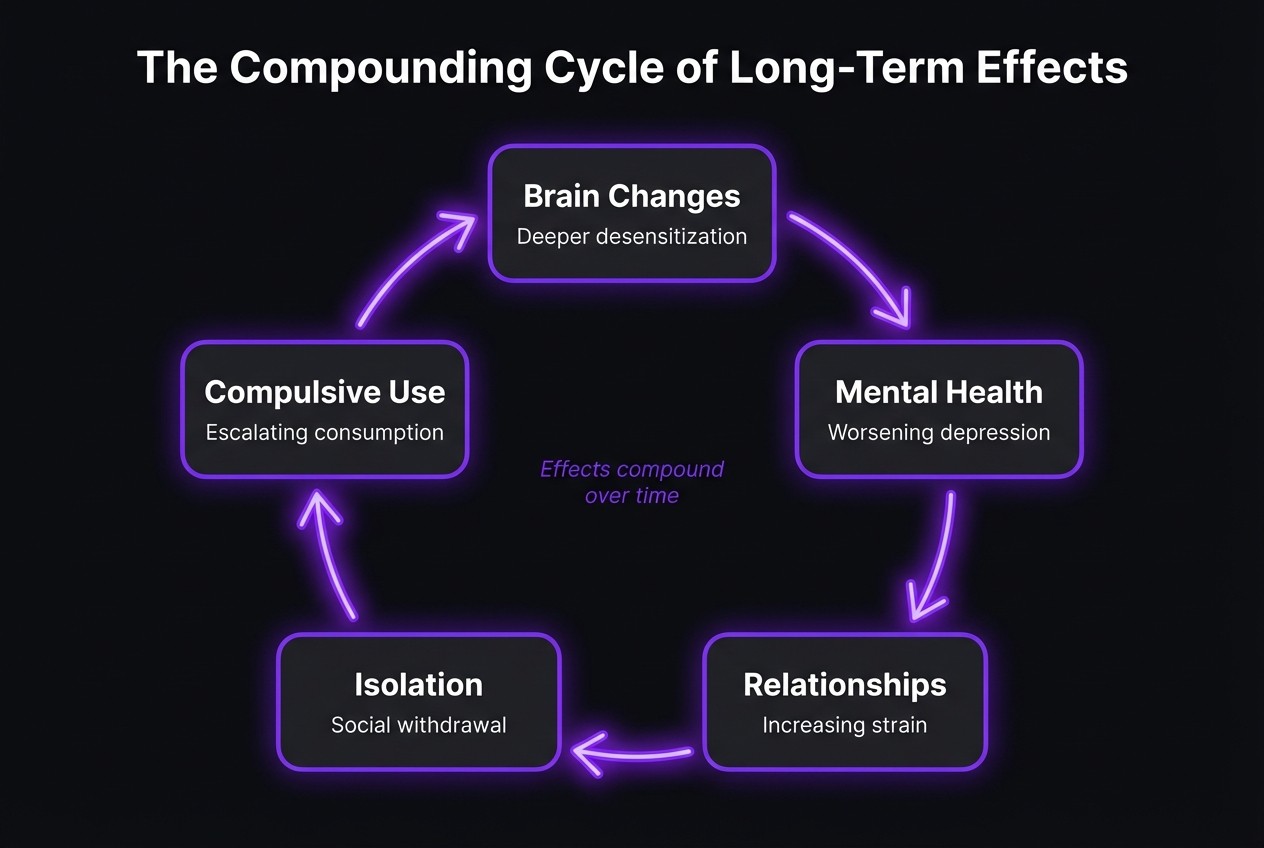
The long-term effects of pornography addiction include deepening brain changes, escalation to extreme content, compounding mental health decline, relationship damage, and difficulty of recovery.
Tolerance deepens over months and years, driving consistent escalation to more extreme, novel, or taboo content. Content that initially produced arousal no longer activates the reward system. The individual requires increasingly intense stimulation.
Long-term pornography addiction does not affect one domain in isolation. Brain changes worsen mental health. Deteriorating mental health strains relationships. Strained relationships increase isolation. Increased isolation drives more compulsive pornography use. The effects form a self-reinforcing cycle that accelerates over time.
Prolonged compulsive use is associated with greater reductions in gray matter volume and weaker prefrontal cortex connectivity based on cross-sectional research. The brain becomes more entrenched in the addictive pattern as compulsive behavior continues.
Chronic pornography addiction can lead to job loss, academic failure, financial problems from paid pornography and lost productivity, and complete social withdrawal. The longer the addiction persists, the deeper the neurological conditioning and the longer recovery takes. Early intervention produces faster neuroplastic recovery than intervention after years of compulsive use.
The brain's neuroplasticity means recovery is possible regardless of addiction duration.
How Common Are the Effects of Pornography Addiction?
An estimated 3–6% of the adult population meets criteria for compulsive sexual behaviour disorder, with compulsive pornography use as the most common presentation. The World Health Organization recognized CSBD in the ICD-11 in 2019, confirming the clinical significance of the effects documented above.
What Should You Do About the Effects of Pornography Addiction?
You should seek professional help from a therapist specializing in compulsive sexual behavior if you are experiencing the effects of pornography addiction. Cognitive-behavioral therapy (CBT) and acceptance and commitment therapy (ACT) are the most evidence-based treatment approaches for compulsive pornography use.
Recognizing the signs of pornography addiction is the first step toward recovery. Structured digital recovery programs like QUITTR provide daily support between therapy sessions.

Ready to finally quit porn?
Start your journey with our porn addiction recovery app and become the best version of yourself. The benefits feel great, trust us - The QUITTR Team