
Porn Addiction Withdrawal: Symptoms & How To Manage
QUITTR is the #1 porn quitting app in the world. Join 1,000,000+ others on a mission to be the best person they can be.
Last Edited
Porn addiction withdrawal symptoms include intense cravings, mood swings, irritability, anxiety, insomnia, depression, fatigue, difficulty concentrating, restlessness, and a temporary loss of libido known as flatline. These symptoms occur when an individual stops or reduces compulsive pornography use after a period of dependence.
Porn addiction withdrawal, also referred to as pornography withdrawal or porn detox, is the set of emotional, physical, cognitive, and sexual symptoms that occur when the reward system adjusts to functioning without pornographic stimulation. Withdrawal from compulsive masturbation often overlaps, as both behaviors activate the same reward pathways.
Withdrawal symptoms are temporary. The brain's neuroplasticity allows the reward system to recover.
Many individuals first recognize their pornography addiction as compulsive when they attempt to stop and experience withdrawal. Lewczuk et al. (2022) found that 65.2% of individuals meeting compulsive sexual behaviour disorder (CSBD) thresholds reported withdrawal-like symptoms.
After porn withdrawal recedes, several benefits emerge: improved mood, restored sexual function, better concentration, and strengthened relationships.
The symptoms of porn addiction withdrawal include intense cravings, mood swings, anxiety, insomnia, depression, fatigue, brain fog, restlessness, and a temporary loss of libido known as flatline. The common porn withdrawal-like symptoms are listed below:
Intense cravings and urges
Mood swings and irritability
Anxiety
Insomnia and sleep disturbance
Depression and low mood
Fatigue and low energy
Difficulty concentrating and brain fog
Restlessness
Temporary loss of libido (flatline)
Table Of Contents
What Is Porn Addiction Withdrawal?
Porn addiction withdrawal is the set of physical, emotional, cognitive, and sexual symptoms that occur when an individual stops compulsive pornography use after the brain has developed a dependence on pornographic stimulation.
Withdrawal occurs primarily because compulsive pornography use overstimulates the mesolimbic dopamine pathway, which causes desensitization. The brain temporarily operates with diminished reward sensitivity after the source of stimulation is removed. Although porn addiction is comparable to substance addiction, behavioral addiction withdrawal produces emotional and psychological symptoms rather than the physical symptoms.
Withdrawal symptoms from compulsive masturbation overlap with pornography withdrawal because both behaviors activate the same dopamine reward pathway.
The World Health Organization recognized CSBD in the ICD-11 in 2019. Lewczuk et al. (2022) in the Journal of Behavioral Addictions found that 65.2% of CSBD-threshold individuals reported withdrawal-like symptoms including irritability, sleep problems, and mood changes. Dwulit and Rzymski (2019) found that 72.2% of abstaining users recalled at least one withdrawal symptom. Roza et al. (2024) in the Journal of Addiction Medicine synthesized 14 studies and found preliminary evidence for withdrawal-like symptoms. Fernandez et al. (2023) found no withdrawal during 7-day abstinence in regular users, though craving emerged in high-frequency problematic users.
Many individuals report withdrawal-like symptoms when they reduce use of porn, though CSBD does not include withdrawal as a diagnostic criterion. Withdrawal-like symptoms may indicate reward system adjustment, disruption of habitual coping, or psychological expectancy effects.
What Are the Symptoms of Porn Addiction Withdrawal?
The symptoms of porn addiction withdrawal include intense cravings, mood swings, anxiety, insomnia, depression, fatigue, difficulty concentrating, restlessness, and a temporary loss of libido. These symptoms fall into four categories: emotional, physical, cognitive, and sexual.
The most common symptoms of porn addiction withdrawal are listed below.
Intense urges to consume porn. Cravings are the most reported withdrawal symptom, producing strong involuntary urges triggered by stress, boredom, loneliness, or environmental cues such as specific times of day and devices. Cravings peak during the first 1–2 weeks and gradually diminish.
Mood swings. Rapid emotional shifts and heightened irritability result from the brain adjusting to reduced dopamine levels. Emotional reactivity is common during the first 2–4 weeks as baseline neurotransmitter levels recalibrate.
Anxiety. Increased generalized anxiety and restlessness during withdrawal may involve HPA axis activation and elevated cortisol, as documented in hypersexual disorder by Chatzittofis et al. (2016). The connection between pornography addiction and anxiety is pronounced during withdrawal.
Insomnia and sleep disturbance. Difficulty falling or staying asleep is common during early withdrawal. Elevated stress hormones and disrupted habitual routines contribute to sleep disturbance.
Depression and low mood. Depleted baseline dopamine signaling produces anhedonia, a reduced ability to experience pleasure from everyday activities. Persistent low mood and emotional flatness are common until the reward system recovers. The connection between pornography addiction and depression is well documented.
Fatigue and low energy. Physical tiredness and reduced motivation occur as the reward system adjusts. One small study (n=21) found reduced fatigue after 3 weeks of combined pornography and masturbation abstinence, though larger studies are needed.
Difficulty concentrating and brain fog. Impaired focus and mental clarity are commonly reported during early withdrawal. Neuroimaging studies show altered prefrontal cortex function in heavy pornography users, and concentration typically improves during sustained abstinence.
Restlessness. Inability to relax or settle is driven by the brain's conditioned expectation of dopamine stimulation. The individual feels agitated and unable to fill the time previously occupied by pornography use.
Temporary loss of libido. Flatline is a period of reduced or absent sexual desire, arousal, and genital sensitivity as the brain recalibrates from screen-based stimulation. Community reports place flatline between weeks 2 and 6.
Not all individuals experience every symptom. Severity of porn addiction withdrawal depends on the duration and intensity of use, and individual neurochemistry.
What Happens When You Stop Watching Porn?
When you stop watching porn, you initially experience withdrawal symptoms as the brain's dopamine reward system recalibrates. This is usually followed by progressive neurological recovery and improvements in mood, sexual function, concentration, and relationship quality.
Stopping pornography use produces two distinct phases. The first phase is withdrawal, which involves negative symptoms. The second phase is recovery, which produces positive outcomes.
Phase 1 is the withdrawal phase, that lasts approximately weeks 1 through 8. This phase is most intense during the first 2–4 weeks. The it gradually subsides.
Phase 2 is the recovery phase, starting around week 4. During the phase, mood stabilizes, energy increases, sexual response to real-world cues returns, concentration sharpens, and emotional availability in relationships improves.
The recovery phase overlaps with the late withdrawal phase. Individuals may experience both withdrawal symptoms and emerging benefits simultaneously during weeks 4–8.
The transition from withdrawal to recovery is not linear. Intermittent symptom flare-ups, sometimes called post-acute withdrawal syndrome (PAWS), can occur for months. PAWS is a concept from substance addiction recovery and its applicability to behavioral addiction is theoretical. Each episode is typically shorter and less intense than the previous one.
What Are the Benefits of Quitting Porn?
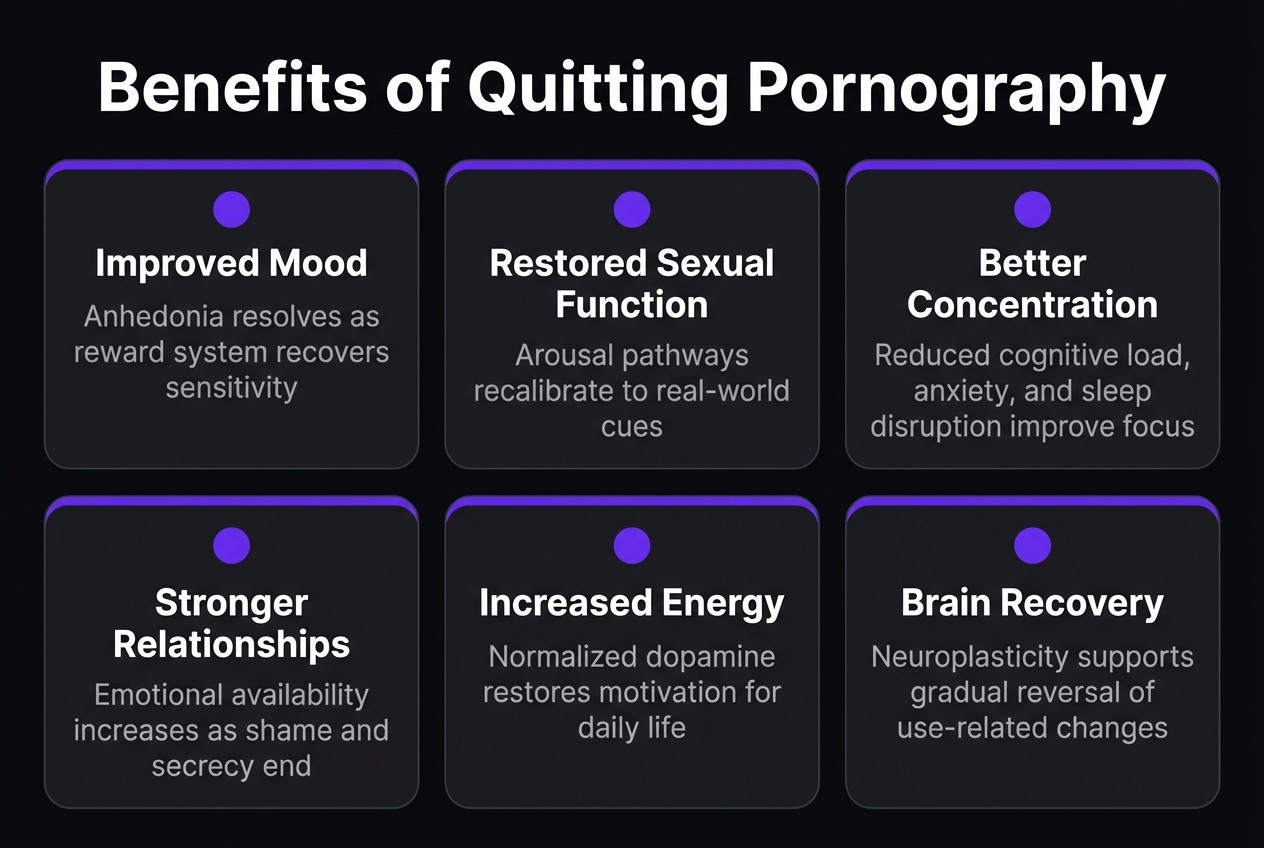
The benefits of quitting porn include improved mood and emotional stability, restored sexual function and libido, better concentration and mental clarity, strengthened relationships, increased energy and motivation, and measurable brain recovery.
The benefits of quitting pornography emerge as the brain's dopamine reward system recovers from the desensitization caused by compulsive use. These benefits are the direct reversal of the neurological, psychological, and sexual effects that pornography addiction produces.
The documented benefits of quitting pornography include the following.
Improved mood and emotional stability. As the reward system recovers sensitivity, anhedonia resolves. Individuals report improved mood, reduced anxiety, and greater emotional range, commonly within 4–8 weeks of sustained abstinence based on clinical observation.
Restored sexual function and libido. Sexual arousal pathways recalibrate from screen-based stimulation to real-world sexual cues. Park et al. (2016) in Behavioral Sciences documented improvement in pornography-induced erectile dysfunction (PIED) with sustained abstinence, with recovery commonly reported within 2–6 months based on clinical observation.
Better concentration and mental clarity. As cognitive load, anxiety, and sleep disruption decrease, focus, decision-making, and impulse control improve. Brain fog dissipates.
Strengthened relationships. Emotional availability increases as shame, secrecy, and the compulsive use cycle end. Partners report improved trust and intimacy.
Increased energy and motivation. Normalized dopamine signaling restores motivation for everyday activities. Individuals report increased productivity and engagement with previously neglected interests.
Brain recovery. The brain's neuroplasticity supports gradual recovery from changes associated with compulsive pornography use. Cross-sectional neuroimaging studies suggest that differences observed in heavy users may improve with sustained abstinence, though longitudinal recovery studies are still needed.
How Long Does Porn Withdrawal Last?
Porn withdrawal typically lasts 2 to 8 weeks for acute symptoms based on clinical observation, with continued recovery progressing over 90 days to 6 months depending on the duration and intensity of the individual's pornography use.
Acute withdrawal lasts approximately weeks 1 through 4. The most intense symptoms — cravings, mood swings, insomnia, anxiety — peak during the first 1–2 weeks and begin to diminish by weeks 3–4. This phase is the most challenging and when relapse risk is highest.
Post-acute withdrawal lasts approximately weeks 4 through 8. Symptoms become less intense and less frequent. Flatline may persist or begin. Mood stabilizes and cravings shift from near-constant to intermittent.
Early recovery occurs during months 2 through 3. Most acute symptoms have resolved. The 90-day benchmark is widely used in recovery communities. This figure aligns with neuroplastic recovery timelines in substance addiction research and self-reported improvement trajectories. Sexual function typically begins to normalize.
Extended recovery continues from months 3 through 6 and beyond. Intermittent post-acute symptoms may recur periodically but decrease in frequency and intensity over time.
These timelines are general patterns. Individual recovery varies based on years of use, intensity, age of first exposure, and co-occurring conditions.
What Are the Stages of Quitting Porn?
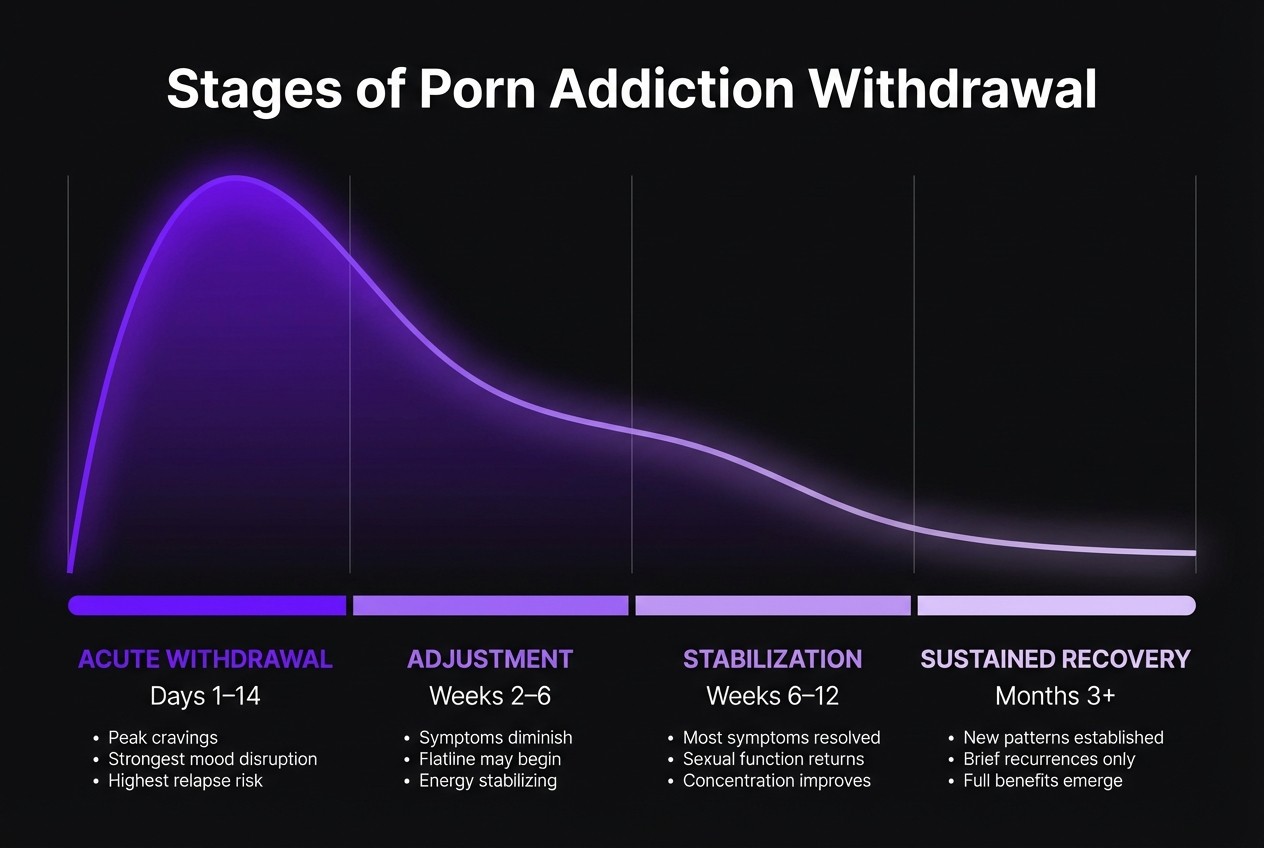
The average and approximate stages of quitting pornography according to behavioral psychology and community reports are the following.
Stage 1: Acute withdrawal (days 1–14). Symptoms are most intense. Cravings are strongest. Mood disruption is greatest. This is the highest-risk period for relapse.
Stage 2: Adjustment (weeks 2–6). Symptoms diminish in intensity. Flatline may begin. The brain is actively recalibrating dopamine sensitivity. Energy and mood begin to stabilize.
Stage 3: Stabilization (weeks 6–12). Most withdrawal symptoms have resolved. Emotional range improves. Sexual response begins returning to real-world cues. Concentration and motivation increase.
Stage 4: Sustained recovery (months 3+). Recovery is well-established. Intermittent symptom recurrences may still occur but are brief and manageable. The individual establishes new behavioral patterns and coping mechanisms.
Why Is Quitting Porn So Hard?
Quitting porn is hard because compulsive pornography use produces neurological changes in the dopamine reward system, stress response pathways, and prefrontal cortex that create physical dependence and impaired impulse control.
Compulsive use overstimulates the mesolimbic dopamine pathway, causing desensitization. Love et al. (2015) in Behavioral Sciences documented this pattern of tolerance and sensitization. Removing pornography causes the brain to operate with diminished reward sensitivity, which produces the withdrawal symptoms described above.
The brain also becomes sensitized to pornography-related cues. Environmental triggers such as devices, times of day, and emotional states produce powerful urges that override conscious intent to stop.
Reduced connectivity between the striatum and prefrontal cortex impairs impulse control. Pornography may also exploit novelty-seeking similar to the Coolidge effect demonstrated by Fiorino et al. (1997) in animal models. Banca et al. (2016) at the University of Cambridge found novelty-seeking and habituation patterns in compulsive sexual behavior.
These factors explain why willpower alone is often insufficient. The effects of pornography addiction on brain function drive the difficulty of quitting.
Can Your Brain Heal From Porn Addiction?
Yes, your brain can heal from porn addiction.
The brain's neuroplasticity supports gradual recovery from changes associated with compulsive pornography use during sustained abstinence. Kühn and Gallinat (2014) at the Max Planck Institute published evidence in JAMA Psychiatry showing structural and functional differences in heavy users. Neuroplastic mechanisms suggest these differences may improve over time, though longitudinal studies have not yet confirmed this directly.
The reward system is expected to recover sensitivity during abstinence based on substance addiction models. Baseline functioning and prefrontal regulation are theorized to improve. Accumulated DeltaFosB protein degrades during sustained abstinence. In substance addiction, D2 receptor recovery has been directly measured. Analogous recovery is theorized in behavioral addiction but not yet measured in pornography users.
Recovery communities use a 90-day benchmark. Withdrawal symptoms are themselves evidence of neuroplastic change. For more on how pornography affects the brain and its capacity for recovery, see our dedicated article.
How Do You Manage Porn Addiction Withdrawal Symptoms?
You manage porn addiction withdrawal symptoms by combining professional support, structured daily routines, physical exercise, and environmental changes that reduce exposure to triggers.
Strategies for managing porn addiction withdrawal symptoms include the following.
Professional therapy. Cognitive-behavioral therapy (CBT) and acceptance and commitment therapy (ACT) are evidence-based strategies for managing cravings.
Physical exercise. Regular exercise enhances dopaminergic signaling capacity and serotonergic receptor sensitivity. This can significantly reduce the severity of withdrawal symptoms and improving mood.
Environmental controls. Removing or restricting access to devices, installing content filters, and changing routines associated with previous use reduces cue-triggered cravings.
Social connection. Replacing isolation with social engagement counteracts the withdrawal-driven urge to withdraw. Support groups and accountability partners provide structure.
Digital recovery tools. Structured recovery programs like QUITTR provide daily support, progress tracking, and evidence-based exercises between therapy sessions.
What Are the Signs of Porn Addiction?
The signs of porn addiction include inability to stop or cut back, escalation to more extreme content, using pornography as a coping mechanism, hiding and lying about use, shame and guilt, mood changes, and neglecting responsibilities.
Many individuals do not realize their use is compulsive until they stop and experience withdrawal. The presence of withdrawal symptoms is itself a sign of addiction. For a comprehensive guide, see signs of pornography addiction.
What Are the Effects of Porn Addiction?
The effects of porn addiction include measurable changes to brain structure and chemistry, mental health deterioration, relationship damage, and sexual dysfunction.
The neurological effects of pornography addiction include reward system desensitization, altered prefrontal connectivity, and heightened cue-reactivity. These mechanisms produce withdrawal symptoms when use stops. Understanding the effects helps contextualize why withdrawal occurs and why recovery is possible.
For a comprehensive guide to the documented effects of pornography addiction, see effects of pornography addiction.
How Do You Treat Porn Addiction?
You treat porn addiction through professional therapy specializing in compulsive sexual behavior, structured recovery programs, and evidence-based behavioral interventions.
Cognitive-behavioral therapy (CBT) and acceptance and commitment therapy (ACT) are the most evidence-based approaches for treating compulsive pornography use. Professional treatment addresses both the addiction itself and the management of withdrawal symptoms, improving outcomes compared to unassisted cessation.
How Does the QUITTR App Help With Porn Addiction Withdrawal?
The QUITTR app helps with porn addiction withdrawal by providing daily structured support, withdrawal symptom tracking, evidence-based exercises, and professional guidance throughout the withdrawal and recovery process.
QUITTR tracks withdrawal symptoms day by day, giving users visibility into their progress through the acute phase and beyond. The app provides CBT and ACT-based exercises targeting cravings, mood instability, anxiety, and urges with in-the-moment coping tools. Daily check-ins reinforce the timeline framework covered in this article, helping users understand that withdrawal is temporary. QUITTR bridges the gap between therapy sessions during the high-risk early withdrawal period when cravings are strongest and relapse risk is highest.

Ready to finally quit porn?
Start your journey with our porn addiction recovery app and become the best version of yourself. The benefits feel great, trust us - The QUITTR Team