
Habit Tracking: How to Track Habits, Build Streaks, and Stay Consistent
Habit tracking is the practice of recording whether a habit was performed each day, using a simple visual cue — a tick, an X, or a filled box — to make consistency measurable. The practice externalizes habit performance into a visible record on a calendar, chart, app dashboard, or journal entry, so the question "did I do it today?" becomes a one-second data point rather than a memory exercise.
The modern habit tracker template — a calendar grid where each completed day gets marked — was popularized by James Clear in Atomic Habits (Avery, 2018) and earlier by the "don't break the chain" productivity heuristic popularly associated with Jerry Seinfeld.
Habit tracking provides three functions in one tool: a memory aid that proves a habit was performed, a motivational lever in which the visible streak triggers a desire to maintain it, and a feedback loop in which gaps in the record reveal which habits are not actually sticking.
This article covers what habit tracking is, how it works, the benefits, how to track habits, the types of habit trackers, how long it takes to build a habit, streak tracking, how habit tracking applies to porn addiction recovery, and the most common mistakes.
What Is Habit Tracking?
Habit tracking is a behavior-change practice in which a person records the daily completion of a target habit on a calendar, chart, app, or journal so that consistency over time becomes visually measurable.
Habit tracking, also called habit logging, habit monitoring converts the abstract question "am I sticking to this?" into a concrete data record. The instrument used to perform the tracking is called a habit tracker, habit log, habit journal, or habit chart, depending on its format. Each completed day is marked with a tick, an X, a dot, a filled square, or an app check-in, which builds a visible chain of evidence that makes performance and gaps in performance impossible to ignore.
The calendar-grid template was popularized by James Clear in Atomic Habits (2018), but the format predates the book by decades. The "don't break the chain" method popularly associated with Jerry Seinfeld is the well-known precursor, and Ryder Carroll embedded habit tracking inside the analog bullet-journal system in The Bullet Journal Method (Portfolio, 2018).
How Does Habit Tracking Work?
Habit tracking works by exploiting four reinforcing mechanisms — the Hawthorne effect, operant conditioning, the cue-routine-reward habit loop, and identity reinforcement — that together convert a daily behavior into a self-sustaining pattern. The practice operates on the brain's reward system rather than on willpower. The visible record of completed days produces measurable engagement signals (visual progress, anticipatory satisfaction, aversion to breaking a streak) that make the next repetition cheaper than the previous one.
Each of the four mechanisms is explained below.
The Hawthorne effect. Named by Henry Landsberger after analyzing the Western Electric Hawthorne Works studies (1924–1932) conducted by Elton Mayo and colleagues, the Hawthorne effect describes how awareness of being observed changes the behavior being measured. A 2011 systematic review by Burke and colleagues in the Journal of the American Dietetic Association reviewed 22 studies and found a consistent positive association between self-monitoring of weight, food intake, and exercise and successful behavior change. Habit tracking is a self-administered application of the same principle.
Operant conditioning via visible reinforcement. B.F. Skinner's framework for behavior shaping (Skinner, The Behavior of Organisms, 1938) demonstrated that behaviors followed by reinforcement increase in frequency. The visible streak of ticked boxes functions as a self-administered reinforcement schedule, in which each daily mark is a small, immediate reward that strengthens the cue-action link. The "don't break the chain" rule turns this into a loss-aversion lever — the longer the chain, the more aversive a missed day becomes.
The cue-routine-reward habit loop. Charles Duhigg's The Power of Habit (Random House, 2012) popularized the cue-routine-reward framework, and habit tracking embeds itself directly inside that loop. The tracker becomes the cue (the empty box prompts the action), the routine is the habit itself, and the reward is the visible mark — a one-second satisfaction signal that arrives faster than any downstream benefit of the habit. Habit tracking pairs naturally with habit stacking, which engineers a reliable cue by attaching the new habit to an existing routine.
Identity reinforcement. Each marked day is a small piece of evidence for an identity claim, such as "I am the kind of person who reads daily" or "I am the kind of person who stays porn-free." James Clear, in Atomic Habits (2018), framed this as casting a vote for your identity. This is the mechanism behind identity-based habits. The tracker accumulates votes that gradually reshape self-perception, which in turn lowers the cost of future repetitions.
What Are the Benefits of Habit Tracking?
The seven benefits of habit tracking are increased consistency, faster habit automaticity, reduced reliance on willpower, improved self-awareness, immediate motivational reward, accountability through evidence, and stronger relapse resistance. Each benefit is explained below.
Increased consistency. Tracking a habit makes it harder to skip without noticing. The 2011 Burke et al. systematic review in the Journal of the American Dietetic Association reviewed 22 studies and found a consistent positive association between self-monitoring and weight-management outcomes. The same effect applies to any habit measurable in a daily yes-or-no format.
Faster habit automaticity. Phillippa Lally and colleagues at University College London (Lally et al., European Journal of Social Psychology, 2010) reported that automaticity grew most reliably when participants performed the habit consistently in a stable daily context. A tracker surfaces the repetition pattern and makes the consistency rate visible.
Reduced reliance on willpower. A visible cue — the empty box for today — prompts the action without requiring the person to remember it or argue themselves into it. The tracker offloads decision-making and memory onto the instrument.
Improved self-awareness. Gaps in the record reveal patterns invisible to memory. The data exposes when a habit consistently fails — on Mondays, after late nights, or after specific emotional triggers — and shows the actual context of failure rather than the imagined one.
Immediate motivational reward. The mark itself is a small dopamine reward that arrives in seconds, whereas the downstream benefit of the habit (fitness, sobriety, savings) takes weeks or months. Habit tracking shortens the reinforcement delay.
Accountability through evidence. A 30-day record cannot be retroactively rationalized. The streak — or its absence — is observable to a partner, coach, sponsor, or accountability group, and converts vague self-reporting into auditable data.
Stronger relapse resistance. For recovery-oriented goals such as sobriety, porn-free streaks, or abstinence from a compulsive behavior, the visible day count produces loss aversion that protects against impulsive relapse. Breaking a 47-day streak feels different from breaking a 2-day streak, and the tracker quantifies the difference.
How to Track Habits
To track a habit, choose one specific behavior to track, pick a recording format, define what counts as a successful day, mark each completion immediately after performing the habit, and review the record weekly. Habit tracking has a low setup cost — the entire system can be running within five minutes — but a few decisions made at the start determine whether the tracker actually works or quietly gets abandoned.
Tracking a habit involves five steps: defining the habit precisely, choosing a recording format, setting the success criterion, marking each completion immediately, and reviewing the record weekly. These steps are explained below.
Step 1: Define the habit precisely. Use a binary, daily question — "did I do X today, yes or no?" Vague targets ("exercise more," "be productive") cannot be tracked because their completion criterion is unclear. Specific targets ("walked 10 minutes," "wrote 200 words," "did not view pornography") collapse to a clean yes-or-no answer that can be marked in two seconds.
Step 2: Choose a recording format. Match the format to where the decision happens. A paper calendar by the bedside works for evening review. An app on the phone works for habits triggered throughout the day. A bullet journal works for people who already maintain an analog journal. The five common formats are described in the next section.
Step 3: Set the success criterion. Decide what counts as a successful day before you start. A successful day for "meditation" might be 5 or more minutes; for "reading" it might be 10 pages; for "porn-free" it is binary by definition. Pre-defined criteria prevent the post-hoc bargaining ("does 30 seconds of meditation count?") that erodes the integrity of the record.
Step 4: Mark each completion immediately. The mark must follow the action by minutes, not hours. Marking immediately closes the cue-routine-reward loop before the brain forgets the connection. Backfilling at the end of the week defeats the immediate-reward mechanism and turns the tracker into a chore.
Step 5: Review the record weekly. Once a week, scan the previous seven days for two patterns: which days were missed, and what circumstances surrounded those misses. The weekly review converts the tracker from a record-keeping tool into a feedback instrument that drives behavior change.
What Are the Types of Habit Trackers?
The types of habit trackers fall into five common formats based on the medium and use case: habit tracker apps, habit tracker printables, bullet journal habit trackers, habit tracker journals, and habit tracking spreadsheets. The best format is the one the person will actually use daily. Paper formats win on simplicity and visibility, apps win on portability and reminders, journals win on integration with reflection, and spreadsheets win on customization and data analysis.
Habit Tracker Apps
Habit tracker apps are mobile or web applications that record daily habit completion, send reminders, and visualize streaks on a phone screen. App trackers add three things that paper cannot — push notifications, automatic streak counting, and cloud sync across devices. Most general-purpose apps share a similar core feature set: a calendar grid, a daily check-in, a streak counter, and a statistics view.
Habit tracker apps fall into four broad categories: general productivity trackers, fitness and health-specific trackers, recovery-and-sobriety trackers (such as nofap trackers and sobriety counters), and gamified trackers that turn habits into points or character growth. For a detailed comparison of recovery-specific tracker apps, see nofap tracker apps.
What Is a Habit Tracker Printable?
A habit tracker printable is a downloadable PDF, chart, or paper template that records habit completion in pen, kept in a visible location such as a fridge, desk, or bedside table. Habit tracker printables win on three dimensions. They are always visible (a fridge calendar cannot be silenced or deleted), they require no battery, and the physical act of marking on paper provides stronger somatic reinforcement than tapping a screen.
The four common printable formats are listed below.
Daily habit tracker. A single-day grid for tracking many habits at once, useful for people building several habits in parallel.
Weekly habit tracker. A 7-day-by-N-habits grid, the most common bullet-journal layout.
Monthly habit tracker. A 30 or 31-day grid for tracking 1 to 5 habits across a full month, optimal for streak visibility.
Quarterly or annual habit tracker chart. Used for low-frequency habits or year-long streaks, in which 1 year equals 365 boxes — the popular "365-box" variant of Seinfeld's chain.
Bullet Journal Habit Tracking
Bullet journal habit tracking is the analog method of recording habits inside the bullet journal system, typically using a monthly grid spread with one row per habit and one column per day. The bullet journal habit tracker, codified by Ryder Carroll in The Bullet Journal Method (Portfolio, 2018), integrates habit tracking with the broader bullet-journal "rapid logging" system of daily logs, monthly migration, and reflection prompts.
The bullet journal habit tracker is preferred by people who already maintain an analog journal because the habit data sits next to reflection notes, mood logs, and weekly reviews. The proximity makes the weekly review step (Step 5 in How to Track Habits) effectively automatic.
Habit Tracker Journals
Habit tracker journals are pre-printed notebooks designed specifically for habit tracking, usually combining a calendar grid with prompts for habit definition, daily reflection, and weekly review. Common features include a year of dated grids, prompts for setting habit definitions and success criteria, monthly reflection pages, and habit-stacking templates. James Clear's Clear Habit Journal is one widely-cited example, and similar journals are sold by analog-productivity publishers. Habit tracker journals reduce setup friction (no DIY layout required) and embed the weekly review step into the format itself.
What Is a Habit Tracking Spreadsheet?
A habit tracking spreadsheet is a customizable digital template — typically built in Google Sheets, Microsoft Excel, or Notion — that records habit completion in a grid and automatically calculates streaks, completion rates, and trends. Spreadsheets win on customization (any number of habits, any color scheme, any conditional formatting rule for streaks) and on analysis (a habit's completion rate can be plotted against day of week, time of month, or context tags). Common formulas include COUNTIF for total days completed, conditional formatting for streak coloring, and a running streak counter built with a chained IF statement on the previous day's value.
How Long Does It Take to Build a Habit?
Building a habit takes a median of 66 days, with an actual range of 18 to 254 days depending on the behavior, the person, and the consistency of repetition. This finding comes from Phillippa Lally and colleagues at University College London (Lally et al., "How are habits formed: Modelling habit formation in the real world," European Journal of Social Psychology, 2010), which followed 96 participants attempting to build a daily eating, drinking, or exercise habit over 84 days.
Simpler habits (drinking a glass of water after breakfast) reached automaticity faster than complex ones (50 sit-ups before breakfast). Missing a day occasionally did not derail habit formation in Lally's data, although a pattern of repeated missed days slowed the process.
What Is Streak Tracking?
Streak tracking is a form of habit tracking that emphasizes consecutive-day completion, in which the unbroken chain of successful days — the streak — is the primary metric rather than the total number of completions. Standard habit tracking measures completion rate (60% of days, 80% of days, 100% of days). Streak tracking measures the longest unbroken run of consecutive completions and treats a single missed day as a reset. Streak tracking trades flexibility for loss aversion: the longer the streak, the more aversive a relapse becomes.
The four canonical streak-based domains are listed below.
Productivity streaks. Jerry Seinfeld's "don't break the chain" applied to writing, exercise, or any daily creative practice.
Learning streaks. Language apps such as Duolingo built their core engagement loop around streak tracking, in which the streak counter is the product's primary motivational lever.
Sobriety streaks. Alcohol, nicotine, or substance-use abstinence, in which each consecutive day is a recovery milestone. 12-step programs use chips at milestones including 24 hours, 30 days, 60 days, 90 days, 6 months, 9 months, and 1 year.
Porn-free streaks (NoFap streaks). The consecutive-day count of abstinence from pornography and compulsive sexual behavior, tracked using a sobriety counter or a dedicated nofap tracker.
A streak counter activates loss aversion, the asymmetric psychological response first formalized by Daniel Kahneman and Amos Tversky in prospect theory (Kahneman and Tversky, Econometrica, 1979). The pain of breaking a 47-day streak is larger than the pleasure of extending it to 48. Standard completion-rate tracking lacks this asymmetry, which is why streak tracking is the dominant format for recovery and abstinence applications. For recovery-context applications — including porn addiction recovery, sobriety, and abstinence — the streak tracker is paired with additional logs (urge log, trigger log, relapse journal) that record the context around the streak. The next section covers how habit tracking applies specifically to porn addiction recovery.
How to Use Habit Tracking for Porn Addiction Recovery
Habit tracking applies to porn addiction recovery in three forms — a sobriety streak counter that records consecutive porn-free days, a relapse log that records each instance of relapse with its context, and an urge-and-trigger log that records cravings and the situations that produced them. Recovery from compulsive sexual behavior — classified by the World Health Organization in the ICD-11 as compulsive sexual behaviour disorder — benefits from the same self-monitoring effects shown in addiction-recovery research more broadly.
The National Institute on Drug Abuse (NIDA) reports that 40% to 60% of individuals recovering from substance addiction experience relapse, and structured self-monitoring is one of the recommended relapse-prevention strategies in evidence-based protocols such as cognitive-behavioral therapy. The same self-monitoring logic applies to pornography addiction recovery, where the daily tracker becomes the data source for both the streak and the patterns that protect it.
How Do You Track a Porn-Free Streak?
You track a porn-free streak by counting each consecutive day of abstinence from pornography use, marking the day on a sobriety counter, calendar, or dedicated nofap tracker app, and resetting the count to zero after a relapse. The porn-free streak operates like any other streak tracker. Each day of abstinence is marked, the counter increments by one, and a relapse resets the count to zero. The reset is the key motivational lever, and loss aversion at high streak counts produces real, measurable resistance to impulsive relapse.
Streak tracking fits porn addiction recovery for three reasons. Pornography use is binary by definition (the day either includes a porn-viewing or PMO event, or it does not). The cue-trigger structure is highly contextual (specific times, environments, and emotional states). And the relapse-prevention literature consistently identifies self-monitoring as a protective factor against impulsive relapse.
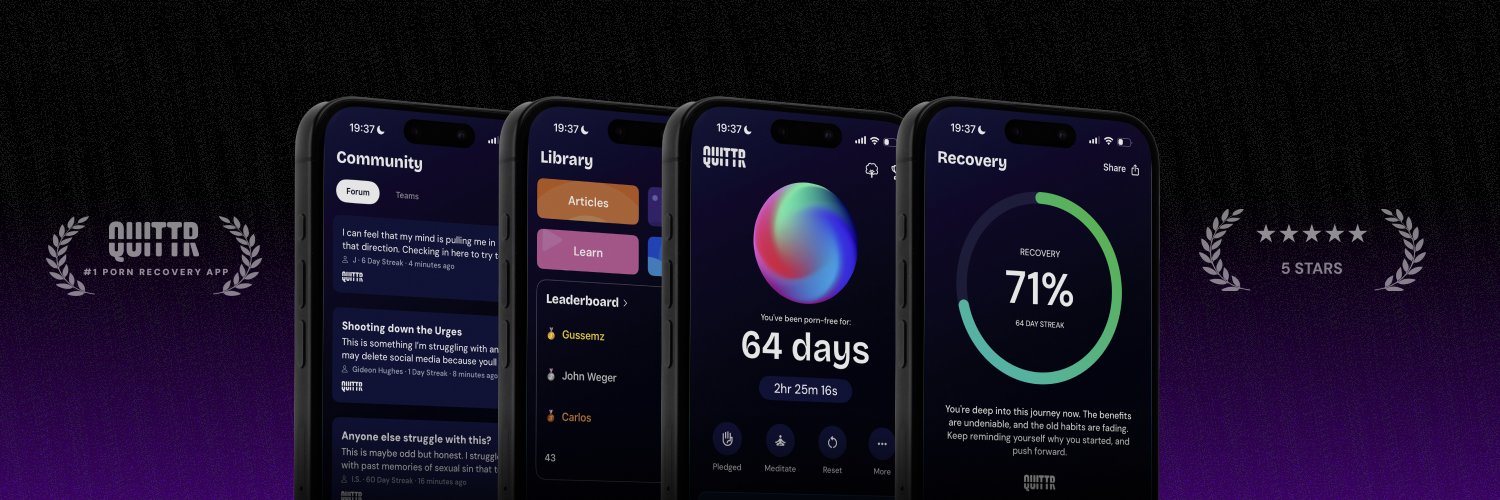
A porn-free streak can be tracked on paper, in a spreadsheet, or in a dedicated app. The QUITTR app combines a sobriety counter with an urge log, a community streak feed, and content-blocking, which co-locates the streak with the relapse-prevention tools that protect it. For a comparison of recovery-specific tracker apps, see nofap tracker apps.
How Do You Track Triggers, Urges, and Relapses?
You track triggers, urges, and relapses by logging each craving, the situation that produced it, and the response — in a separate log from the binary streak counter, but reviewed together with it. A streak counter records whether a relapse occurred. A trigger log records why and when urges occur, including urges that did not lead to relapse. The trigger log is the data source for understanding the recovery process; the streak is the outcome variable.
What Are the Most Common Habit Tracking Mistakes?
The six most common habit tracking mistakes are tracking too many habits at once, defining the habit too vaguely, tracking outcomes instead of actions, marking days retroactively, abandoning the tracker after a missed day, and using a tracker that is harder to update than the habit is to perform. Each mistake is explained below.
Tracking too many habits at once. A 12-row habit grid signals ambition but produces a tracker that is harder to maintain than the habits themselves. Start with 1 to 3 habits. Add habits one at a time, only after the previous one has run for at least 30 consecutive days.
Defining the habit too vaguely. "Be healthier" cannot be tracked. The habit must be answerable in a daily yes-or-no format with no room for interpretation. Replace abstract goals with specific actions such as "walked 10 minutes," "drank 2 liters of water," or "did not view pornography."
Tracking outcomes instead of actions. Outcomes (lost 1 pound, increased focus, felt happier) are downstream variables that the person does not directly control on a daily basis. Tracked habits must be actions the person can choose to perform; the outcomes follow.
Marking days retroactively. Backfilling the tracker at the end of the week defeats the immediate-reward mechanism and converts the tracker from a behavior-change tool into a record-keeping chore. The mark must follow the action by minutes.
Abandoning the tracker after a missed day. A single missed day extends the timeline to automaticity slightly; abandoning the tracker after the miss extends it to never. Lally et al. (2010) found that occasional missed days did not derail habit formation, so the tracker should resume immediately.
Using a tracker that is harder to update than the habit is to perform. A 5-tab spreadsheet with conditional formatting takes longer to update than the meditation it tracks. The marking action must take fewer than 5 seconds. If the tracker has more friction than the habit, the tracker is the bottleneck and should be simplified.