
Is Pornography Addictive?
QUITTR is the #1 porn quitting app in the world. Join 1,000,000+ others on a mission to be the best person they can be.
Last Edited
Yes, pornography is addictive. Pornography addiction develops because pornography activates the brain's dopamine reward system through supernormal sexual stimulation, producing neurochemical responses that create tolerance, sensitization, and compulsive seeking behavior. The World Health Organization recognized this condition by including compulsive sexual behaviour disorder (CSBD) in the ICD-11 in 2019. CSBD encompasses compulsive pornography use as its most commonly reported manifestation.
Not all researchers use the term "addiction" to describe compulsive pornography use. The Diagnostic and Statistical Manual of Mental Disorders (DSM-5) does not include pornography addiction as a diagnosable condition. However, multiple neuroimaging studies have documented brain changes in compulsive pornography users that parallel those observed in substance addicts, including reduced gray matter volume and heightened cue-reactivity in reward circuits.
This article explains why pornography is addictive, whether pornography addiction is a scientifically recognized condition, how addictive pornography is compared to other behavioral addictions, and when pornography use crosses the threshold into addiction.
Table Of Contents
Why Is Pornography Addictive?
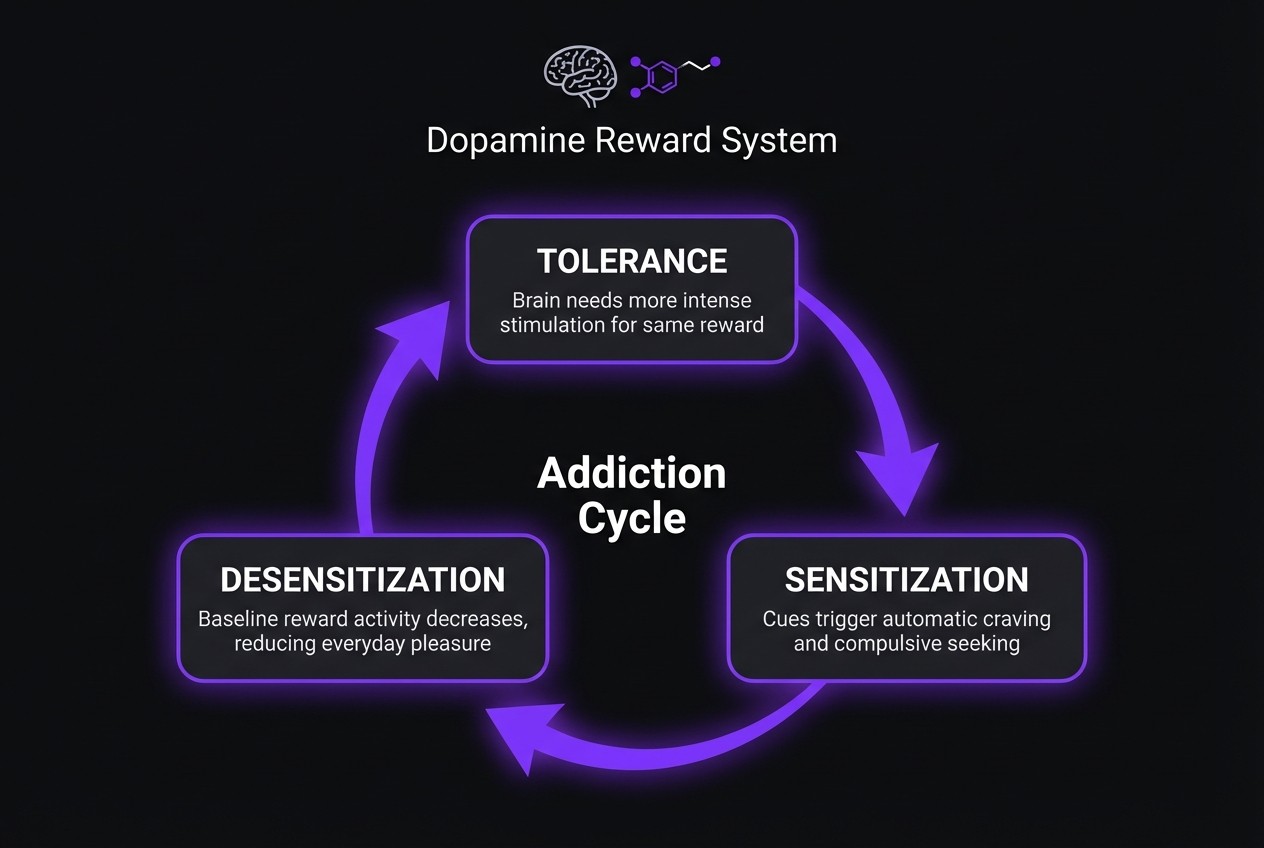
Pornography is addictive because it activates the brain's dopamine reward system through supernormal stimulation, producing neurochemical responses that create tolerance, sensitization, and compulsive seeking behavior.
Novel sexual stimuli trigger dopamine activity in the nucleus accumbens. Dopamine is the neurotransmitter responsible for reward, motivation, and reinforcement learning. Internet pornography provides an endless supply of novel sexual partners and scenarios. This novelty triggers the Coolidge effect, a biological phenomenon in which sexual arousal renews with each new potential mate. The Coolidge effect allows pornography users to sustain elevated dopamine levels far beyond what a single sexual encounter produces.
The brain adapts to this repeated overstimulation through three mechanisms. Tolerance develops as the reward system becomes less responsive to the same level of stimulation, requiring more intense or novel content to produce the same reward response. Sensitization creates conditioned neural pathways that link pornography-related cues to craving, triggering compulsive seeking behavior in response to environmental triggers such as being alone with a device. Desensitization is theorized to reduce baseline reward system activity, which may contribute to low motivation and diminished pleasure from everyday activities outside of pornography use.
Internet pornography is uniquely potent because of what Dr. Al Cooper of the San Jose Marital and Sexuality Centre described as the Triple-A Engine. The Triple-A Engine identifies three factors that drive compulsive internet pornography use: accessibility through any connected device at any time, affordability because most content is free, and anonymity that removes social barriers to consumption.
Todd Love and colleagues documented these tolerance and sensitization mechanisms in a 2015 review published in Behavioral Sciences. The review described how internet pornography produces addiction-related brain changes through the same neuroplasticity processes observed in substance addictions.
Is Pornography a Drug?
Pornography is not a drug. Pornography is a behavioral stimulus, not a chemical substance. However, pornography produces neurochemical responses in the same reward circuits that addictive drugs activate. Addictive drugs such as cocaine and heroin introduce external chemicals into the mesolimbic dopamine pathway. Pornography triggers the brain's own dopamine system to overproduce dopamine without an external substance.
The American Society of Addiction Medicine (ASAM) defines addiction as a chronic brain disorder involving reward, motivation, and memory circuitry. This definition encompasses both substance and behavioral patterns. The mechanism of compulsive behavior, not the presence of a substance, defines addiction.
Is Porn Addiction Real?
Yes, porn addiction is real. The World Health Organization included compulsive sexual behaviour disorder (CSBD) in the ICD-11 in 2019. CSBD encompasses compulsive pornography use as a recognized diagnostic category.
Neuroscience research provides three lines of evidence supporting the reality of pornography addiction. Dr. Valerie Voon at the University of Cambridge found in 2014 that compulsive pornography users showed heightened cue-reactivity in the ventral striatum. This is the same neural activation pattern observed in drug addicts exposed to drug cues. Dr. Simone Kühn at the Max Planck Institute for Human Development and Dr. Jürgen Gallinat at Charité University Medicine in Berlin found in a 2014 study published in JAMA Psychiatry that higher pornography use was associated with reduced gray matter volume in the caudate nucleus and reduced functional connectivity between the right caudate and left dorsolateral prefrontal cortex. Todd Love and colleagues documented tolerance, sensitization, and withdrawal patterns in compulsive pornography users that parallel substance addiction in a 2015 review published in Behavioral Sciences.
The American Society of Addiction Medicine (ASAM) defines addiction as a chronic brain disorder involving reward, motivation, and memory circuitry. This definition includes behavioral addictions. The neuroimaging evidence demonstrates that compulsive pornography use meets this definition.
Despite this evidence, pornography addiction is not universally accepted as a clinical diagnosis.
Why Do Some Experts Say Porn Addiction Isn't Real?
Some experts say porn addiction isn't real because the condition is not included as a diagnosable addiction in the DSM-5. The American Psychiatric Association determined in 2013 that there was insufficient evidence to include "hypersexual disorder" in the DSM-5. This represents a different evidentiary threshold than the World Health Organization applied when classifying CSBD in the ICD-11.
The disagreement is partly terminological. Dr. Eli Coleman at the University of Minnesota argues that "compulsive sexual behavior" is more accurate than "addiction." Some researchers maintain that "compulsive" or "dysregulated" better describes the behavior pattern than the addiction framework.
Dr. Joshua Grubbs at Bowling Green State University found that perceived pornography addiction correlates strongly with moral disapproval of pornography. This moral incongruence theory suggests that some individuals who self-identify as addicted are experiencing moral conflict rather than neurobiological dependence.
The counter-evidence is substantial. The ICD-11 did classify the condition. Multiple neuroimaging studies document brain changes in compulsive pornography users that parallel substance addiction. The neurobiological evidence for compulsive, harmful pornography use patterns is well-established regardless of the diagnostic label applied.
How Addictive Is Pornography?
Internet pornography is one of the most potent behavioral addictions because it combines supernormal sexual stimulation with unlimited novelty and zero barriers to access.
Pornography activates mesolimbic reward circuits that overlap with those engaged by addictive drugs such as cocaine and heroin. Sexual reward is one of the brain's most powerful natural reinforcement signals because it is tied to the evolutionary drive for reproduction. The Coolidge effect ensures that each new pornographic image or video triggers a fresh dopamine response. Unlike addictive drugs where the same substance is consumed repeatedly, pornography constantly provides new stimuli that renew the reward signal.
The Triple-A Engine described by Dr. Al Cooper makes internet pornography uniquely accessible compared to other addictive behaviors. Pornography is available on any connected device at any time, most content is free, and consumption is private. These three factors remove the social and financial barriers that limit other addictive behaviors such as gambling or substance use.
Not all pornography use leads to addiction. Individual vulnerability varies based on neurobiology, psychological factors, age of first exposure, and environmental context.
When Does Pornography Use Become an Addiction?
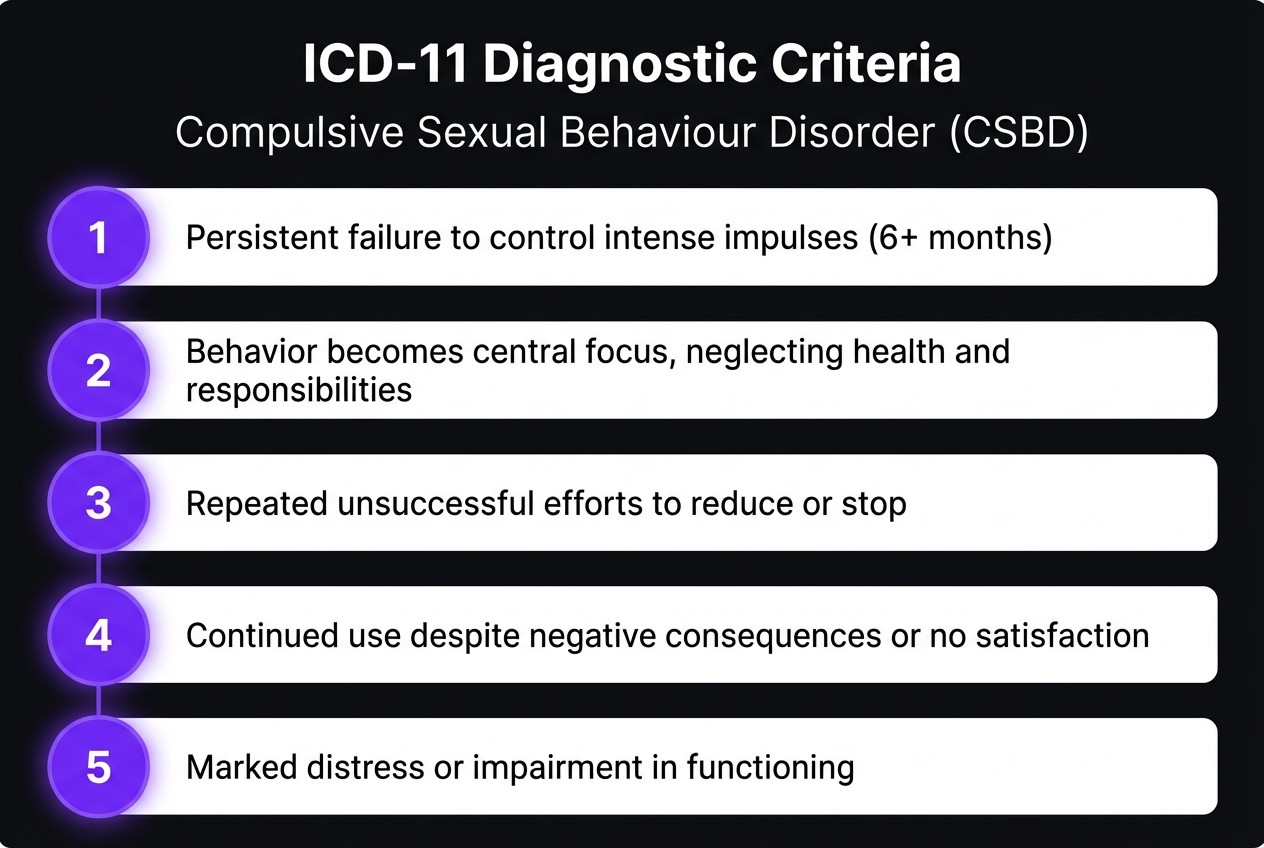
Pornography use becomes an addiction when the individual loses control over consumption despite experiencing negative consequences.
The defining factor is not the frequency or duration of pornography use. A person who watches pornography daily is not necessarily addicted. The line between regular use and addiction is crossed when the behavior becomes compulsive and causes harm to the individual's relationships, work, mental health, or daily functioning.
The ICD-11 criteria for compulsive sexual behaviour disorder (CSBD) specify five diagnostic features. The individual must show a persistent pattern of failure to control intense sexual impulses or urges over an extended period of time, such as six months or more. The repetitive sexual behavior must become a central focus of the person's life to the point of neglecting health, personal care, responsibilities, or other interests. The individual must have made repeated unsuccessful efforts to reduce or stop the behavior. The behavior must continue despite adverse consequences or the individual deriving little or no satisfaction from it. The pattern must cause marked distress or significant impairment in personal, family, social, educational, or occupational functioning.
Regular pornography use that does not cause distress, impairment, or loss of control does not meet the clinical threshold for addiction. The distinction between use and addiction is whether the behavior has become compulsive and is producing harm that the individual cannot stop despite wanting to.
Is Watching Porn Every Day an Addiction?
Watching porn every day is not necessarily an addiction. Frequency alone does not define addiction. The defining factors are loss of control over the behavior, negative consequences to relationships or daily functioning, repeated failed attempts to stop, and continued use despite harm. Daily pornography use that causes no distress or impairment in functioning does not meet the ICD-11 criteria for compulsive sexual behaviour disorder.
How Do You Know If You Are Addicted to Pornography?
The key indicators that you are addicted to pornography include inability to stop despite repeated attempts, escalation to more extreme content, neglect of responsibilities and relationships, use of pornography as an emotional coping mechanism, and distress when access is restricted.
Inability to stop means making genuine efforts to quit that consistently fail. Escalation means needing more novel or extreme content to achieve the same level of arousal. Neglect means pornography use takes priority over work and personal relationships. Emotional coping means using pornography to manage stress, anxiety, or loneliness rather than for sexual interest. Distress when access is restricted means experiencing anxiety or irritability when pornography is unavailable.
For a complete guide to pornography addiction signs and self-assessment, see signs of pornography addiction.
What Does Pornography Addiction Do to the Brain?
Pornography addiction changes the brain's structure, chemistry, and functional connectivity in ways that parallel substance use disorders.
Dr. Simone Kühn at the Max Planck Institute for Human Development and Dr. Jürgen Gallinat at Charité University Medicine in Berlin found reduced gray matter volume in the caudate nucleus of compulsive pornography users in a 2014 study published in JAMA Psychiatry. The same study documented weakened functional connectivity between the right caudate and the left dorsolateral prefrontal cortex, which is associated with impaired impulse control. Dr. Valerie Voon at the University of Cambridge found in 2014 that compulsive pornography users showed heightened cue-reactivity in the ventral striatum, matching the neural response pattern of drug addicts exposed to drug cues.
For a comprehensive overview of how pornography changes the brain, see effects of pornography addiction.
How Common Is Porn Addiction?
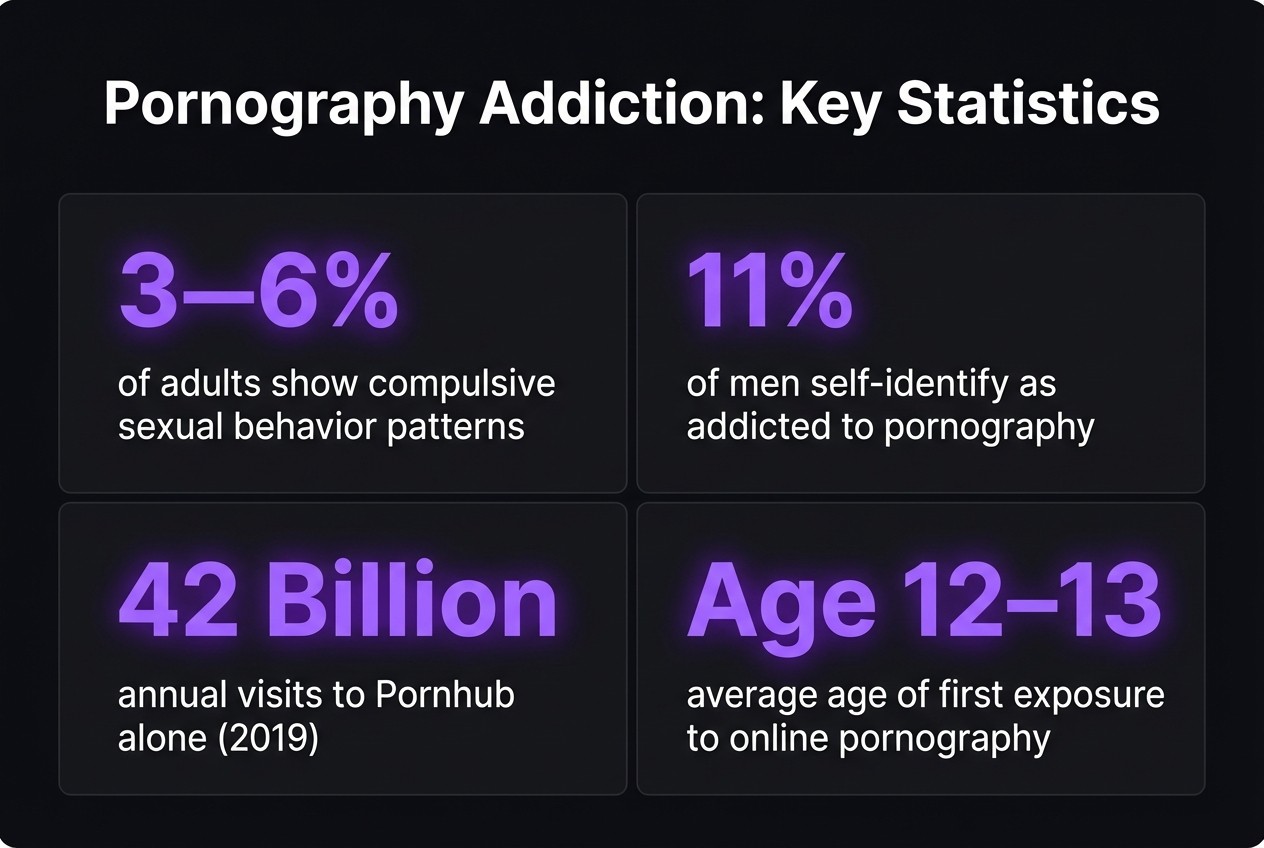
Pornography addiction affects an estimated 3% to 6% of the adult population.
A 2019 study by Dr. Joshua Grubbs at Bowling Green State University, published in the Journal of Behavioral Addictions, found that approximately 11% of men and 3% of women self-identify as addicted to pornography. An estimated 3% to 6% of the general adult population exhibits patterns of compulsive sexual behavior, with pornography use the most commonly reported behavior.
The scale of pornography consumption provides context for these prevalence figures. Pornhub's 2023 Year in Review reported over 42 billion total annual visits to its platform, averaging approximately 115 million daily visits. The average age of first exposure to online pornography is between 12 and 13 years old.
Pornography-related concerns account for the majority of individuals seeking treatment for compulsive sexual behavior in clinical settings, according to Dr. Shane W. Kraus at the University of Nevada, Las Vegas.
Is Masturbation to Pornography Addictive?
Masturbation to pornography can become addictive when it follows the same compulsive pattern as pornography addiction.
The reinforcement loop combines two reward signals. Pornography provides visual stimulation. Masturbation provides orgasm. The combined dopamine release reinforces both behaviors as a single reward circuit. The brain associates pornography and masturbation together, making the paired behavior more reinforcing than either alone. Pornography viewing and masturbation are the two most commonly reported behaviors in compulsive pornography use and frequently co-occur.
Masturbation itself is normal sexual behavior. The compulsive combination of pornography and masturbation creates the addictive cycle.
What Is the Difference Between Porn Addiction and Masturbation Addiction?
The difference between porn addiction and masturbation addiction is that porn addiction is driven by compulsive consumption of visual sexual content, while masturbation addiction involves compulsive self-stimulation regardless of pornography.
The two conditions often co-occur but are distinct. An individual can have pornography addiction without compulsive masturbation, as some users compulsively view content without physical stimulation. Compulsive masturbation can also occur without pornography. Both compulsive pornography use and compulsive masturbation can be behavioral expressions of compulsive sexual behaviour disorder (CSBD) in the ICD-11.
What Should You Do If You Are Addicted to Pornography?
You should seek professional help from a therapist specializing in compulsive sexual behavior if you believe you are addicted to pornography.
Cognitive-behavioral therapy (CBT) and acceptance and commitment therapy (ACT) have shown promise in treating compulsive pornography use, with preliminary clinical evidence supporting their effectiveness. Support communities such as Sex Addicts Anonymous (SAA), Sexaholics Anonymous (SA), and SMART Recovery provide structured group support.
Digital recovery tools including accountability apps, content blockers, and porn addiction recovery apps like QUITTR provide daily support between therapy sessions. Medical evaluation is important for identifying co-occurring conditions such as depression, anxiety, or ADHD that may require separate treatment.

Ready to finally quit porn?
Start your journey with our porn addiction recovery app and become the best version of yourself. The benefits feel great, trust us - The QUITTR Team