
Gooning Addiction: Signs and How to Stop


Gooning addiction is an informal name for losing control over gooning, the slang term for very long masturbation sessions, usually with porn, that deliberately put off orgasm. It isn't an official diagnosis. But when you can't cut back, it has gone on for months and it is costing you sleep, time, relationships or peace of mind, it can match the WHO's definition of compulsive sexual behavior disorder, and it can be treated.
This guide gives you a clinical, non-graphic definition, the warning signs that separate a habit from a problem, an honest look at what the research does and doesn't say, a 30-day plan to stop, and specific guidance if you're a teen or quitting for faith reasons.
What Is Gooning? A Neutral Definition
Merriam-Webster lists "gooning" as vulgar slang for masturbation, especially prolonged masturbation without orgasm in order to stay aroused. The dictionary dates its first known use to around 2005. The word spread far beyond porn forums in the 2020s, and today many teens and young adults first hear it as a TikTok or Gen Z joke.
Three features define it in practice:
Duration. Sessions are measured in hours rather than minutes.
Delay. Orgasm is put off on purpose, again and again.
Absorption. People who goon often describe a "zoned-out" or trance-like state. That's a self-description from online communities, not something researchers have measured.
Gooning overlaps with edging but isn't identical. Edging is the technique of stopping just before climax; gooning is a long, immersive session built around it, usually with porn on screen the whole time. We break down the differences in gooning vs edging, and our explainer on what gooning is covers the slang and its origins.
One honest point before going further: we found no peer-reviewed study on gooning itself. Everything below draws on research into compulsive sexual behavior and problematic porn use in general, which is where gooning fits clinically.
Is Gooning an Addiction? What the Diagnosis Actually Says

"Porn addiction" and "gooning addiction" are everyday phrases, not medical terms. The closest official diagnosis is compulsive sexual behavior disorder (CSBD), code 6C72 in the WHO's ICD-11. The DSM-5, used by many US clinicians, has no equivalent: the American Psychiatric Association considered a "hypersexual disorder" and decided not to include it.
According to the ICD-11 description published by Kraus and colleagues in World Psychiatry, CSBD is a persistent pattern of failing to control intense, repetitive sexual urges, resulting in repetitive sexual behavior. The pattern shows up in one or more ways:
Sexual activity becomes the central focus of life, to the point of neglecting health, self-care, interests or responsibilities.
Repeated efforts to significantly cut back have failed.
The behavior continues despite negative consequences.
The behavior continues even when it brings little or no satisfaction.
Two more conditions must be met. The pattern has to last an extended period, typically six months or more, and it has to cause marked distress or significant problems in your personal, family, social, school or work life.
The WHO placed CSBD among impulse-control disorders, not addictions, because it isn't yet clear whether the brain processes behind it match those of substance addictions.
How common is it?
The best US estimate comes from a 2018 JAMA Network Open survey of 2,325 adults aged 18 to 50, who completed a 13-item screening questionnaire.
8.6% — Adults screening positive for clinically relevant distress about controlling sexual urges
10.3% — Men screening positive
7.0% — Women screening positive
6 months — Typical minimum duration for a CSBD diagnosis
A screening score is not a diagnosis; it flags people who should be assessed further. Still, it tells you that struggling to control sexual behavior is far from rare.
What a diagnosis is not
The ICD-11 text is explicit about what doesn't count. A high sex drive without loss of control isn't a disorder. Masturbation that's common in adolescence isn't a disorder. And distress that comes entirely from moral judgment or disapproval of your sexual behavior isn't enough on its own. That last point matters a lot for religious readers, and we come back to it below.
Gooning Addiction Signs and Symptoms
The amount of time you spend isn't the whole story. A 2024 Sexual Medicine Reviews paper by an International Society for Sexual Medicine committee stresses that frequent porn use is not necessarily problematic by itself. What matters is impaired control and harm.
Use this checklist to look at your own pattern honestly.
Failed limits: You set a rule ("not on weeknights," "one hour max") and break it repeatedly
Sessions keep stretching: What started as an hour now regularly runs past midnight or eats a whole afternoon
Escalation: You need longer sessions or more extreme content to feel the same pull
Sleep loss: You go to bed hours later than planned and pay for it the next day
Missed responsibilities: Schoolwork, work, workouts or plans get skipped or rushed
Pulling away: You turn down time with friends or a partner to have the house to yourself
Little satisfaction: Sessions leave you feeling flat, numb or ashamed, but you return anyway
Using it to cope: It's your main way of handling stress, boredom, loneliness or a bad mood
Secrecy: You hide how much time it takes and feel anxious about being found out
Effects on partnered sex: Real-life intimacy feels less interesting, or arousal with a partner is harder
How to read your results. One or two signs now and then is a reason to pay attention. Several signs, steady for months, with real damage to sleep, work or relationships, is a reason to make a plan and consider talking to a professional. For a structured self-check, take our porn addiction quiz; like any screening tool, it can point you in a direction but can't diagnose you.
Why gooning is so hard to put down
Gooning is built differently from a quick porn session. Delaying orgasm removes the natural endpoint, so there's no built-in moment that says "done." Endless feeds and tabs supply constant novelty. And the absorbed, zoned-out state many people describe can feel like an escape from stress, which is exactly the kind of relief that turns a habit into a go-to coping tool.
That combination explains a common pattern: the session you planned to keep short becomes three hours, and you're not sure where the time went.
Ready to quit with a plan? Download QUITTR for iPhone or Android → · See how the app works
Is Gooning Bad for You? Effects on Sex, Sleep and Mood

"Is gooning bad?" is one of the most searched questions about it. The honest answer: gooning hasn't been studied directly, so claims about specific damage are guesses. What we can do is look at related evidence and at what gooning displaces.
Sexual function
The research on porn and erectile problems is mixed, and the details are useful.
A 2015 analysis of four large samples of younger men in Croatia, Norway and Portugal (Landripet & Štulhofer, Journal of Sexual Medicine) found little evidence that how often men watched porn was linked to sexual problems.
A 2021 international survey of 3,419 men aged 18 to 35 (Jacobs et al., JMIR Public Health and Surveillance) found that 21.5% of sexually active participants had some degree of erectile dysfunction. Higher scores for problematic porn use went with a higher chance of ED, while masturbation frequency did not seem to matter.
Put together, these suggest the risk sits with loss of control and the way you use porn, rather than with a number of sessions per week. Both studies are cross-sectional surveys, so they show links, not cause. If you notice erection problems, read our guide to porn-induced erectile dysfunction and see a doctor, because ED can also signal heart, hormone or medication issues.
Sleep, time and focus
This is where gooning's costs are most obvious. Sessions measured in hours, often late at night, come straight out of sleep and the next day's energy. Chronic short sleep affects mood, concentration and motivation on its own, regardless of what kept you up.
Mood, shame and the cycle
Many people describe feeling low, empty or ashamed after a long session, then returning to it to escape those same feelings. The ICD-11 description lists continuing despite little satisfaction as a sign of CSBD, and the 2024 review notes that shame and guilt are common. Shame tends to keep the cycle going rather than break it, which is why the plan below treats slips as information, not verdicts.
What about withdrawal?
People often fear that quitting will make them feel terrible. A 2023 randomized trial (Fernandez et al., Archives of Sexual Behavior) asked 176 regular porn users to abstain for seven days or carry on as usual. The abstaining group showed no measurable withdrawal symptoms overall. In exploratory analyses, craving did rise for people who had both high problematic use and daily use. The sample was mostly female students with fairly mild problems, so heavier users may find the first weeks harder. Plan for strong urges, not for collapse.
How to Stop Gooning: A 30-Day Plan
There's no gooning-specific treatment protocol, but the tools with the most support for compulsive sexual behavior are cognitive-behavioral: understanding your triggers, managing urges, building alternative coping skills and preventing relapse. The 2024 review lists those same components across the intervention studies it examined. Here is how to turn them into a month of action.
Before day 1: decide your goal
Be specific. "Stop gooning completely" is a different goal from "no porn at all" or "no masturbation at all," and people succeed more often when they know exactly where the line is. Write your line down, along with your top three reasons for drawing it.
The five core steps
Map your sessions. For one week, note when a session started, where you were, what you felt beforehand (bored, stressed, lonely, tired) and how long it lasted. Most people find two or three repeating windows, such as late night in bed, a free afternoon, or right after a stressful day.
Add friction to those windows. Charge your phone outside the bedroom. Install a content blocker on every device you use. Keep laptops in shared rooms. Each barrier buys you the few seconds you need to choose differently.
Kill the "just a quick look" opener. Gooning almost always starts with something small: a feed, a suggestive account, a search. Unfollow and mute the accounts that reliably pull you in, and treat the first click as the real decision point.
Learn to ride out urges. Urges rise, peak and fall. Our step-by-step guide to urge surfing gives you a script for staying with the feeling until it passes without acting on it.
Replace what gooning was doing for you. If it was stress relief, you need another form of stress relief. If it was filling empty evenings, you need a plan for those evenings: the gym, a call with a friend, a game with other people, a book, a walk.
Your first 30 days
1
Focus: Awareness
Do this: Log every urge and session; set up blockers; phone out of the bedroom
Watch for: The times and moods that keep showing up
2
Focus: Friction
Do this: Write three if-then plans for your top windows ("If I'm in bed with my phone after 11 p.m., then I put it on the dresser and sit up")
Watch for: Loopholes, like new apps or browsers
3
Focus: Replacement
Do this: Fill your riskiest windows with a planned activity, ideally with other people
Watch for: Boredom and loneliness, which are urge fuel
4
Focus: Review
Do this: Re-read your log, adjust what isn't working, and set your next 30-day goal
Watch for: Overconfidence after a good streak
If you slip
A single session doesn't erase a month of progress. Note what happened, what you felt and what you'll change, then return to the plan the same day. The real danger isn't the slip; it's the "I've already failed, so it doesn't matter" spiral that turns one session into a weekend.
How to Stop Gooning as a Christian or Muslim
Searches like "how to stop gooning as a Christian" and "how to stop gooning in Islam" are common, and faith can be a powerful reason to change. It also adds a layer worth understanding.
Separate guilt from loss of control
Researchers use the term moral incongruence for the distress of acting against your own beliefs. A 2019 integrative model and meta-analysis by Grubbs and colleagues argues that many people who feel "addicted" to porn are experiencing this gap between values and behavior, not necessarily a compulsive pattern. The 2024 review adds that roughly one in four men seeking treatment may do so mainly because of moral incongruence, even without highly dysregulated or very frequent use.
That doesn't mean your values are wrong or that you should stop caring. It means two different problems can feel the same:
"I do this more than I want and can't stop." That's a control problem, and the 30-day plan above targets it directly.
"I do this occasionally, and every time I feel crushed by guilt." That's mostly a values conflict, and it's often best worked through with a faith leader and a therapist who respects your beliefs.
Many people have some of both. Knowing which one is louder for you helps you pick the right help.
Practical steps for people of faith
Build accountability you trust. A pastor, imam, mentor or same-sex friend you check in with weekly can make your goal real outside your own head.
Use your faith practices as anchors. Many people set their hardest windows around existing routines, such as prayer times, morning devotions or evening reading, so the risky hours already have a plan.
Drop the shame spiral. Most traditions draw a line between falling and staying down. Treat a slip as a reason to confess, repair and continue, not as proof that you're beyond help.
Choose a therapist carefully. Ask whether they have experience with clients of your faith. The 2024 review cautions against clinicians imposing their own moral or religious values, in either direction.
Christian readers can find a fuller faith-based plan in our guide on how to stop masturbating as a Christian.
Gooning as a Teen: What's Normal and What Isn't
If you're a teenager who found this page, you're not weird for searching it, and you're definitely not alone. Common Sense Media's 2022 national survey of 1,358 US teens aged 13 to 17 found that 73% had seen porn online. The average age of first exposure was 12, and 58% said they had come across it accidentally.
Here's what's important to know:
Curiosity and masturbation in adolescence are common. The ICD-11 description specifically says ordinary adolescent sexual behavior is not a disorder.
The warning signs are the same as for adults. If sessions keep getting longer, you're losing sleep before school, your grades or friendships are slipping, or you keep breaking promises to yourself, that's worth acting on now, while the habit is young.
Use the tools that are easiest for you. Phone out of your room at night, Screen Time or Digital Wellbeing limits, a blocker, and a plan for the hours you're home alone all work at any age.
Talk to someone. A parent, school counselor, doctor or coach you trust can help more than you might expect. If that feels impossible, start with a counselor; they deal with questions like this all the time.
If you're a parent, avoid opening with punishment. Calm, private conversations about what your teen has seen and how it makes them feel tend to work better than a confrontation, and help from your pediatrician or a family therapist is always an option.
When to Get Professional Help

Self-help works for many people, but it isn't the right tool for everyone. Talk to a doctor or a licensed therapist with experience in compulsive sexual behavior if:
you've tried to cut back seriously for weeks and keep losing control,
gooning is damaging your work, school, finances or relationships,
you're also dealing with depression, anxiety, ADHD or obsessive thoughts,
you have persistent erection, orgasm or pain problems, or
you feel hopeless, or think about harming yourself.
What treatment looks like
Therapy usually starts with stabilizing the behavior and building motivation, then moves on to what the behavior does for you, along with intimacy and relationship issues, according to the 2024 review. Cognitive-behavioral therapy is the most common approach.
Acceptance and commitment therapy (ACT) has also shown promise. In a small randomized trial (Crosby & Twohig, Behavior Therapy, 2016), 28 men received 12 sessions of ACT or waited for treatment. Porn viewing fell by 93% in the ACT group versus 21% on the waitlist, and 35% of participants had stopped completely at the three-month follow-up. Nearly all participants belonged to one church, so the results may not apply to everyone.
For moderate to severe cases, some clinicians add off-label medication, such as an SSRI antidepressant or naltrexone. The 2024 review describes the evidence for medication as limited, so it's a decision for you and a psychiatrist, not something to try on your own.
Is there a gooning addiction helpline?
There's no hotline just for gooning. In the US, SAMHSA's National Helpline at 1-800-662-4357 is free, confidential and open 24/7/365 in English and Spanish, and it can refer you to local mental health services and support groups. If you're in crisis or thinking about suicide, call or text 988 right away.
Key takeaways
Gooning is slang for very long masturbation sessions that delay orgasm; "gooning addiction" isn't a diagnosis, but loss of control over it can fit compulsive sexual behavior disorder (ICD-11 6C72).
Control and harm matter more than hours: failed limits, lost sleep, escalation and continuing despite little satisfaction are the key warning signs.
No study has examined gooning directly; related research ties problems such as ED to problematic, out-of-control use rather than frequency alone.
Stop by mapping your risky windows, adding friction, learning to ride out urges and replacing what gooning did for you.
If you can't regain control on your own, CBT and ACT-based therapy can help, and the SAMHSA helpline (1-800-662-4357) can connect you with local services.
How QUITTR Can Help
Gooning thrives on long, unplanned hours alone with a screen, so the most useful help is the kind that steps in early. QUITTR's Content Blocker filters adult websites, risky search terms and porn URLs, and integrates with your phone's system to block adult content across browsers, which adds the friction step 2 of the plan calls for.
When an urge hits, the Panic Button launches a quick sequence of distractions, breathing exercises and motivational messages to break autopilot, and it's recommended for HALT moments (Hungry, Angry, Lonely, Tired). The tracker shows your porn-free days and streaks, and Melius, QUITTR's AI therapist, offers private 24/7 support during urges and after a relapse. QUITTR is subscription-based; check the app for current pricing.
“The community part surprised me the most. It helps knowing other guys are going through the same thing and making progress too.” — Connor
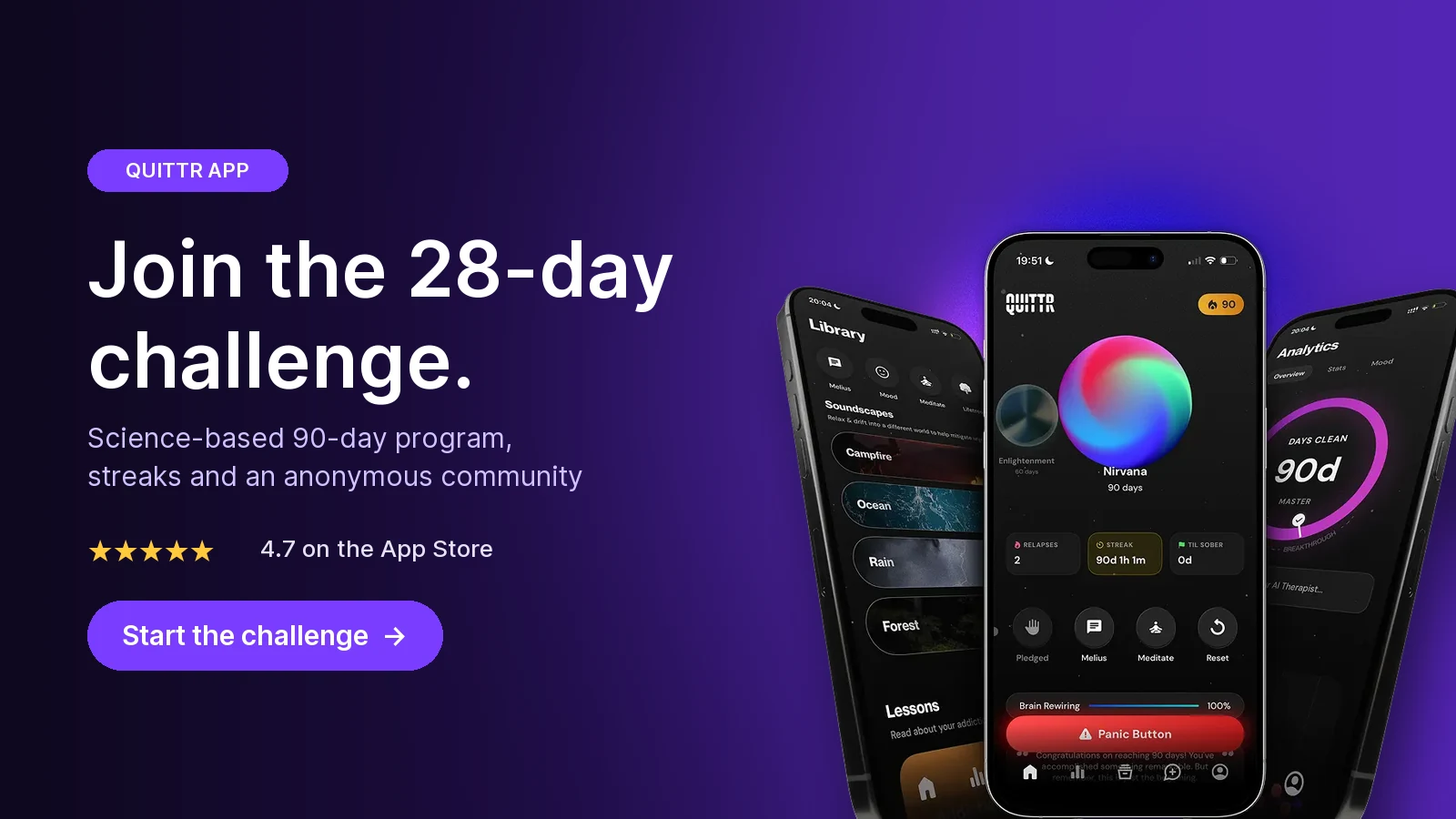
Join the 28-day challenge. Get QUITTR on the App Store or Google Play → · Learn more about QUITTR
Related articles
Betrayal Trauma After Porn Discovery: Signs, Stages and Healing
Canopy vs Covenant Eyes (2026): Which Porn Blocker App Wins?
Is Edging Bad for You? Yes — Here's What It Does to Your Brain
How to Stop Masturbating Permanently as a Christian: A Step-by-Step Faith-Based Guide
Frequently Asked Questions
Is gooning an addiction?
Gooning is slang, not a diagnosis, and neither the WHO nor the DSM uses the word. If you can't control it, it has lasted around six months or more, and it is causing real distress or damage to your life, it may fit compulsive sexual behavior disorder (ICD-11 code 6C72), which the WHO classifies as an impulse-control disorder rather than an addiction. Only a qualified clinician can make that call.
Is gooning bad for you?
There are no peer-reviewed studies on gooning itself, so nobody can give a precise list of its effects. The problems people report come from what it crowds out: hours of time, sleep, relationships and control. Research on porn in general suggests that loss of control, not frequency alone, is what links to problems such as erectile difficulties.
How long does it take to stop gooning?
No study has measured a recovery timeline for gooning. In a 7-day trial with regular porn users, quitting did not produce measurable withdrawal symptoms, although craving rose in a small subgroup with daily, problematic use. Expect the first two to four weeks to take the most deliberate effort, and judge progress by control regained, not by a calendar.
Is there a gooning addiction helpline?
There is no hotline specifically for gooning. In the US, SAMHSA's National Helpline (1-800-662-4357) is free, confidential and open 24/7, and it can refer you to local mental health services. If you are in crisis or thinking about harming yourself, call or text 988 right away.
Can gooning cause erectile dysfunction?
It hasn't been studied directly. In a survey of 3,419 men aged 18 to 35, higher scores for problematic porn use were linked to a higher chance of erectile dysfunction, while masturbation frequency was not. Those studies show association, not cause, so see a doctor if erection problems persist.


