
How to Quit Porn as a Teenager: A Guide for Teens


How to quit porn as a teenager comes down to a few things done together: make porn harder to reach (phone out of the bedroom, built-in filters on), plan what you'll do instead in the moments you usually watch, look after your sleep and energy, and get one trusted adult on your side. Watching porn as a teen is common and doesn't make you a bad person, and quitting is a skill you can build.
This guide gives you the honest numbers, why the teen brain makes this both harder and very doable, exact phone settings, a 7-day starter plan, how to bring up the subject with an adult, and what to do if anyone online asks you for photos or tries to threaten you.
First: You're Not Weird, and You're Not in Trouble
If you're reading this, you noticed a habit you don't like and went looking for help. That takes guts. And you're far from alone. Common Sense Media's 2022 Teens and Pornography report, a national survey of 1,358 US teens aged 13 to 17, found:
73% — Have seen porn online
12 — Average age of first exposure
58% — Came across it by accident
50% — Felt guilty or ashamed after watching
43% — Have talked about porn with a trusted adult
More than half of teens ran into porn without looking for it. If that's how it started for you, it wasn't your fault: phones, pop-ups and group chats put it in front of kids before anyone explains what it is.
Half felt guilty or ashamed afterward. Shame is common, but it's a bad coach; feeling awful after a slip often sends people straight back to the habit to escape the feeling. This guide works on the habit, not on making you feel worse.
For more numbers, see our breakdown of what percent of teens watch porn.
Is porn "bad," or is it just me?
The same survey asked teens what they thought of porn. Only 27% said it accurately shows the way most people have sex, and 52% disagreed. Porn is made to entertain adults, not to teach anyone about real relationships, real bodies or respect.
You don't need to be "broken" to want to quit. Wanting your evenings back, better sleep, or a life that fits your values or faith are all good enough reasons.
Also worth knowing: quitting porn doesn't mean you have to feel bad about your body or about growing up. Pediatricians at the American Academy of Pediatrics describe self-touch as a regular part of normal adolescence. If that's something you've been worrying about, our guide Is it normal to masturbate at 13? covers it calmly.
Why It Feels So Hard: Your Brain Is Still Being Built

Here's the part most "just stop" advice skips. According to the National Institute of Mental Health's guide The Teen Brain: 7 Things to Know, your brain doesn't finish maturing until your mid-to-late 20s. The prefrontal cortex, the area behind your forehead that handles planning and decision-making, is one of the last parts to mature.
That means two things for you:
Struggling with impulse control is normal at your age. It's not a character flaw. Your "brakes" are still being installed, so you need to rely more on your environment (where your phone is, what's on it) than on willpower alone.
Your brain is unusually good at changing. NIMH says the teen brain has an amazing ability to adapt to new experiences, and that challenging classes, exercise and creative activities like art or music can strengthen brain circuits. The habits you practice now get stronger, and so do the new ones you choose.
NIMH also points out that teens may react to stress differently than adults, and that most teens don't get enough sleep, which makes it harder to pay attention and control impulses. Stress and tiredness are two of the most common times people reach for their phone. So sleep and stress aren't side topics here. They're part of the plan.
The good news is in NIMH's final point: the teen brain is resilient. Most teens grow into healthy adults, and you can absolutely change a habit you picked up at 12 or 13.
Step 1: Make Porn Harder to Reach

You don't beat a habit by staring it down every night. You win by making the easy path the right one. These changes take about 20 minutes and do a lot of the work for you.
Get the phone out of your bedroom at night
This is often the biggest single change you can make. Late night, alone, in bed, phone in hand: that's when most of the trouble happens.
Charge your phone in the kitchen or living room overnight.
Use a cheap alarm clock instead of your phone alarm.
If you need the phone for music or sleep sounds, set it to play on a speaker and leave the phone outside the door.
The CDC's sleep advice includes turning off electronic devices at least 30 minutes before bed, which makes this easier to explain to your family too.
Turn on the filters that are already on your phone
Most phones and Google accounts already have adult-content filters built in, and many are switched on by default for under-18 accounts. Check that they're on, and ask a parent to lock them so they stay on when you're tempted to turn them off at midnight. That isn't weakness; it's smart planning.
iPhone or iPad with a child account in Family Sharing: On the parent's device: Settings > Family > your name > Apps & Websites > Restrictions > Filtering under Websites > Limit Adult Websites. Apple says this is on by default for child accounts under 18.
iPhone: Communication Safety: Apple turns this on automatically for new accounts under 18; it steps in when you receive or try to send photos or videos with detected nudity.
Android or Chrome with Google Family Link: In the parent's Family Link app: select you > Controls > Google Chrome and Web > Try to block explicit sites.
Google Search on any device: Go to SafeSearch settings and choose Filter. Google turns Filter on automatically when it thinks a user may be under 18.
Menu names can shift between software versions, so if something looks different, search the official help page for your device. Sources: Apple's guide to blocking websites on a child's device and its teen protections overview, Google's Family Link Chrome controls and SafeSearch help.
No filter is perfect. Google says so itself. Filters are a speed bump, not a wall, which is why the other steps matter. For a deeper walkthrough, see how to block porn on iPhone and Android.
Clean up your feeds
It often doesn't start on porn sites but with a suggestive post, a "recommended" video or a link in a group chat. Unfollow or mute accounts that keep pulling you in (even if they're "not technically porn"), mute chats where people share explicit stuff, and take a two-week break from any app whose algorithm keeps serving the same kind of content.
Step 2: Know Your Danger Times and Plan for Them
Porn habits usually run on autopilot. Something happens (you're bored, stressed, lonely, tired, or alone in your room) and your thumb heads for the same place before you've really decided.
Spend five minutes figuring out your pattern. Think about the last few times and ask:
When was it? (After school? Late at night? Weekends?)
Where was I? (Bed? Bathroom? Alone at home?)
How was I feeling? (Bored, stressed about school, upset after a fight, lonely?)
Then write a simple "if-then" plan for your top two or three danger moments:
If it's 10 p.m. and I'm in my room, then my phone is already charging in the kitchen.
If I'm home alone and bored after school, then I text a friend, go shoot hoops or get started on something with my hands.
If something suggestive pops up in my feed, then I close the app right away and get up.
When an urge hits
Urges feel huge, but they rise and fall like a wave. You don't have to act on one just because it's loud.
Put the phone down somewhere out of reach, or leave the room.
Name it: "This is an urge. It'll pass."
Breathe slowly for a minute: in for three counts, out for three counts.
Move: get a glass of water, do 20 push-ups, walk around the block.
Switch to your plan: a friend, a game with other people, music, homework, a shower.
Our guide to urge surfing explains this technique step by step. It works for all kinds of cravings, not just porn.
Step 3: Fill the Time With Things That Actually Feel Good

Quitting leaves a gap. If you just delete something and put nothing in its place, the old habit sneaks back in. The trick is to fill those danger times with things that give you energy, connection or a sense of getting better at something.
Move your body
The CDC's physical activity guidelines say people aged 6 to 17 need 60 minutes or more of moderate-to-vigorous activity every day, including muscle-strengthening and bone-strengthening activities at least three days a week. That could be a team sport, running, skating, dance, climbing, cycling or push-ups in your room.
Exercise is also one of the activities NIMH lists as helping to strengthen brain circuits. And being physically tired at night makes it easier to fall asleep instead of scrolling.
Get around people
Being alone with a screen is the classic setup. Join a club, team, band or youth group, say yes more often to hanging out, and study at the library instead of alone in your room.
Learn a skill
Guitar, drawing, coding, cooking, chess, video editing: anything where you can look back after a month and see progress. That "I'm getting better at this" feeling is exactly what a porn habit can't give you.
For more ideas, see 10 things to do instead of watching porn.
Protect your sleep
The CDC's sleep guidance, based on the American Academy of Sleep Medicine, recommends 8 to 10 hours of sleep per 24 hours for teens aged 13 to 17. Most teens fall short of that. Being tired makes every urge feel stronger and every decision harder.
A simple routine helps: same bedtime most nights, phone out of the room, screens off 30 minutes before bed, and a cool, quiet bedroom.
Your 7-Day Starter Plan
You don't need to overhaul your whole life on day one. Here's a simple first week. Pick a start day and go.
1
Do this: Pick a charging spot outside your bedroom and use it tonight
Why it helps: Removes the biggest danger time
2
Do this: Check the filters in the table above (ask a parent to lock them if you can)
Why it helps: Adds a speed bump for weak moments
3
Do this: Unfollow or mute five accounts or chats that pull you in
Why it helps: Fewer surprise triggers
4
Do this: Write your three if-then plans and save them in your notes
Why it helps: You won't have to decide in the moment
5
Do this: Do 30 to 60 minutes of sport or exercise
Why it helps: Burns off restlessness and helps sleep
6
Do this: Make one plan with friends or family for your usual danger time
Why it helps: Being with people beats being alone with a screen
7
Do this: Look back: what worked, what was hard, what will you change?
Why it helps: Turns the week into lessons, not just a streak
After week one, keep what worked and repeat. Count days if that motivates you, but don't let the number become a reason to quit trying. One bad night doesn't cancel six good ones.
Step 4: Talk to a Trusted Adult
This is the step most teens want to skip, and the one that helps the most. In the Common Sense Media survey, fewer than half of teens had ever talked about porn with a trusted adult. But among those who had, 51% said the conversation encouraged them to think about ways to explore sex or their sexuality other than porn. Teens were also more likely to say they had learned a lot about sex from a parent, caregiver or trusted adult (47%) than from porn (27%).
You don't have to tell anyone every detail. You just need one adult who knows you're working on this, can help with device settings, and can step in if things get hard.
Who you can talk to
A parent or caregiver: Can set and lock device filters, help you move the phone out of your room, and back you up when it's hard
School counselor: Trained to talk with teens about tough, private topics; can help you work out how to tell your family
Your doctor: Can talk privately about your body, mood and sleep, and refer you to a therapist if needed
Another adult you trust: An older relative, coach, teacher or faith leader who has your back
How to start the conversation
Saying it is usually the hardest part, so have a first line ready. Pick a calm moment, like a car ride or a walk, where you don't have to make eye contact the whole time. Try one of these:
"Can I talk to you about something a bit awkward? I'm not in trouble, I just need some help."
"I've been watching stuff online I don't want to watch anymore, and I want help setting up my phone."
"I've been having a hard time with something on my phone and it's making me feel bad. Can we figure it out together?"
If writing it down is easier, send a text or leave a note. Coming to them first, as the one asking for help, usually makes the conversation a lot easier for everyone.
If you're a parent who found this page, our guide on how to talk to your son about porn covers how to respond without shame.
If Someone Asks You for Photos or Threatens You
This section matters even if it has never happened to you. Know it now so you're ready.
You never have to send anyone a photo of yourself, ever. If an adult asks you, a minor, for sexual images, that person is committing a crime. Even someone your age who pressures you is crossing a serious line.
Some people online pretend to be a teen, build trust, get a photo, and then threaten to share it unless you pay or send more. This is called sextortion. The National Center for Missing & Exploited Children (NCMEC) says it has seen a dramatic increase in these cases, and teenage boys have been the most common targets in recent ones.
If it happens to you, NCMEC's sextortion guidance says:
Remember it's not your fault. The person threatening you is the one committing a crime.
Get help before you pay or send anything. NCMEC says paying or cooperating rarely stops the blackmail.
Report the account using the app's safety or report feature.
Block the person, but don't delete your profile or your messages. They can help stop the blackmailer. Keep the usernames and messages, but don't save, forward or share any explicit images.
Tell a trusted adult right away. You will not be the one in trouble here.
Report it to NCMEC's CyberTipline at report.cybertip.org, or call 1-800-843-5678 (1-800-THE-LOST), which is answered 24 hours a day.
Getting images taken down
If a nude or partly nude image or video of you, taken before you turned 18, has been shared or might be shared online, use NCMEC's Take It Down. It's free, you can stay anonymous, and your image never leaves your device. The tool creates a digital fingerprint (called a hash) of the image, and participating platforms use it to find and remove matching copies.
When to Get More Help, and What to Do in a Crisis

The steps above are a strong start, and you can keep using them for as long as you need. Talk to your doctor or a counselor about extra help if:
you've tried for a while and feel like you can't stop, even when you really want to,
it's eating into your sleep, schoolwork, friendships or the things you used to enjoy,
you're feeling anxious, down or ashamed a lot of the time,
you saw something online that upset you and you can't stop thinking about it, or
someone is pressuring, threatening or blackmailing you.
Feeling overwhelmed is a reason to reach out, not a reason to hide.
If you're thinking about hurting yourself, or you feel like you can't go on, reach out right now. In the US, call or text 988, or chat at 988lifeline.org. The 988 Suicide & Crisis Lifeline is free, confidential and open 24/7, and you can also contact it if you're worried about a friend. If you're in immediate danger, call 911 or your local emergency number.
What if you slip?
Most people don't quit a habit in one perfect try. A slip is information, not a verdict on who you are. Ask what led up to it, change one thing in your plan, and start again today. Our step-by-step guide on bouncing back after a porn relapse walks through it.
Key takeaways
Watching porn as a teen is common: 73% of US teens in a 2022 survey had seen it, and 58% first came across it by accident. You're not broken.
Your brain is still developing until your mid-to-late 20s, so lean on your environment (phone out of the bedroom, filters on) instead of willpower alone.
Fill your danger times with sport, friends, a skill and good sleep (8 to 10 hours for teens).
Tell one trusted adult: a parent, school counselor or doctor. It makes quitting much easier.
Never send photos to anyone. If someone threatens you, don't pay, keep the messages, tell an adult, and use NCMEC's CyberTipline and Take It Down. In a crisis, call or text 988.
How QUITTR Can Help
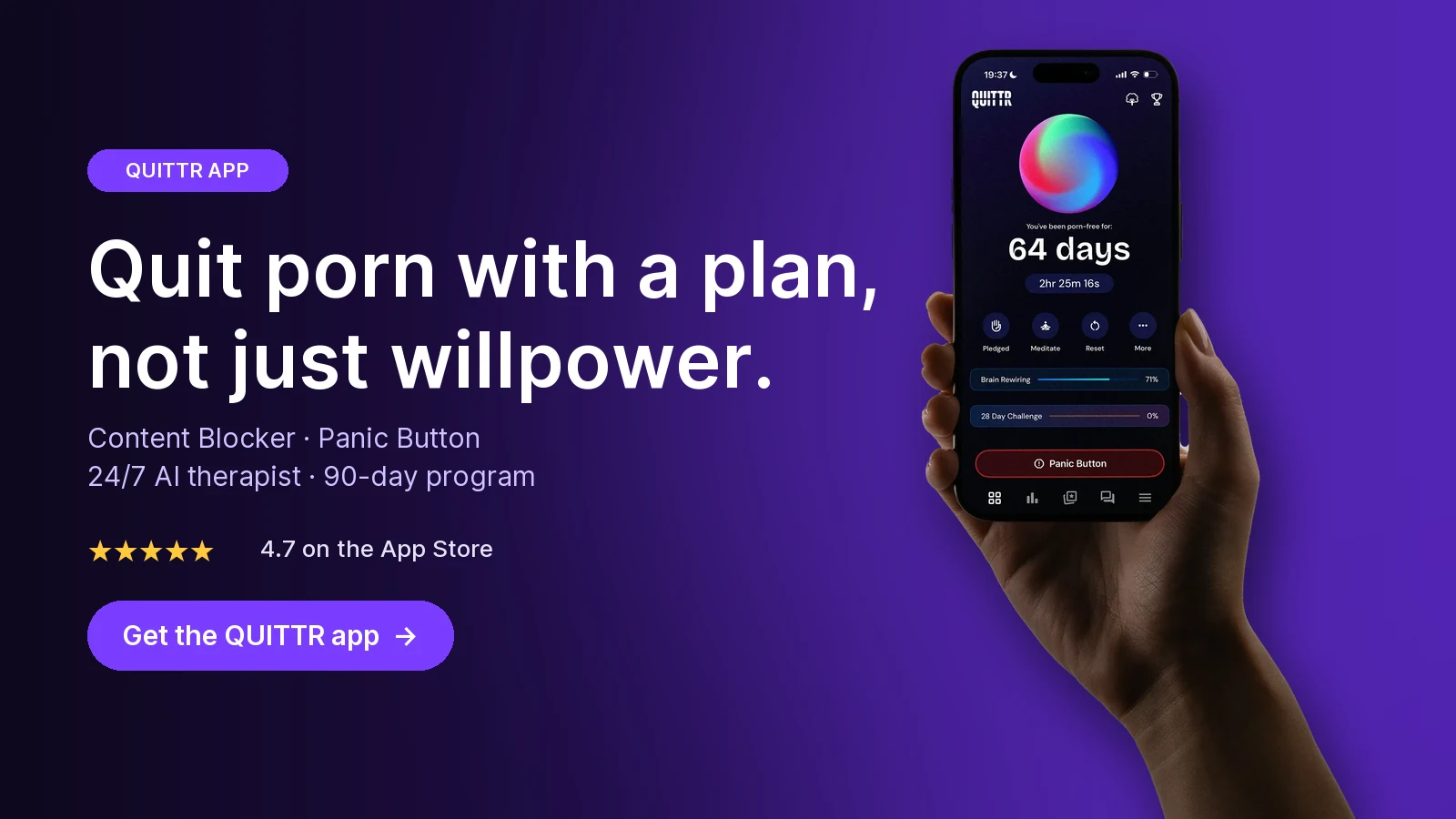
Everything above is free and works without any app. If you want extra tools, QUITTR is a paid recovery app that combines a Content Blocker for adult sites and risky searches with a Panic Button that launches breathing exercises, distractions and motivational messages when an urge hits.
Be aware of age limits first. As of October 2026, QUITTR's US App Store listing is rated 18+, and its Google Play listing is rated Teen. It's also subscription-based (check the app for current pricing). So if you're under 18, talk to a parent before downloading anything; they'll need to agree, and they can help you set it up.
“The community part surprised me the most. It helps knowing other guys are going through the same thing and making progress too.” — Connor
Ready to quit with a plan? Download QUITTR for iPhone or Android → · See how the app works
Related articles
Frequently Asked Questions
Is it normal for teens to watch porn?
It's common. In a 2022 Common Sense Media survey of 1,358 US teens aged 13 to 17, 73% said they had seen porn, and 58% said they had come across it by accident. Common doesn't mean you have to keep watching, though, and half of the teens who had seen it said they felt guilty or ashamed afterward.
How do I quit porn at 14, 15 or 16?
The basics are the same at any age: get your phone out of the bedroom at night, turn on the built-in adult-content filters, plan what you'll do in the moments you usually watch, protect your sleep and talk to a trusted adult. Younger teens usually need a parent to help set up device filters; older teens can do more themselves but still benefit from having someone in their corner.
Can I quit porn without telling my parents?
You can start on your own today with the steps in this guide, and that's a good start. But quitting is easier with one trusted adult on your side. If talking to a parent doesn't feel possible yet, a school counselor, your doctor or another adult you trust can help, and you can choose what and how much to share.
What should I do if someone online asks me for nude photos?
You never have to send anything, and an adult asking a minor for sexual images is committing a crime. Stop replying, block and report the account, but don't delete your messages. Tell a trusted adult and report it to NCMEC's CyberTipline at report.cybertip.org. If images of you are already out there, NCMEC's free Take It Down tool can help get them removed.
What if I relapse after trying to quit?
A slip doesn't erase your progress or mean you can't do this. Notice what led up to it (time of day, mood, where your phone was), change one thing in your plan, and start again the same day. If you keep slipping and it feels out of control, or you're feeling really low, talk to a doctor or counselor.
Sources
Teens and Pornography (2022) — Robb & Mann, Common Sense Media
The Teen Brain: 7 Things to Know — National Institute of Mental Health (NIMH)
Masturbation — HealthyChildren.org, American Academy of Pediatrics
About Sleep: How much sleep do I need? — Centers for Disease Control and Prevention
Block or allow access to apps and websites on your child's device — Apple Support
Family Sharing and parental controls overview for kids and teens — Apple Support
Manage your child's browsing on Google Chrome — Google For Families Help
Filter or blur explicit results with SafeSearch — Google Search Help
Sextortion — National Center for Missing & Exploited Children
Take It Down — National Center for Missing & Exploited Children


