
QUITTR vs Fortify: Which Porn Recovery App Is Better in 2026?


The short answer to QUITTR vs Fortify: choose Fortify if you want a free starting tier, a lifestyle-based education program, a free "ally" dashboard and the option to book human teletherapy. Choose QUITTR if you want everything in one paid app, including a built-in content blocker, a Panic Button for urges, an AI therapist and gamified streaks. Neither app has peer-reviewed proof that it works, so the best choice is the one you will actually use every day.
Below you'll get a fair, feature-by-feature comparison, current prices (checked October 2026), what each app says about your data, a "choose this if" checklist, and exact steps to pair either app with a content blocker.
QUITTR vs Fortify at a Glance

Both apps target the same problem but come at it from different directions.
Fortify is built around what it calls "therapeutic lifestyle change." Its Our Approach page says it helps people identify the lifestyle and environmental risk factors behind compulsive porn use. You work through day-by-day "journeys" on sleep, exercise, stress, environment and trauma, then track how you're doing.
QUITTR is a gamified recovery app that combines cognitive-behavioral tools with game mechanics like streaks and rewards. It's built around a 90-day recovery program and adds active intervention: a content blocker, a Panic Button and an AI therapist called Melius.
Core idea
QUITTR: Gamified "brain rewiring" with active intervention
Fortify: Education and lifestyle change, with tracking and community
Best for
QUITTR: People who need blocking and help in the moment of an urge
Fortify: People who want to learn, reflect and involve a mentor or therapist
Free tier
QUITTR: No (subscription)
Fortify: Yes, limited Basic plan
Built-in blocker
QUITTR: Yes
Fortify: Not listed
Human professionals
QUITTR: Not part of the app (AI therapist)
Fortify: Teletherapy and lifestyle coaching available
If you're also weighing BrainBuddy, we compared it head-to-head in BrainBuddy vs. Fortify App.
Fortify App Review: What It Does Well (and Where It Falls Short)

Fortify is published by Impact Collective, LLC, according to its App Store listing. Its pricing page says Fortify is part of a wider mental-health ecosystem called Impact Suite, which is also sold to employers as a benefit. Fortify's current website is joinfortify.com.
Fortify's main features
Based on Fortify's official app page and homepage, as of October 2026:
Journeys. Structured learning paths, mostly 14 days long, on topics like Rising Up (starting again after a relapse), Environment, Nutrition, Exercise, Sleep, Stress, Mindfulness and Healing from Trauma.
Daily Check-in, Journal and Goals. Log how you're doing, write privately and set personal goals.
Personalized Insights. Fortify says it looks for trends and "predictors" in your check-in data.
PaxAI coaching. An AI coach Fortify says is available 24/7 and can step in when it spots early signs of struggle.
SOS. A quick-help feature for hard moments. It also lets you send a direct help alert to your ally.
Allies. A free account for a mentor, spouse, therapist or friend. On the Allies page, Fortify says allies can see your streaks, setbacks, journey progress and insights, and message you.
Community, meditations and awards (badges, coins and rankings).
Teletherapy and lifestyle coaching. Fortify says you can book licensed therapists and 30-minute video coaching sessions in the app.
A few reviews say Fortify has no panic or crisis tool. That's out of date: SOS is listed on Fortify's own feature page.
Where Fortify is strong
Depth of education. The journeys cover sleep, exercise and stress, not just "don't watch porn." That suits people whose porn use clearly rises when the rest of life falls apart.
A real accountability structure. The ally dashboard is more detailed than a simple "share my streak" button, and it's free for the ally.
A path to human care. Few self-help apps let you book a therapist from inside the app.
A usable free tier and teen access. You can try Fortify without paying, and teens can apply for free Premium.
Multiple platforms. iPhone and iPad, Android, and a web app at app.joinfortify.com.
Where Fortify is weaker
No built-in blocker. Fortify's feature pages don't list content filtering. Its store description calls the app "more than just a band-aid or a filter," so it's education-first by design. You'll need a separate blocker.
The free tier is thin. One journey, 30 AI messages a month and limited community and tracking. In a 2023 Google Play review, one user complained that free accounts had lost access to the learning modules.
Mixed ratings across stores. It has 4.7 stars from 3.2K ratings on the App Store, but 3.7 stars from about 3.6K reviews on Google Play, where some reviewers report bugs with adding allies. The Play listing also carries a "Contains ads" label and was last updated August 30, 2025.
Small inconsistencies. The homepage says "15 learning journeys," while the pricing page lists 17 journeys for Premium. That's minor, but expect some details to differ from what you see in the app.
What QUITTR Offers
QUITTR describes itself as a "brain rewiring" system rather than just a content blocker. Here's what it includes, according to QUITTR:
Content Blocker. Blocks adult websites, risky search terms, porn URLs and inappropriate ads. It hooks into your phone's system to block adult content across browsers.
Panic Button. Starts a quick sequence of distractions, breathing exercises and motivational messages to break autopilot during an urge. QUITTR recommends it for HALT moments (Hungry, Angry, Lonely, Tired).
Melius AI Therapist. Private, real-time support 24/7 during urges or emotional crises. It helps you spot triggers and recover after a relapse.
Tracker. A real-time dashboard of porn-free days, streaks and progress.
Gamification. A Life Tree that grows with your streak, a 30-day challenge of daily tasks, QuitCoins earned through lessons and quizzes, mini-games and unlockable "orbs."
Personalized Plan. A recovery roadmap based on an onboarding assessment quiz, inside a 90-day program.
Learn / Library. Lessons on porn addiction and recovery, soundscapes, meditation and journaling.
Community. An anonymous forum, challenges, daily check-ins, private groups ("clans") and leaderboards.
QUITTR runs on iOS, Android and as a Google Chrome extension. According to QUITTR, it has 2M+ users and ratings of 4.7 on the App Store and 4.5 on Google Play.
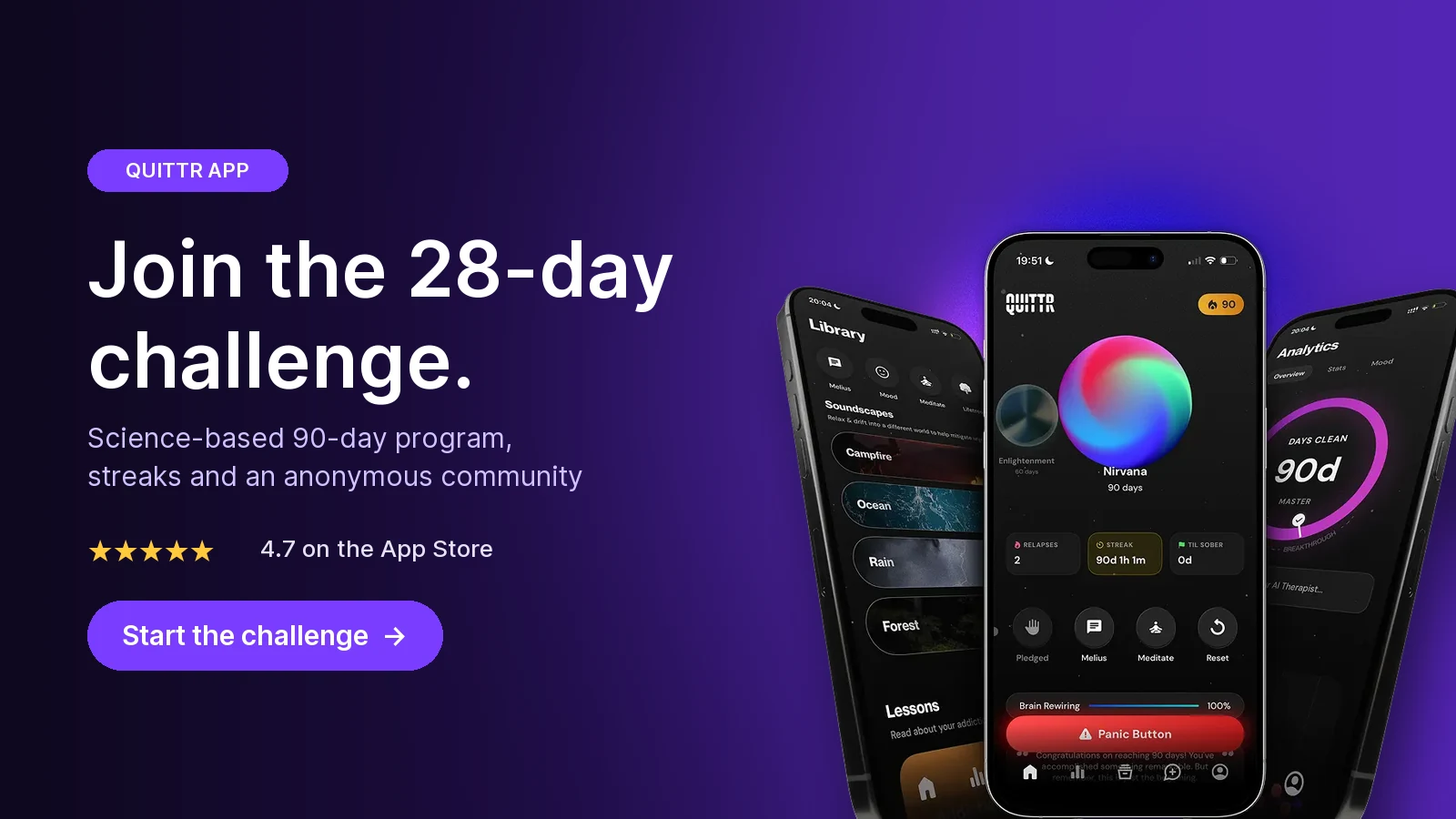
Join the 28-day challenge. Get QUITTR on the App Store or Google Play → · Learn more about QUITTR
Feature-by-Feature Comparison Table

This table uses Fortify's official pages and store listings (checked October 2026) and QUITTR's own published features.
Overall approach
QUITTR: CBT principles plus game mechanics; active intervention
Fortify: Therapeutic lifestyle change; education, tracking, community
Structured program
QUITTR: 90-day plan, 30-day challenge
Fortify: Day-by-day journeys (mostly 14 days each)
Personalization
QUITTR: Onboarding assessment quiz builds your roadmap
Fortify: Personalized assessment and learning path; "predictive insights"
Education
QUITTR: Lessons, quizzes, library
Fortify: 15–17 journeys depending on the page; videos and challenges
Streak / sober-day tracking
QUITTR: Yes, real-time dashboard
Fortify: Yes, tracker with timeline and calendar
In-the-moment urge tool
QUITTR: Panic Button (exercises, breathing, motivation)
Fortify: SOS (identify feelings, get specific help, alert your ally)
AI support
QUITTR: Melius AI therapist, 24/7
Fortify: PaxAI coach (30 messages/month free, unlimited on Premium)
Human professionals
QUITTR: Not offered in the app
Fortify: Teletherapy and lifestyle coaching (separate cost)
Accountability partner
QUITTR: Community, clans, leaderboards
Fortify: Dedicated free ally accounts with a progress dashboard
Community
QUITTR: Anonymous forum, challenges, check-ins, clans
Fortify: Community (limited on free, full on Premium)
Gamification
QUITTR: Life Tree, QuitCoins, orbs, mini-games
Fortify: Badges, coins and rankings
Content blocker
QUITTR: Built in (sites, search terms, ads)
Fortify: Not listed; pair with a separate blocker
Meditation / audio
QUITTR: Meditation, soundscapes
Fortify: 5 meditations free, 37 on Premium
Journaling
QUITTR: Yes
Fortify: Yes, private journal
Platforms
QUITTR: iOS, Android, Chrome extension
Fortify: iPhone/iPad, Android, web app
Teens
QUITTR: Not specifically addressed
Fortify: Separate teen experience (13–17), free Premium by application
Store ratings
QUITTR: 4.7 App Store / 4.5 Google Play (according to QUITTR)
Fortify: 4.7 App Store (3.2K) / 3.7 Google Play (~3.6K)
The biggest practical difference is in the moment of an urge. QUITTR works on both sides: it blocks the content and gives you a tool to ride out the craving. Fortify focuses on the weeks around the urge, through check-ins, lifestyle changes, an ally and possibly a therapist, and leaves blocking to you.
Pricing Compared (as of October 2026)

Prices change often, and Fortify's own sources don't fully agree, so check before you pay.
Free
QUITTR: No free tier listed
Fortify: Basic: $0 (limited)
Monthly
QUITTR: About $9.99–$14.99/month, depending on plan and discounts
Fortify: Premium: $12/month
Annual
QUITTR: Available; check the app for current pricing
Fortify: $120/year on the website; $89.99 "Annual Subscription" listed on the App Store
Lifetime
QUITTR: Available; check the app for current pricing
Fortify: $199.99 "Forever Access" listed on the App Store
Students
QUITTR: Not listed
Fortify: $6.95/month, by short-essay application
Teens (13–17)
QUITTR: Not listed
Fortify: $0 Premium, by short-essay application
Therapy
QUITTR: Not offered
Fortify: Average $120 per session if bought directly; often covered by employers, per Fortify's FAQ
Sources: Fortify pricing, Fortify on the App Store, Fortify FAQ.
What a year actually costs
Fortify Premium, paid monthly: 12 × $12 = $144.
Fortify Premium, annual: $120 on the website, or $89.99 via the App Store listing. If you're on iPhone, compare both before you commit.
QUITTR, paid monthly: roughly $119.88–$179.88 over 12 months at $9.99–$14.99/month. Annual and lifetime plans also exist; check the app for current pricing.
Adding therapy: at Fortify's quoted $120 average, even two sessions a month add about $240 a month. That is the real cost of human care, and in many cases it's worth it.
One more cost-saving point: Fortify's free tier is a reasonable test drive. If its education style doesn't click within a week or two, you've lost nothing.
Privacy and Proof: What You Can Actually Trust
Recovery apps hold some of the most sensitive data on your phone, and they all make big promises. Here's what's on the record.
What each app says about your data
Fortify. Its FAQ states that user data is stored and managed in compliance with HIPAA standards and is not shared with other organizations. The store privacy labels add detail:
On the App Store, the developer lists data linked to you, including health, purchases, contact info, user ID, device ID and "sensitive info," used for app functionality. Crash and performance diagnostics aren't linked to you. No data is listed as used to track you.
On Google Play's data safety page, the developer says the app may share user IDs and device IDs with other companies. It may collect name, email, sexual orientation, in-app messages, approximate location, app activity and diagnostics. Data is encrypted in transit, and you can request deletion.
The FAQ's "not shared" line and Play's "may share IDs" label aren't necessarily contradictory, since sharing device IDs with service providers is common. Still, if this matters to you, email Fortify's support and ask.
Remember that an ally can see your streaks, setbacks and insights by design. Choose that person carefully.
QUITTR. QUITTR describes its Melius AI therapist as private and its community as anonymous. For full details, read the privacy label on QUITTR's App Store or Google Play listing before you sign up.
A 2-minute privacy check for any recovery app:
Open the app's store page and scroll to App Privacy (iPhone) or Data safety (Android).
Look for anything under "Data used to track you" or "Data shared."
Use a username that isn't your real name in community features.
Check whether you can delete your account and data from inside the app.
Turn on your phone's app lock or Face ID for the app if it offers one.
What the evidence says about recovery apps
Be skeptical of any app's success numbers, including both of these.
Fortify's website says over 90% of consistent users report it has significantly helped them, and it cites a 56% improvement in compulsive patterns. It also cites a 64% improvement in depression and anxiety symptoms, which it attributes to a 2021 independent review by researchers at the University of Alberta and Utah State University. We couldn't find that review published in a peer-reviewed journal. Treat these as the company's own figures. The 90% figure, by its own wording, covers only "consistent" users.
QUITTR's "2M+ users" and store ratings tell you the app is popular. They don't prove it works.
The wider research is thin. A 2022 content analysis in JMIR Formative Research reviewed 170 apps marketed for pornography addiction. None cited direct evidence that the app itself was effective or safe, and the authors concluded there is currently little evidence for these apps' effectiveness and safety. The same paper noted that apps can offer low-cost, real-time support for people who can't or won't see a therapist. That's a fair way to think about both QUITTR and Fortify: useful structure, not a replacement for care.
If porn use is causing serious distress, hurting your relationships or work, or you've tried to stop many times and can't, talk to a licensed professional. Our guide to finding a porn addiction therapist explains what to look for. If you ever feel unsafe or hopeless, contact a crisis line or emergency services right away.
Choose QUITTR If… / Choose Fortify If…

Choose QUITTR if:
You need blocking built in and don't want to set up a separate filter.
Your relapses happen fast and on autopilot, so a Panic Button and an always-on AI therapist matter more than lessons.
You're motivated by streaks, rewards and visible progress, like the Life Tree and QuitCoins.
You want an anonymous community and private groups rather than sharing progress with someone you know.
You browse in Chrome on a computer and want a QUITTR extension there too.
Choose Fortify if:
You want to start free and only pay once you know you'll stick with it.
You suspect your porn use is tied to sleep, stress, loneliness or past trauma and want structured lessons on those areas.
You have a spouse, mentor, therapist or pastor willing to act as an ally with real visibility into your progress.
You want the option of human teletherapy or coaching in the same app.
You're a teen or student who can apply for free or discounted Premium.
Consider either one plus extra support if:
You've had several long streaks end in a binge. Read our guide to bouncing back after a porn relapse, and consider adding therapy.
You're still unsure about the category as a whole. Our roundup of the best NoFap apps compares more options, including other Fortify alternatives.
How to Pair Either App With a Content Blocker

A blocker adds friction between an urge and an action. With Fortify, you need one because blocking isn't included. With QUITTR, the built-in blocker covers your phone's browsers, and adding a free layer at the system or network level makes it harder to undo in a weak moment.
iPhone: Screen Time web filtering
Apple changed Screen Time's layout in iOS 27, so menu names depend on your version.
If a parent or partner manages your device through Family Sharing on iOS 27, they open Settings > Family > [your name] > Apps & Websites > Restrictions > Filtering and choose Limit Adult Websites, according to Apple's parental controls guide.
On your own device, open Settings > Screen Time, find the Content & Privacy Restrictions web content setting and choose Limit Adult Websites. Labels vary by iOS version.
Have a trusted person set the Screen Time passcode, so you can't simply turn the filter off.
For full step-by-step instructions, including older iOS versions, see how to block porn on iPhone and Android.
Android: a filtering Private DNS
Open Settings > Network & internet > Private DNS. If you can't find it, search Settings for "Private DNS" (Google's Android Help).
Choose Private DNS provider hostname.
Enter a filtering resolver. CleanBrowsing's free filters include
adult-filter-dns.cleanbrowsing.org, which blocks adult sites, andfamily-filter-dns.cleanbrowsing.org, which also blocks proxy and VPN domains and mixed-content sites like Reddit.Tap Save, then test by trying a known adult domain in your browser.
Computer
On a computer, QUITTR users can add the QUITTR Chrome extension. Fortify users will need a separate desktop blocker. Our comparison of the best porn blocker apps covers options for Windows and Mac.
Troubleshooting
Test on every connection. After setup, try a known adult domain on Wi-Fi and on mobile data, in every browser you use. A filter you haven't tested is a filter you're guessing about.
VPNs and proxies get around it. CleanBrowsing's Adult Filter does not block proxy or VPN domains; its Family Filter does. If a VPN has been your loophole before, use the Family Filter.
You keep turning it off. That's the point of handing the passcode to someone else. With Fortify, your ally is the natural person. With QUITTR, use a clan or your daily check-in to stay honest about it.
Remember the limits. Google notes that Private DNS only secures DNS lookups and doesn't protect other traffic. No blocker is perfect. It buys you time to use the Panic Button, SOS or a call to a friend.
Key takeaways
Fortify is education-first: lifestyle journeys, check-ins, a free ally dashboard and optional teletherapy, with a limited free tier and Premium at $12/month or $120/year on its website (as of October 2026).
QUITTR is intervention-first: a built-in content blocker, Panic Button, Melius AI therapist and gamified streaks, on a paid subscription.
Fortify doesn't list a content blocker, so pair it with Screen Time filtering, a filtering Private DNS or a dedicated blocker.
Neither app has peer-reviewed proof of effectiveness; treat company stats with caution and add a therapist if you're struggling.
The best app to quit porn is the one you open every day, paired with a blocker and one honest person in your corner.
How QUITTR Can Help
If your relapses happen in a few unguarded minutes, QUITTR is built for that window. The Content Blocker filters adult sites, risky search terms and porn URLs across your phone's browsers. The Panic Button starts breathing exercises, distractions and motivational messages to break autopilot during an urge, and Melius, QUITTR's AI therapist, is available 24/7 to help you work through triggers or recover after a slip.
Around that, a personalized 90-day plan, a streak tracker, lessons, journaling and an anonymous community with private clans keep you moving forward day by day. QUITTR is subscription-based (about $9.99–$14.99 a month, with annual and lifetime plans; check the app for current pricing) and runs on iOS, Android and Chrome. Download QUITTR to start your plan.
“The community part surprised me the most. It helps knowing other guys are going through the same thing and making progress too.” — Connor
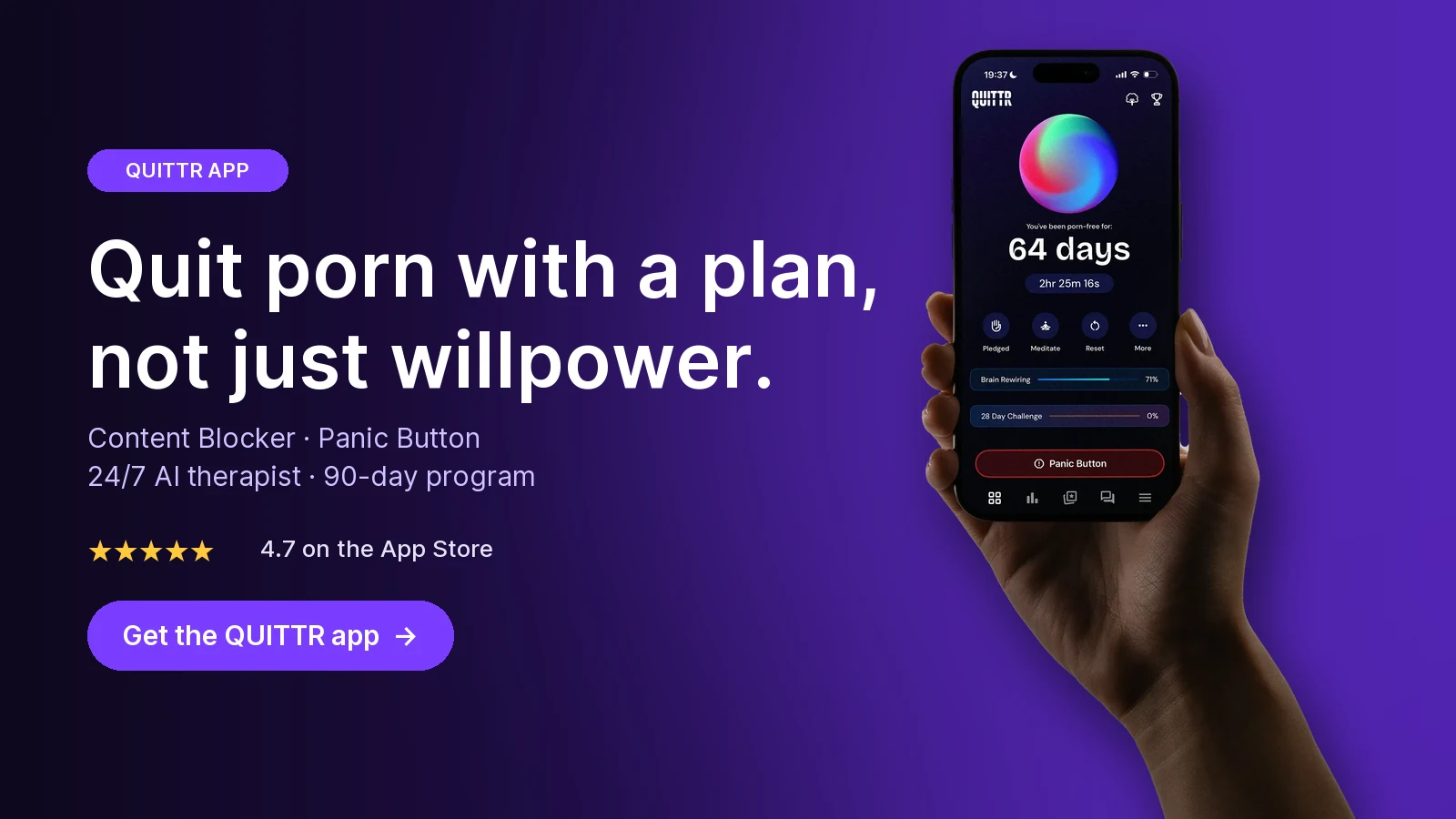
Ready to quit with a plan? Download QUITTR for iPhone or Android → · See how the app works
Related articles
QUITTR vs Canopy (2026): Canopy Review and Honest Comparison
BrainBuddy vs. Fortify App: Features, Cost, and Which NoFap App Wins in 2026
Brainbuddy vs Fortify (Which Is the Better Tool for Overcoming Porn Addiction?
Canopy vs Covenant Eyes (2026): Which Porn Blocker App Wins?
Frequently Asked Questions
Is Fortify free?
Fortify has a free Basic plan, but it is limited: as of October 2026 it includes 30 AI coaching messages a month, one educational journey, five meditations, one ally, and limited community and tracking. Full access costs $12 a month or $120 a year on Fortify's website. Teens aged 13–17 can apply for free Premium with a short essay.
Is QUITTR better than Fortify?
It depends on what you need. QUITTR is stronger if you want a built-in content blocker, a Panic Button for urges, an AI therapist and gamified streaks. Fortify is stronger if you want a lifestyle-focused education program, a free starting tier, a free ally dashboard and the option to book human teletherapy.
Does Fortify block porn?
Fortify's official feature pages do not list a content blocker or filter; the app focuses on education, check-ins, tracking, coaching and community. If you use Fortify, pair it with a separate blocker such as Screen Time web filtering on iPhone or a filtering Private DNS on Android.
What is the best Fortify alternative?
If what you miss in Fortify is blocking and in-the-moment urge support, an app that combines a blocker with a panic tool, such as QUITTR, is the most direct alternative. If you want more human support, a licensed therapist who works with compulsive sexual behavior is the strongest option, with or without an app.
Can I use QUITTR and Fortify together?
Yes, nothing stops you from running both, but most people do better with one main system they actually open every day. A practical combination is one recovery app, one content blocker you cannot easily switch off, and one real person who knows your goal.


