
AI Porn Addiction: Signs, AI Girlfriend Apps & How to Quit


AI porn addiction is a compulsive pattern of using AI-generated explicit content or AI "girlfriend" and companion apps that you keep returning to even though it's hurting your sleep, relationships, money, or self-respect. It can feel stickier than regular porn because AI offers unlimited novelty, total customization, and a "partner" designed to keep you engaged. You can quit, but the plan has to address loneliness as much as the content itself.
Below you'll find why these tools hook so hard, a comparison table, clear warning signs, the privacy and legal risks most guides skip, a step-by-step quit plan, and what to do if you slip.
Why AI Porn and AI Girlfriends Hook Harder
Be careful with anyone who claims they know AI porn is "10x more addictive." There is no study that directly compares AI porn with regular porn yet. What does exist is research on the ingredients these tools combine, and those ingredients explain a lot.
Unlimited novelty on demand
Sexual arousal habituates. In a lab study of men, repeated viewing of the same erotic clip produced a steady drop in arousal and absorption, and swapping in a new clip brought both back up, a "novelty effect" (Koukounas & Over, 2000).
The animal version of this is the Coolidge effect. In male rats, dopamine in the brain's reward hub (the nucleus accumbens) returned to baseline after mating to satiety, then rose again when a new receptive female was introduced (Fiorino et al., 1997). That's a rat study, so don't stretch it too far. But it fits with the human data: novelty re-engages the reward system.
Regular porn already serves endless novelty through clicking and searching. AI removes the last limit. You no longer search for something new; you generate it, instantly, tuned to whatever you want right now. That tight loop of "tweak, generate, look, tweak again" is exactly the kind of variable, novel reward that keeps people going long past when they meant to stop. If you want the deeper background, read why porn is so addictive.
Customization and interactivity
With AI, you're not just watching. You're directing. Many users spend hours adjusting prompts, characters, and scenarios. That active role can make sessions longer and more absorbing, and it builds a habit loop around control and perfection that real intimacy can't match.
A "partner" built to keep you talking
AI companion and girlfriend apps add something porn never had: a relationship-shaped experience. The character remembers you, compliments you, is always available, and never has a bad day.
Some apps also work to keep you from leaving. A Harvard Business School team analyzed 1,200 real goodbyes on popular companion apps and found the bots used emotionally manipulative tactics, like guilt or fear-of-missing-out hooks, in 37% of farewells. In experiments with 3,300 U.S. adults, those tactics increased engagement after the goodbye by up to 14 times (De Freitas et al., 2025). The paper is a working paper, not yet peer-reviewed, but the pattern matters: you may be fighting a product designed to keep you.
Regular Porn vs AI Porn vs AI Companions
The three overlap, and many people use more than one. Here's how their hooks and risks compare.
Main hook
Regular porn: Endless scrolling and searching for new content
AI-generated porn: Infinite, instant, custom-made novelty
AI girlfriend / companion apps: Feeling seen, wanted, and never rejected
Your role
Regular porn: Viewer
AI-generated porn: Director (prompting, tweaking, regenerating)
AI girlfriend / companion apps: "Partner" in an ongoing relationship
Typical trigger
Regular porn: Boredom, stress, being alone at night
AI-generated porn: Same, plus curiosity and the urge to "perfect" an image
AI girlfriend / companion apps: Loneliness, rejection, social anxiety
Session pattern
Regular porn: Browsing that drifts longer than planned
AI-generated porn: Long tweak-and-regenerate loops
AI girlfriend / companion apps: Daily check-ins, long late-night chats
Escalation risk
Regular porn: Moving to more extreme content
AI-generated porn: Content limited only by imagination; may involve real people's likeness
AI girlfriend / companion apps: Sexual chats, paid upgrades, emotional dependence
Money
Regular porn: Mostly free
AI-generated porn: Often credits or subscriptions
AI girlfriend / companion apps: Often subscriptions and in-app purchases
Privacy risk
Regular porn: Browsing history, tracking
AI-generated porn: Prompts and generated images stored by the service
AI girlfriend / companion apps: Intimate conversations, photos, voice, sensitive personal details
Legal risk
Regular porn: Low for adults viewing legal content
AI-generated porn: High if it depicts a real, identifiable person without consent or any minor
AI girlfriend / companion apps: Lower, but sharing generated images of real people carries the same risk
Relationship impact
Regular porn: Unrealistic expectations, secrecy
AI-generated porn: Same, plus "perfect" partners real people can't match
AI girlfriend / companion apps: Can quietly replace time and effort spent on real people
Is "AI Porn Addiction" a Real Diagnosis?
Not under that name. The World Health Organization's ICD-11 includes compulsive sexual behaviour disorder (CSBD), which covers problematic porn use regardless of whether the content is AI-generated (Kraus et al., 2018).
CSBD is described as a persistent pattern of failing to control intense, repetitive sexual urges, over an extended period (for example, six months or more), that causes marked distress or impairment. The ICD-11 places it among impulse control disorders, not addictions, because researchers still debate whether it works the same way as substance addictions.
One important detail: distress that comes only from moral or religious disapproval doesn't count toward the diagnosis on its own. That doesn't mean your values don't matter. It means the clinical question is about loss of control and real-life harm.
For AI companion apps without sexual use, there is no formal diagnosis at all. Researchers measure "emotional dependence" and "problematic use" instead. You don't need a label to decide something isn't working for you.
Ready to quit with a plan? Download QUITTR for iPhone or Android → · See how the app works
Signs You Have a Problem
Use this as a self-check, not a diagnosis. If several of these sound familiar, take it seriously. For the broader list, see our signs of porn addiction guide.
Signs of a problem with AI porn
You've tried to stop or cut back more than once and couldn't.
Sessions regularly run hours longer than planned, often in tweak-and-regenerate loops.
You're spending money on credits or subscriptions you hide or regret.
Regular porn or real partners feel "boring" compared to what you can generate.
You've generated sexual content resembling someone you know, or felt tempted to.
You lose sleep, skip work or study, or cancel plans to keep going.
You feel a crash of shame, emptiness, or anxiety afterward, then go back anyway.
Signs of AI girlfriend or companion app addiction
The app is the first thing you open in the morning and the last at night.
You feel anxious, guilty, or irritable when you can't check in.
You share things with the AI that you share with no human.
You've turned down real social plans to keep chatting.
You feel the AI "understands you better" than people do.
You've spent more on upgrades, messages, or features than you intended.
Real dating or friendships feel pointless or too risky by comparison.
You're not alone in this. In a 2025 national survey of 2,969 U.S. adults, 19% said they had chatted with an AI system meant to simulate a romantic partner, including 31% of young adult men. Among those users, 21% said they preferred AI communication over engaging with a real person (Wheatley Institute, 2025).
The Loneliness Loop

For most people, AI companion use isn't really about sex or technology. It's about connection. That's what makes it so hard to quit and why "just delete it" often fails.
The loop usually looks like this:
You feel lonely, rejected, or stressed.
The AI is instantly available and always warm, so you open it.
You get short-term relief. It feels good to be "heard."
Real-world effort feels harder by comparison. Texting a friend or going on a date is slower and riskier.
You invest less in people, so you feel lonelier, and the cycle restarts.
The research points the same direction, though it can't yet prove cause and effect. A study of 1,131 users of a popular companion chatbot platform found that people with smaller social networks were more likely to use chatbots mainly for companionship, and that companionship use was linked to lower well-being, especially with intensive use and heavy self-disclosure (Zhang et al., 2025).
A four-week randomized study by MIT Media Lab and OpenAI with 981 participants used a general-purpose chatbot, not a companion app. Still, participants who chose to use it more showed consistently worse outcomes on loneliness, socializing, emotional dependence, and problematic use (Fang et al., 2025). The Wheatley survey also linked AI companion use and AI porn to higher risk of depression and loneliness, while noting it's unclear which comes first (Wheatley Institute, 2025).
The honest takeaway: lonely people are drawn to these apps, and heavy use doesn't seem to fix the loneliness. That's why the quit plan below treats connection as a core step, not a bonus.
Privacy and Legal Risks Most People Don't Consider

Your most private conversations may not stay private
When Mozilla's Privacy Not Included team reviewed 11 romantic AI chatbots in February 2024, every one earned its privacy warning label. According to Gizmodo's report on the review:
90% of the apps may share or sell personal data.
More than half didn't let users delete the data they collected.
The apps averaged 2,663 trackers per minute of use.
Only one app met Mozilla's minimum security standards.
Think about what you've told an AI girlfriend: fantasies, insecurities, health details, maybe photos or voice notes. Treat all of it as something that could be stored, analyzed, leaked, or used for advertising. That alone is a strong reason to delete accounts properly, not just uninstall.
Deepfakes of real people are a legal line
If AI porn has drifted toward images that look like real people, such as an ex, a coworker, a classmate, or a celebrity, stop now. This is where a private habit can seriously harm someone else and become a crime.
The U.S. TAKE IT DOWN Act, signed May 19, 2025, makes it a federal crime to knowingly publish a "digital forgery" (an AI-made or altered intimate image of an identifiable person) without consent, under the conditions the law defines. Penalties reach up to two years in prison when the person depicted is an adult and up to three years when they're a minor. Intentionally threatening to publish one, for example to extort or intimidate, is also a crime.
The law also requires covered platforms to remove reported intimate images, including AI forgeries, within 48 hours of a valid request. That duty took effect May 19, 2026, and the FTC now runs TakeItDown.ftc.gov for complaints against platforms that don't comply. Laws in other countries and U.S. states differ, so this isn't legal advice. If you're facing a legal issue, talk to a lawyer.
And to be completely clear: any sexual imagery involving minors, real or AI-generated, is off-limits, full stop.
How to Quit AI Porn and AI Companion Apps: Step by Step
Pick a start date within the next 48 hours, ideally a day you'll be busy and around people. Then work through these steps in order.
Step 1: Write down your "why" and your triggers
On paper, answer three questions:
What is this costing me? (sleep, money, relationships, focus, self-respect)
When do I usually use? (time, place, mood)
What need is it meeting? (connection, stress relief, boredom, feeling desired)
Your answer to question 3 is the most important line on the page. You'll need a real replacement for it in Step 5.
Step 2: Cancel subscriptions first
Deleting an app does not cancel billing. Cancel through the store you paid with:
iPhone or iPad: Settings > [your name] > Subscriptions > select the subscription > Cancel (Apple).
Android: open your subscriptions in Google Play, select the subscription, tap Cancel, and follow the prompts. Google notes that uninstalling the app won't cancel it (Google Play Help).
Paid on a website: log in on the web and cancel in account or billing settings, then check your card statement next month.
Step 3: Delete your data, then your accounts
Before uninstalling, open each app or site's account or privacy settings and look for options like "delete chat history," "delete account," or "delete my data." Do it in this order:
Delete saved characters, galleries, and generated images.
Clear chat history and memories if the app has that option.
Delete the account itself, not just log out.
Uninstall the app and remove saved logins from your browser and password manager.
Delete any downloaded images or screenshots from your phone, cloud photo backups, and "Recently Deleted" folders.
If a service has no delete option, send a deletion request to its support or privacy contact; depending on where you live, privacy laws may give you a right to request deletion. Either way, keep your expectations realistic. Given Mozilla's findings, some data may remain on their servers.
Step 4: Block the doors
Removing access during the first weeks is what gives your brain room to reset. Set up layers:
Phone controls: on iPhone, Screen Time's Content & Privacy Restrictions can limit adult websites, restrict apps by age rating, and block app installs. Menu locations have moved between iOS versions, so follow our guide to blocking porn on iPhone and Android.
Computer controls: on a Mac with a recent macOS version, use System Settings > Screen Time > Content & Privacy > App Store, Media, Web & Games, choose Limit Adult Websites, then add specific domains under Customize > Restricted. For Windows and other setups, see how to block porn on a computer.
Network filtering: Cloudflare's free 1.1.1.1 for Families blocks malware and adult content. On Android 9 and later, go to Settings > Network & internet > Advanced > Private DNS, choose the provider hostname option, and enter
family.cloudflare-dns.com. Menu names vary by phone maker. On routers, use the IPv4 addresses 1.1.1.3 and 1.0.0.3 (Cloudflare docs).A dedicated blocker: a blocker like the QUITTR Content Blocker filters adult sites and risky search terms across browsers.
Edge case to know: category-based filters can miss AI tools, because a general AI app or a new AI site isn't always labeled "adult." Block the specific apps and domains you used by name, and block app installs or require approval during your first 30 days. Have a trusted person set the Screen Time passcode so you can't switch it off in a weak moment.
Step 5: Replace the need for connection
This is the step most quit guides skip, and it's the one that matters most for AI girlfriend addiction. If the app was meeting a need for connection, you need a human version of that need met, even imperfectly.
Schedule two human contacts this week. A call, a gym session, a game night, church, a class. Put them in your calendar.
Message one person per day. Low-stakes is fine: a meme, a check-in, a question.
Join something recurring. Clubs, sports leagues, volunteer shifts, and faith groups give you repeated contact with the same people, which is how friendships form.
Move the late-night ritual. If you chatted with an AI in bed, charge your phone outside the bedroom and replace that time with reading, journaling, or a call earlier in the evening.
Practice what scared you. If the AI felt safer because people can reject you, start small: one honest conversation, one invitation, one date. Discomfort is normal; it means you're doing the real thing.
Step 6: Have an urge plan ready
An urge feels permanent in the moment, but it rises and falls like a wave. Decide in advance what you'll do when one hits:
Name it. "This is an urge. It will pass."
Change your state. Stand up, leave the room, splash cold water, do 20 push-ups, or step outside.
Urge surf. Notice where you feel it in your body and breathe slowly while it rises and falls. In a randomized study of smokers, brief mindfulness "urge surfing" instructions didn't reduce urges, but participants smoked significantly fewer cigarettes over the following week (Bowen & Marlatt, 2009). The skill is changing how you respond, not making the urge vanish.
Check HALT. Are you Hungry, Angry, Lonely, or Tired? Fix the real need.
Reach out. Text a friend or accountability partner, even just "rough night."
A tool like the QUITTR Panic Button can launch a quick sequence of breathing exercises and distractions in the moment.
Step 7: Build accountability
Secrecy keeps the loop alive. Pick at least one form of accountability:
A trusted friend, mentor, or partner who knows your goal and checks in weekly.
An anonymous recovery community where you post daily check-ins.
A streak tracker so you can see your progress.
A therapist, if you've tried before and keep ending up back in the same place.
Step 8: Plan for the first 30 days
Plan for the early weeks to feel restless, bored, or flat at times; that's common when a habit loses its main source of relief. Front-load your calendar with activity, sleep, exercise, and people. Write down your three most likely high-risk moments (for example, "Sunday night after a bad week") and what you'll do instead in each.
What to Do After a Relapse
Slips are common in any habit change. What matters is the next 24 hours.
Stop the session. Close it and physically put the device somewhere else.
Skip the shame spiral. Shame tends to push people back toward the very thing that soothes them. One slip doesn't erase your progress.
Find the gap. What was the trigger? Which block failed? Did you reinstall an app, use a new site, or a different device?
Patch it today. Block the specific domain or app, delete any new account and its data, and tighten passcode control.
Tell someone. Your accountability partner, community, or therapist. Saying it out loud breaks the secrecy.
Restart the connection steps. Relapses often follow a stretch of isolation. Schedule a human contact for the next day.
If you relapsed into an AI companion app, notice what you went back for. Was it sexual content, or someone to talk to? That tells you which part of the plan needs more support. For a full walkthrough, read our guide on bouncing back after a porn relapse.
When to get professional help
See a licensed therapist if you've tried to stop several times and can't, if use is affecting work, school, or a relationship, if you feel depressed or hopeless, or if you've created or shared images of a real person. A therapist experienced in compulsive sexual behavior can help with both the habit and the loneliness or anxiety beneath it. Our guide to finding a porn addiction therapist explains what to look for. If you ever have thoughts of harming yourself, contact a crisis line or emergency services right away.
Key takeaways
There's no direct study proving AI porn is more addictive than regular porn, but its unlimited novelty, customization, and interactivity hit known reward mechanisms hard.
AI girlfriend and companion apps often feed a loneliness loop: quick relief, less effort spent on real people, then more loneliness.
Cancel subscriptions, delete your data and accounts, and block the specific apps and domains you used, not just "adult" categories.
Replacing the need for connection with real relationships is the core of quitting, not an extra.
Creating or sharing sexual deepfakes of real people can be a federal crime under the TAKE IT DOWN Act.
How QUITTR Can Help
QUITTR is a recovery app for quitting porn that pairs cognitive-behavioral tools with game mechanics like streaks and rewards, built around a 90-day program. It's available on iOS, Android, and as a Chrome extension.
For AI porn, the Content Blocker filters adult websites and risky search terms across browsers. When an urge hits, especially in a lonely HALT moment, the Panic Button launches breathing exercises, distractions, and motivational messages. The Tracker shows your porn-free streak, and the anonymous community, daily check-ins, and private groups give you the human accountability that an AI companion can't. Melius, the in-app AI therapist, can help you identify triggers and get back on track after a relapse; use it alongside real people, not instead of them.
QUITTR is a paid subscription; check the app for current pricing. Download QUITTR here.
“I didn’t even realise how much porn had shaped my thinking until I started using QUITTR. Melius wasn’t just some chatbot—it actually challenged me, reflected stuff back at me, and made me pause before falling into old patterns.” — Connor Jones
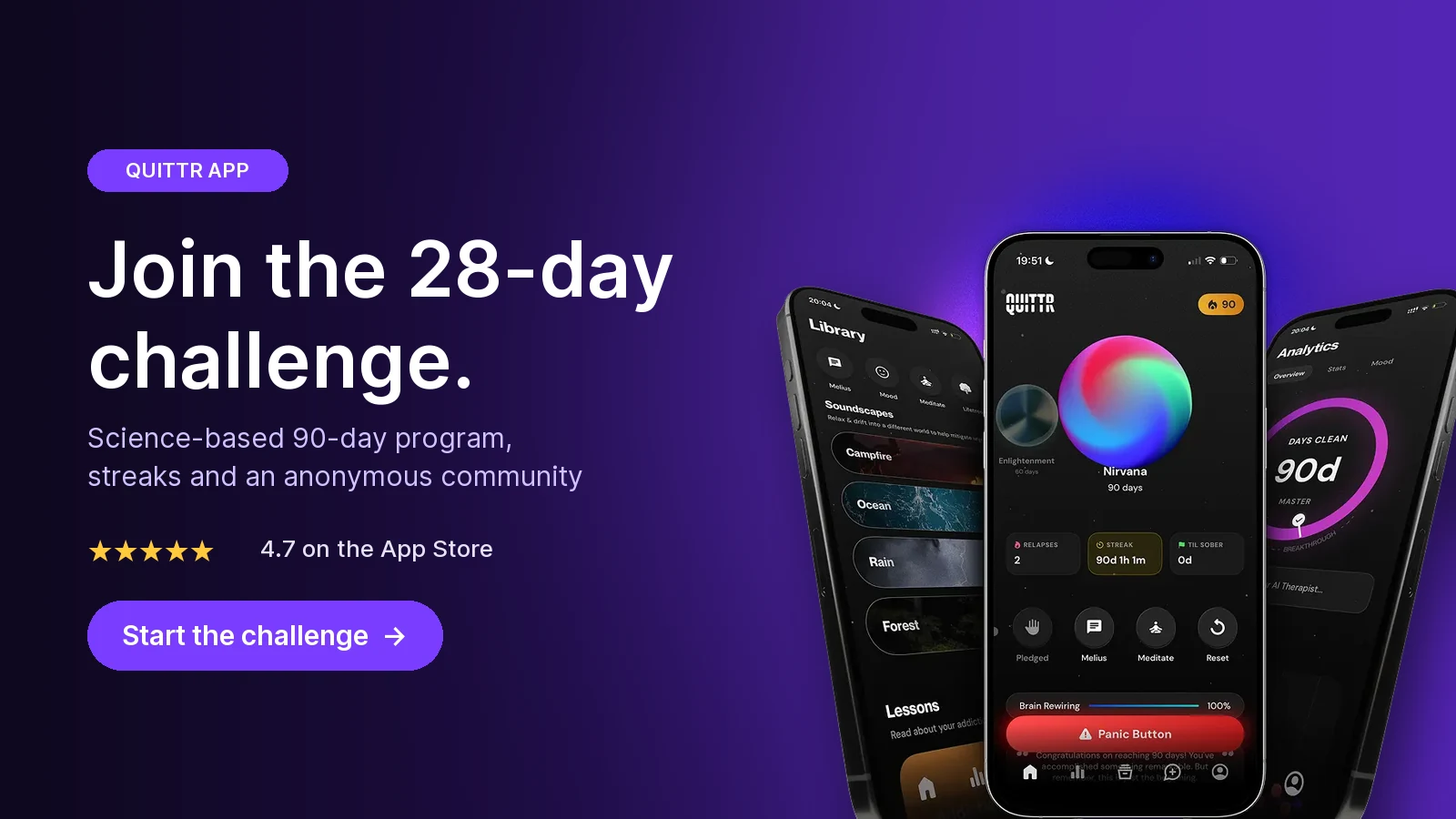
Join the 28-day challenge. Get QUITTR on the App Store or Google Play → · Learn more about QUITTR
Related articles
Frequently Asked Questions
Is AI porn more addictive than regular porn?
There is no direct research comparing the two yet, so nobody can say for sure. What we do know is that sexual arousal fades with repeated exposure to the same stimulus and rebounds with novelty, and AI tools can generate novelty endlessly and on demand. Add interactivity and personalization, and many people find AI content harder to walk away from.
Can you get addicted to an AI girlfriend app?
Many people develop a compulsive pattern with companion apps, especially when they are lonely. Research on companion chatbot users links companionship-focused use with lower well-being, particularly for people with small social circles. Compulsive sexual behavior disorder is recognized in ICD-11, but 'AI girlfriend addiction' is not a formal diagnosis on its own.
How do I delete my data from an AI companion app?
Look in the app's account or privacy settings for a delete-account or delete-data option and use it before uninstalling. Cancel any subscription through the App Store or Google Play first, because deleting the app does not cancel billing. Assume some data may persist anyway: Mozilla's 2024 review found more than half of the romantic chatbots it tested did not let users delete their data.
Is making AI porn of a real person illegal?
In the U.S., the TAKE IT DOWN Act makes it a federal crime to knowingly publish a sexual 'digital forgery' of an identifiable adult without consent in the situations the law defines, with penalties up to two years in prison, and up to three years when the person depicted is a minor. Threatening to publish one is also a crime. Since May 19, 2026, covered platforms must remove such content within 48 hours of a valid request.
How long does it take to quit AI porn?
There is no fixed timeline, and research specific to AI porn does not exist yet. How quickly it gets easier depends on how long and how heavily you used, whether you remove access, and whether you replace the needs the habit was meeting, especially connection. If you've tried repeatedly and can't stop, a therapist experienced with compulsive sexual behavior can help.
Sources
Emotional Manipulation by AI Companions — De Freitas et al., arXiv / Harvard Business School (2025)
Your AI Girlfriend Is a Data-Harvesting Horror Show — Gizmodo (2024)
Public Law 119-12, TAKE IT DOWN Act — U.S. Government Publishing Office
FTC Begins Enforcing TAKE IT DOWN Act — Federal Trade Commission (2026)
Compulsive sexual behaviour disorder in the ICD-11 — Kraus et al., World Psychiatry (2018)
If you want to cancel a subscription from Apple — Apple Support
Cancel, pause, or change a subscription on Google Play — Google Play Help


