
Sexting Addiction: Signs, the Cycle and How to Stop


Sexting addiction is not an official diagnosis, but compulsive sexting is real: it's when sending and seeking sexual messages, photos or videos becomes something you keep doing despite promises to stop, secrecy, and harm to your relationship, sleep, work or safety. Doctors would usually place it under compulsive sexual behavior disorder, and the fix is a mix of cutting off access, understanding your triggers, and getting support.
Below you'll get an honest look at what the research says, the reward cycle that keeps you on the phone, a sign checklist, the real risks (leaks and sextortion, with exactly where to report), verified Snapchat and Instagram settings to cut the habit off, and a plan for relationships and professional help.
Is Sexting Addiction Real? What the Research Says

Start with what sexting isn't: rare or automatically unhealthy. A 2020 meta-analysis of 50 studies and 18,122 adults aged 18 to 28 found that about 38% had sent a sext, about 42% had received one, and nearly half had sexted in both directions. So if you've sexted, you're in a very large crowd.
What makes it a problem is loss of control. The World Health Organization's ICD-11 doesn't list "sexting addiction" or even "sex addiction." It lists compulsive sexual behavior disorder (CSBD): a persistent pattern of failing to control intense, repetitive sexual urges, lasting roughly six months or more and causing significant distress or problems in daily life, as described by the experts who drafted the diagnosis. Compulsive sexting can be one form of that pattern, alongside compulsive porn use, hookups or cybersex.
One important detail from that same definition: feeling guilty because of moral or religious beliefs is not enough on its own to count as a disorder. The test is whether you can't stop and it's hurting your life.
What studies have actually found
Research on sexting as a compulsion is thin. Most sexting studies look at teens, risk or consent, not at people who can't stop. Here's the honest picture:
It travels with compulsive sexual behavior. In a 2023 German survey of 3,564 adults, 19% reported sexting erotic pictures. Every digital sexual behavior measured, sexting included, correlated moderately to strongly with scores on a CSBD screening scale. Correlation isn't cause, but the overlap is clear.
Why you sext matters. In a 2025 study of 911 young adults in Italy, fear of missing out predicted risky sexting (sexting while drunk or high, and sexting to manage emotions) but not ordinary experimental sexting.
Pressure predicts harm. A 2025 longitudinal study of 405 young adults found that sexting more often, and sexting for "controlled" reasons such as pressure, guilt or a need for approval, predicted more negative outcomes six weeks later. Sexting for your own genuine reasons predicted positive ones.
No brain-imaging study has looked at compulsive sexting specifically, and no treatment trial has targeted it. Anyone telling you exactly what sexting "does to your dopamine" is extrapolating from research on other behaviors.
38.3% — Young adults who have sent a sext
41.5% — Young adults who have received one
15% — Who say a sext was forwarded without consent
75,000+ — Sextortion reports to the FBI's IC3 in 2025
22,061 — Of those, from people aged 20–29
The first three numbers come from the 2020 meta-analysis; the last two from the FBI's 2025 Internet Crime Report.
The Sexting Cycle: Why It's So Hard to Put Down
Sexting has a feature porn doesn't: another person who answers. You don't know when they'll reply, what they'll send, or how they'll react to what you send. That unpredictability is a likely part of the pull: you keep checking because the next buzz might be the one you're waiting for.
Most people who struggle describe a loop that looks like this:
1. Trigger: Boredom, loneliness, stress, a fight, alcohol, late night in bed, a notification from a familiar name
2. Opening move: A "hey" or a flirty message that feels harmless, often to an old contact or a new match
3. Escalation: Messages get more explicit; you start waiting for each reply and checking the phone constantly
4. Reward: Validation, arousal and attention, often followed by masturbation
5. Crash: Guilt, anxiety about what you sent, fear of being found out, deleting threads
6. Reset: Promises to stop, until the next trigger arrives, often within days
Notice what fuels stage 1. The Italian study above found that sexting to regulate emotions was the type linked to fear of missing out. If sexting is how you handle feeling low, lonely or unwanted, cutting it off without replacing it leaves that need unmet, and the urge comes back.
Notice stage 5, too. Shame doesn't break the loop; it feeds stage 1. That's why the plan below focuses on access, triggers and replacements rather than willpower and self-criticism.
How it differs from porn
If you've worked on porn use before, a lot will feel familiar: cues, cravings, the "just this once" voice. But sexting adds three things that make it stickier:
Social validation. Someone wants you, specifically. That hits harder than a video.
Obligation. The other person keeps messaging, so stopping can feel rude or like a breakup.
Permanent evidence. Every image you send creates a risk that doesn't go away when the urge does.
Signs Your Sexting Has Become Compulsive
There's no validated "sexting addiction test." These signs are adapted from the ICD-11 CSBD criteria and from what people describe when sexting turns compulsive. The more that apply, and the longer they've lasted, the more seriously you should take it.
You can't cut back: You've deleted the app, blocked people or promised your partner, and been back within days
It takes up hours: You lose evenings or work time to chats, waiting for replies and re-reading threads
You escalate: You need more explicit content, more people or riskier situations to get the same rush
Secrecy: Hidden apps, deleted threads, a second account or a different phone
It's your coping tool: You reach for it when stressed, lonely, rejected or after drinking
You ignore the risk: You send images you know could identify you, or sext people you've never verified
It's costing you: Arguments, a breakup, a work warning, poor sleep, or money spent on content or subscriptions
You keep going anyway: You feel little satisfaction now, but you still can't stop
If three or more fit and the pattern has lasted months, you're past the point where "just be more disciplined" works. That's not a character flaw; it's how compulsive loops behave. Our porn addiction quiz covers many of the same patterns if porn is part of the picture too.
Ready to quit with a plan? Download QUITTR for iPhone or Android → · See how the app works
The Real Risks: Leaks, Sextortion and Your Relationship

The relationship cost is the one most people think about. The safety cost is the one that can arrive suddenly.
Image leaks
The 2020 meta-analysis found that about 15% of young adults reported a sext being forwarded without consent. Once an image is out of your hands, you can't control where it goes. Screenshots, cloud backups and hacked accounts all make "disappearing" messages less disappearing than they look.
Sextortion
Sextortion is when someone threatens to share your images unless you pay or send more. It's not just a teen problem. In 2025 the FBI's Internet Crime Complaint Center received more than 75,000 sextortion submissions, and the single largest age group in its table was people aged 20 to 29, according to the 2025 IC3 annual report. The FBI notes that the shame and fear victims feel often stop them from asking for help, which is exactly what scammers count on.
The IC3 describes a common pattern: it often starts with someone who seems interested in a relationship or offers something of value. Once they have an image or video, they threaten to publish it, or threaten violence, to get more images or money.
If someone threatens to share your images: do this now
Don't pay and don't send anything more. The National Center for Missing & Exploited Children (NCMEC) warns in its sextortion guidance that paying or cooperating rarely stops the blackmail. It's written for teens, but the logic holds for adults: paying marks you as someone who pays.
Stop responding. Don't negotiate, argue or plead.
Report and block the account, but keep the evidence. NCMEC advises blocking without deleting your profile or the messages. Take screenshots of the profile, username, messages and any payment details.
Report it. In the US, file a report with the FBI at ic3.gov. If you're in immediate danger, call 911.
Hash your images so platforms can block them. If you were 18 or older in the images, use StopNCII.org: it creates a digital fingerprint (a hash) on your device, and only the hash is shared with participating platforms, not the image itself. If you were under 18 in the images, use NCMEC's Take It Down service (takeitdown.ncmec.org), linked from the NCMEC page above.
Use the new removal law. Under the federal TAKE IT DOWN Act, covered platforms must remove intimate images within 48 hours of a valid request. If a platform doesn't, or has no working removal process, you can report it to the FTC at TakeItDown.ftc.gov.
Don't pay "recovery" companies. Be wary of anyone who charges to "handle" the extortionist or scrub your images. StopNCII, Take It Down, NCMEC and law enforcement don't charge you.
Tell one safe person. A friend, a partner if it's safe, or a therapist. Carrying it alone is how panic turns into bad decisions.
If you're having thoughts of harming yourself because of a threat like this, call or text 988 in the US right now. This passes. A leak, even if it happens, is survivable.
How to Stop Sexting: A 7-Step Plan
This plan works whether you're single, in a relationship, or somewhere in between. Do steps 1 to 3 today.
Decide exactly what you're stopping. "Less sexting" is vague. Write a clear line, for example: "No sexual messages or images with anyone but my partner" or "No sexting at all for 90 days." Clear rules beat fuzzy intentions.
Cut off the people. Block, don't just mute, every contact you sext with. Unmatch on dating apps. If one person is the main draw, send one short message ("I'm stepping away from this, take care") or nothing, then block. You don't owe a long goodbye.
Lock down the apps. Use the settings below so new people can't message you directly. Delete apps you only use for sexting, including dating apps if that's where it starts.
Map your triggers. For one week, note every urge: time, place, mood, HALT state (hungry, angry, lonely, tired) and what you were doing. Most people find two or three repeat situations, such as in bed after midnight, after drinking, or after an argument. Our guide to common relapse triggers helps you read the pattern.
Write if-then plans for those moments. "If I'm in bed and feel the urge to message someone, then I put the phone on the dresser and read." "If I've been drinking, then the phone stays in my jacket."
Ride out the urge instead of fighting it. Cravings rise, peak and fall. Urge surfing gives you a step-by-step script for staying with the feeling without picking up the phone.
Replace what sexting gave you. If it gave you validation, build it elsewhere: real-world social plans, exercise, a project you're proud of. If it gave you connection, invest it in an actual relationship. If it was stress relief, find a stress outlet that doesn't leave evidence.
Snapchat settings that stop the easy access
These paths come from Snapchat's own help center as of October 2026. Labels can shift slightly between app versions; if a menu looks different, search the setting name inside Settings.
Only friends can contact you: Tap your profile icon, tap the gear icon, scroll to App & Privacy, tap Contact Me, choose Friends (Snapchat Support)
Block someone you sext with: Go to the Chat screen, press and hold their name, tap Manage Friendship, tap Block (Snapchat Support)
Mute a chat you can't block yet: Chat screen, press and hold their name, tap Chat and Notification Settings, then Notification Settings, and turn on Mute Chats (Snapchat Support)
What these do and don't do:
With Contact Me set to Friends, only people you've added can send you Snaps, Chats or Calls. Snapchat says the "Everyone" option is no longer available for regular accounts, so the real door is your friends list. Remove anyone you added for sexting.
Blocking stops someone from sending you Snaps or Chats or seeing your Story, and they aren't notified. If you share a group chat with them, the group stays, so leave it.
Muting only silences notifications. The messages still arrive, so treat mute as a temporary step, not the fix.
Snapchat sexting addiction tip: disappearing messages make it feel lower-stakes than it is. Remember that the other person can screenshot or record with a second device.
Instagram message settings
On Instagram, the main control is who can send you message requests. Per Instagram's Help Center: tap your profile picture, tap the Menu in the top right, under "How others can interact with you" tap Messages and story replies, tap Message requests, then choose whether requests go to your requests folder or aren't delivered at all.
One catch: messages from people you follow skip that filter and land in your chats. So for anyone you sext with on Instagram, unfollow and block them rather than relying on the request setting.
Phone-level friction
App settings are easy to undo at midnight. Add friction outside the app too:
Charge your phone outside the bedroom.
Move social and dating apps off your home screen, or delete them and use them only on a laptop in a shared room.
Use your phone's built-in app limits, and give the passcode to someone you trust if you keep overriding them.
Install a content blocker on your phone if porn is part of your loop too.
If you slip
You'll probably have at least one slip. What matters is the next hour. Block the person you messaged, write down what triggered it, and adjust one thing in your plan. Treating a slip as total failure is what turns one message into a week-long binge.
Sexting While in a Relationship: Is It Cheating?

Sexting your own partner, when you both want it, isn't the problem. The 2025 study of 405 young adults mentioned above found that sexting for genuine, self-chosen reasons was linked to positive outcomes. The problem is secret sexting with other people, or compulsive sexting that you'd hide even from a partner who's involved.
Is sexting cheating? Most people say yes. In two exploratory studies by psychologist Aimee Adam, sexting and "sexy Snapchatting" were judged much like cybersex and physical sexual infidelity, both in whether they count as cheating and in how much pain they cause. Every couple sets its own rules, but if you're hiding it, you already know where your partner would draw the line.
If you've been sexting someone else and want to repair things:
Stop first. Block the contacts before you have the conversation, so you're not promising something you haven't started.
Don't trickle out the truth. Partial confessions followed by more discoveries usually do more damage than one honest conversation.
Expect a strong reaction. Discovering a partner's secret sexual behavior can trigger something close to trauma. Our guide to betrayal trauma explains what your partner may be going through.
Get outside help. A couples therapist with experience in sexual behavior issues can structure the conversation so it doesn't become a cycle of interrogation and defensiveness.
If you're the partner who found the messages, the same guide on betrayal trauma is for you too. You're allowed to ask for full transparency and time, and you don't have to decide anything about the relationship in the first week. For a related question many couples face, see whether watching porn counts as cheating.
When to Get Professional Help
Self-help is enough for some people. Talk to a licensed therapist or your doctor if:
you've tried the steps above seriously for a few weeks and keep going back,
sexting is putting your relationship, job or safety at risk,
you're also dealing with depression, anxiety, heavy drinking or other compulsive behaviors, or
you're being threatened, or you feel hopeless (in the US, call or text 988).
Look for someone who works with compulsive sexual behavior, not someone who will only lecture you about morality. Our guide on finding the right porn addiction therapist explains what to ask in a first call, and the same questions apply to sexting.
A good therapist will look at what sits underneath: loneliness, low self-worth, relationship problems, ADHD, trauma or anxiety. Sexting is often the symptom, not the root.
Key takeaways
"Sexting addiction" isn't a separate diagnosis; compulsive sexting fits under compulsive sexual behavior disorder in ICD-11 when you can't control it and it causes real harm.
Sexting is common, but research links pressured, emotion-driven sexting with worse outcomes than sexting for your own genuine reasons.
The loop runs on triggers, unpredictable replies and validation; shame after the crash usually feeds the next round.
To stop, block the people, set Snapchat Contact Me to Friends, restrict Instagram message requests, and add friction at the phone level.
If someone threatens to leak your images: don't pay, keep evidence, report at ic3.gov, and use StopNCII.org or Take It Down.
How QUITTR Can Help
Sexting urges tend to hit at the same vulnerable moments as porn urges: late at night, alone, bored or upset. QUITTR's Panic Button launches a quick sequence of exercises, including distractions, breathing exercises and motivational messages, to break autopilot when you're about to pick up the phone. It's built for HALT moments (hungry, angry, lonely, tired).
Melius, QUITTR's AI therapist, offers private, real-time support 24/7 during urges or emotional crises, helps you identify triggers, and helps after a relapse. The app also includes a tracker for your streak, a personalized recovery plan and an anonymous community for accountability without shame. QUITTR is subscription-based; check the app for current pricing.
“The community part surprised me the most. It helps knowing other guys are going through the same thing and making progress too.” — Connor
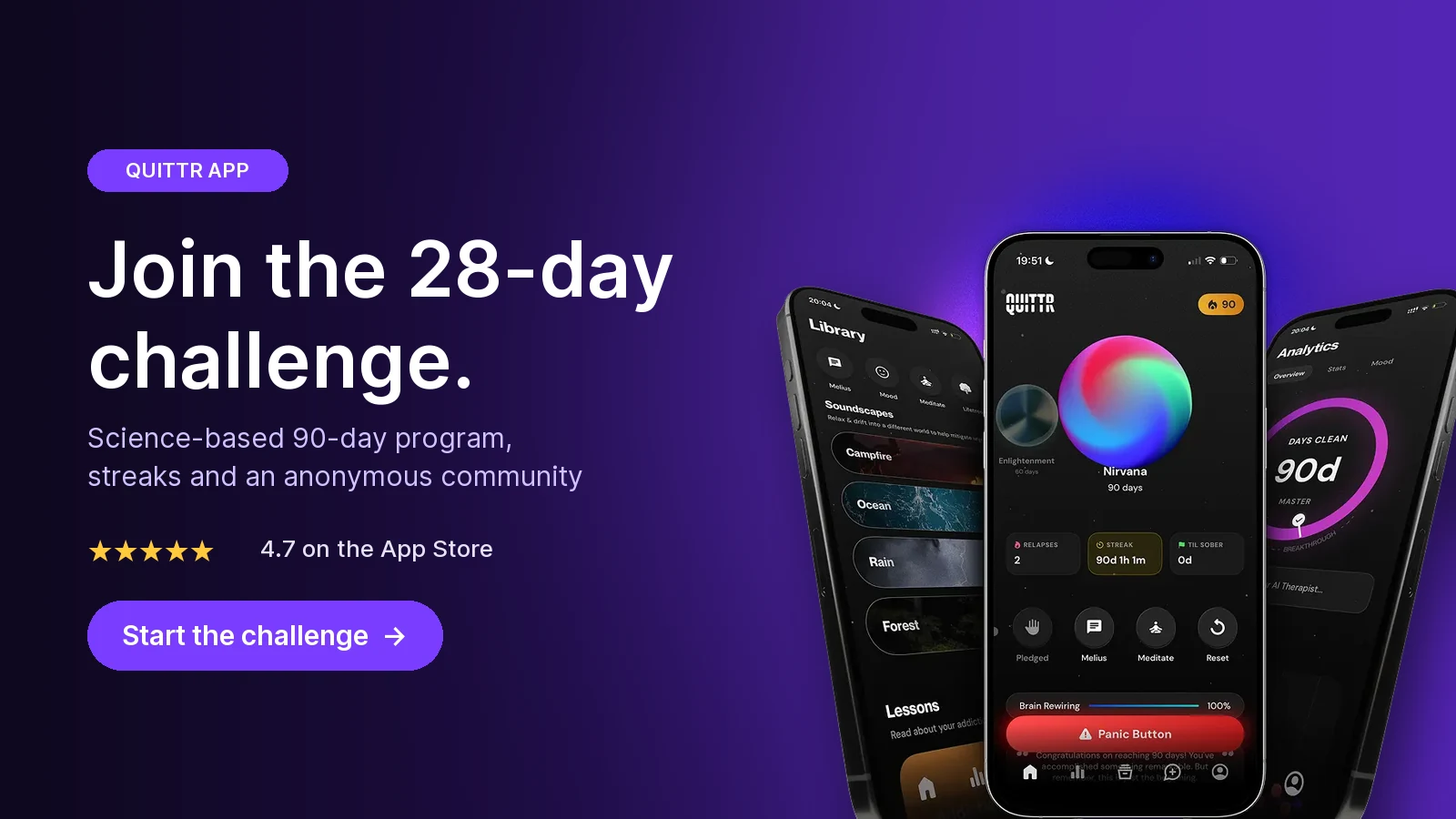
Join the 28-day challenge. Get QUITTR on the App Store or Google Play → · Learn more about QUITTR
Related articles
Betrayal Trauma After Porn Discovery: Signs, Stages and Healing
Is Edging Bad for You? Yes — Here's What It Does to Your Brain
Benefits of Quitting Masturbation: What Happens When You Stop (7-Day to 90-Day Timeline)
Frequently Asked Questions
Is sexting addiction a real diagnosis?
Not as a separate diagnosis. The closest official condition is compulsive sexual behavior disorder in the WHO's ICD-11, defined as a persistent failure to control intense, repetitive sexual urges that lasts about six months or more and causes significant distress or impairment. Compulsive sexting can be one way that pattern shows up, but sexting on its own is common and is not a disorder.
Is sexting cheating?
It depends on the agreements in your relationship, but most people treat it as cheating. In research by psychologist Aimee Adam, sexting and sexual Snapchat messages were judged much like cybersex and physical sexual infidelity, both in whether they count and how much they hurt. If you are sexting someone other than your partner in secret, assume your partner would see it as a betrayal.
How do I stop sexting on Snapchat?
Block the people you sext with (Chat screen, press and hold their name, Manage Friendship, Block), set Contact Me to Friends only in Settings under App & Privacy, and mute any chats you can't block yet. Then add friction at the phone level, for example moving or deleting the app, and plan for the times of day when you usually start.
What should I do if someone threatens to leak my sexts?
Don't pay and don't send more images. Stop responding, report and block the account, but keep the messages and profile as evidence. Report to the FBI at ic3.gov, use StopNCII.org to hash the images if you were 18 or older when they were taken, or NCMEC's Take It Down if you were under 18.
Can sexting be healthy in a relationship?
For some couples, yes. A 2025 study of 405 young adults found that sexting for your own reasons was linked to positive outcomes, while sexting from pressure or a need for approval was linked to negative ones. The problem is compulsive, secret or pressured sexting, not consensual flirting between partners who both want it.
Sources
Compulsive sexual behaviour disorder in the ICD-11 — Kraus et al., World Psychiatry (2018), PMC
2025 IC3 Annual Report — FBI Internet Crime Complaint Center
Sextortion — National Center for Missing & Exploited Children
How do I turn off message or call notifications from someone on Snapchat? — Snapchat Support
Manage message requests on Instagram — Instagram Help Center


